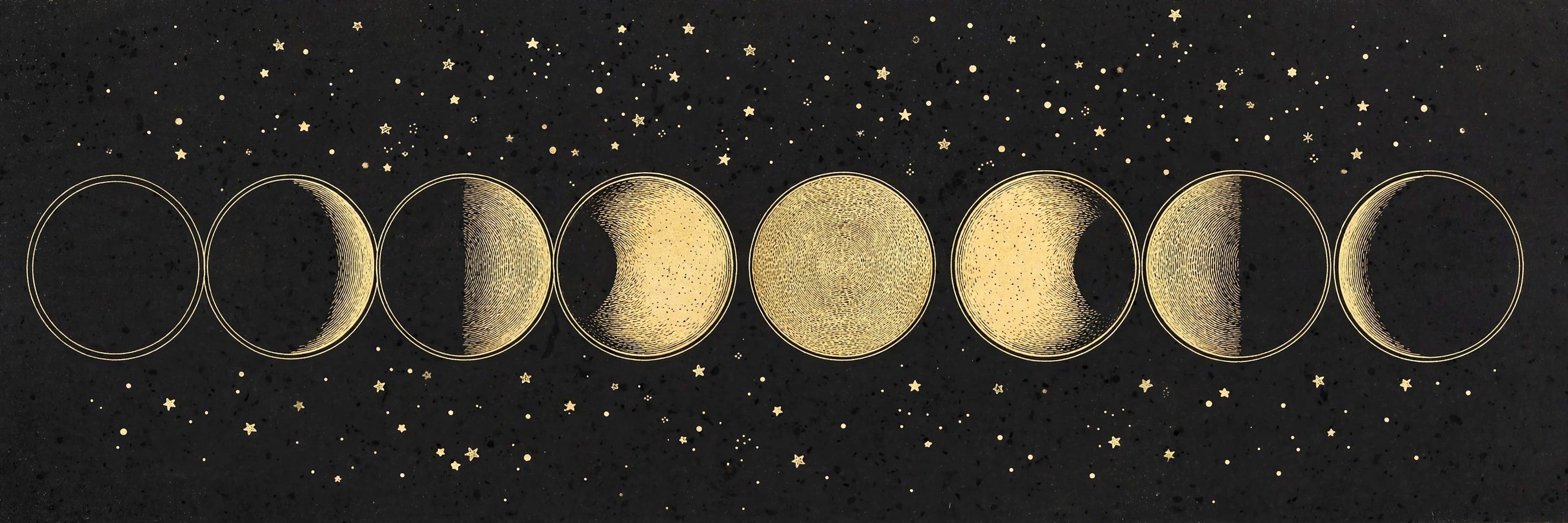
Find the moon phase for any date — computed from the Sun's and Moon's real positions rather than counted from a calendar: the phase name, a disc drawn from the computed angle, the illumination, the Moon's age and zodiac sign, and what the phase means as a tattoo.
What a moon phase actually is
A moon phase is not something happening to the Moon — it is something happening to our view of it. The Sun lights exactly half of the Moon at all times (the new moon excepted only in the sense that the lit half then faces away from us). As the Moon orbits Earth over about 29.5 days, we see the lit half from a changing angle: first a sliver of its right edge, then half, then the whole face, then the light retreating from the right until only a left-hand sliver remains. The eight named phases are simply eight stops on that turning view.
One misconception is worth clearing away, because it is everywhere: the dark part of a crescent moon is not the Earth's shadow. Earth's shadow only touches the Moon during a lunar eclipse, a few times a year at most. On every ordinary night, the dark part is the Moon's own night side — the half turned away from the Sun — and on a clear night you can often see it faintly, lit by earthshine: sunlight reflected off the Earth. The disc this finder draws keeps that dark side dimly visible for exactly that reason. For the Moon's place in a full chart — its sign, its house companions, its planets — the Birth-Chart Wheel plots the same Moon this finder uses, from the same published method.
How this finder works — midday, illumination and honest approximations
Most moon-phase pages count days from a known new moon at the Moon's average speed. That works near the epoch they start from, but the real Moon speeds up and slows down along its elliptical orbit, so a counted phase can drift a day or more from the true one. This finder does not count: it computes. For midday of the date you enter, it works out the Sun's and Moon's ecliptic longitudes with Paul Schlyter's published method — the same astronomy behind this site's Birth Chart Generator — and takes the angle between them, the elongation. Everything on the result comes from that one angle.
The phase name is the elongation's 45-degree sector (New, Waxing Crescent, First Quarter and so on). The illumination is the standard formula, (1 − cos elongation) / 2 — a real computed quantity, the one percentage on this site that measures geometry rather than rating anything. The Moon's zodiac sign is read from its longitude. Two things are labelled approximate, because they are: the Moon's age and the countdowns to the next new and full moons run at the Moon's average speed (the mean synodic month, 29.53 days), so they can be out by up to about a day. And the reading is taken at midday: a phase is a day-level answer, and the exact moment of a new or full moon can fall earlier or later that day. The disc is drawn as the Moon appears from the northern hemisphere — waxing light on the right, waning on the left; from the southern hemisphere it appears mirrored.
The eight phases and their traditional themes
Alongside the astronomy, the cycle carries a traditional set of reflective themes — interpretation layered over the geometry by generations of readers, offered here the way this site offers all its readings: as prompts for reflection, never as facts about a day. New Moon — beginnings and intentions, set quietly. Waxing Crescent — first proof and momentum. First Quarter — decision and commitment, the cycle's push-through point. Waxing Gibbous — refinement and patience, the last adjustments. Full Moon — the reveal: whatever has been building, seen in full light. Waning Gibbous — review and gratitude, taking stock. Last Quarter — release: forgiving, dropping, clearing space. Waning Crescent — rest and surrender, the cycle emptying before it begins again.
The result names the theme of the phase you look up, under its astronomy — read the geometry as the fact and the theme as the lens. If a daily rhythm appeals to you, the Tarot Card of the Day works the same way: one sky, one day, the same for everyone.
Your birth moon — and phase-row tattoos
The commonest reason to look up a past date is a birth: enter a birth date and the result is the moon that person was born under — its phase, its age and its sign. That birth moon is a classic tattoo subject, drawn as a single disc in the phase of the day, sometimes with the sign's symbol worked in. The fuller version is the phase row: all eight discs in a line — down a spine, along a collarbone, around a wrist or forearm — one of the oldest astronomical motifs in tattooing, because it carries a whole cycle in a strip of skin. The Moon tattoo meanings page reads the symbolism in depth, and the celestial tattoo ideas collect the designs that pair moons with stars, suns and planets.
Two practical notes for a phase row. Orientation matters: the row in this finder runs as the northern hemisphere sees it — waxing light growing on the right. If you live in the southern hemisphere, or the row will sit somewhere it is mostly seen in a mirror, talk the direction through with your artist before it is drawn. And spacing matters more than size: eight discs need even gaps and consistent line weight to read as one design as they age, so give the row room — a forearm or a spine line rather than a cramped ankle — and let a licensed artist set the spacing. The AI Tattoo Generator can draft a row in different styles before you commit.
How it works
Pick any date — today is filled in for you — and the phase is worked out for midday of that date, in your browser. Nothing is uploaded or stored.
The tool computes the Sun's and Moon's ecliptic longitudes with Paul Schlyter's published method, takes the angle between them (the elongation), and derives everything from that one angle: the phase name, the illumination, the Moon's age, the countdowns to the next new and full moons, and the Moon's zodiac sign.
Read the disc — drawn from the same angle, lit on the correct side — then the phase explained three ways: its astronomy, its traditional theme, and its tattoo angle.
Your Sun, Moon and Rising signs from your birth date and time — all three computed in your browser, with the Moon and Rising honestly labelled approximate. Each sign comes with a short traditional reading and a tattoo angle, plus links to its sign guide and to the wheel and fusion tools.
One card for today, dealt by the date itself: the same Major Arcana card for every visitor, turning at midnight, shown with its traditional upright keywords, a short reflection reading and its tattoo angle — plus the full 22-card deck to browse below it.
One tattoo design built from your Sun, Moon and Rising signs. Work the three signs out from your birth date (with a birth time for the Rising) or pick them yourself if you already know them — then get a fusion emblem, a design concept woven from the three symbols, style and placement notes, and a ready-to-copy brief for your artist or the AI Tattoo Generator.
Because a phase is a day-level answer. The Moon moves about 13 degrees a day, so within a single date the phase name almost never changes — but the exact moment (the precise new or full instant) can fall in the morning or the evening of that date. Reading at midday keeps the answer stable and honest for the whole day, and the result says so. It is also why the Moon's age can read near 29 days on a new-moon date: at midday, the old cycle may still have a few hours to run.
How accurate is the illumination percentage?
It is computed, not looked up: the finder works out the Sun's and Moon's positions with Paul Schlyter's published method, takes the angle between them (the elongation), and the illumination is the standard formula from that angle, (1 − cos) / 2. Against documented new and full moons it lands within about a percentage point. It is also the one percentage on this site that is a measurement — of geometry — rather than a score or a match rating.
Why would the Moon look mirrored in the southern hemisphere?
Because you are looking at the Moon from the other side of the planet. The lit side is the side facing the Sun; from the southern hemisphere the Moon appears upside down compared with the northern view, so a waxing moon's light appears on the left instead of the right. The finder draws the northern-hemisphere view and labels it as such — if you are in the southern hemisphere, mirror the disc in your mind (and tell your tattoo artist, if the phase is going in a design).
What was the moon phase on the day I was born?
Enter the date and read the result — that date's phase, age and Moon sign are your birth moon. People look it up because the birth moon is a classic tattoo subject: the phase you were born under, drawn as a single disc or as the centre of a phase row. Two details worth taking to the design: the Moon's sign for the date (this finder names it, and links to that sign's tattoo ideas) and the phase's exact look — at midday the drawn disc can be a few hours off the moment of birth, which no design will ever show.
Are the 'next full moon' and 'next new moon' countdowns exact?
Approximate — the finder labels them that way on the result. The countdowns run at the Moon's average speed (the mean synodic month, 29.53 days), but the real Moon speeds up and slows down along its elliptical orbit, so a countdown can be out by up to about a day. The phase name, illumination and Moon sign for the date you entered are computed from the actual positions; only the forward-looking countdowns use the average.
Do the phase themes mean something about my day?
The astronomy is fact; the themes are tradition. That the Moon is a waxing gibbous on a given date is geometry, and this page computes it properly. That the gibbous is traditionally read as a time of refinement and patience is an interpretation people have layered over the cycle for generations — offered here the way this site offers all its readings: as a prompt for reflection, not a fact about your day and not a prediction. Nothing about a moon phase should be used to decide anything about health, money or relationships.