Skip to content
Generate Your Tattoo

Tattoo Aging Simulator

Visual simulation: upload a photo of your tattoo — it is processed in your browser and never uploaded — and see the same design with ink fade, line spread and contrast loss applied for 5 / 10 / 20 / 30 years, next to your placement's real fading notes from our placement guides. No photo? The tool runs on a sample design. Client-side canvas simulation only.

AI ESTIMATE, NOT A GUARANTEE. This is a visual simulation, not a prediction. How a tattoo ages depends on skin, sun, artist and aftercare. Do not promise a result for any skin type.

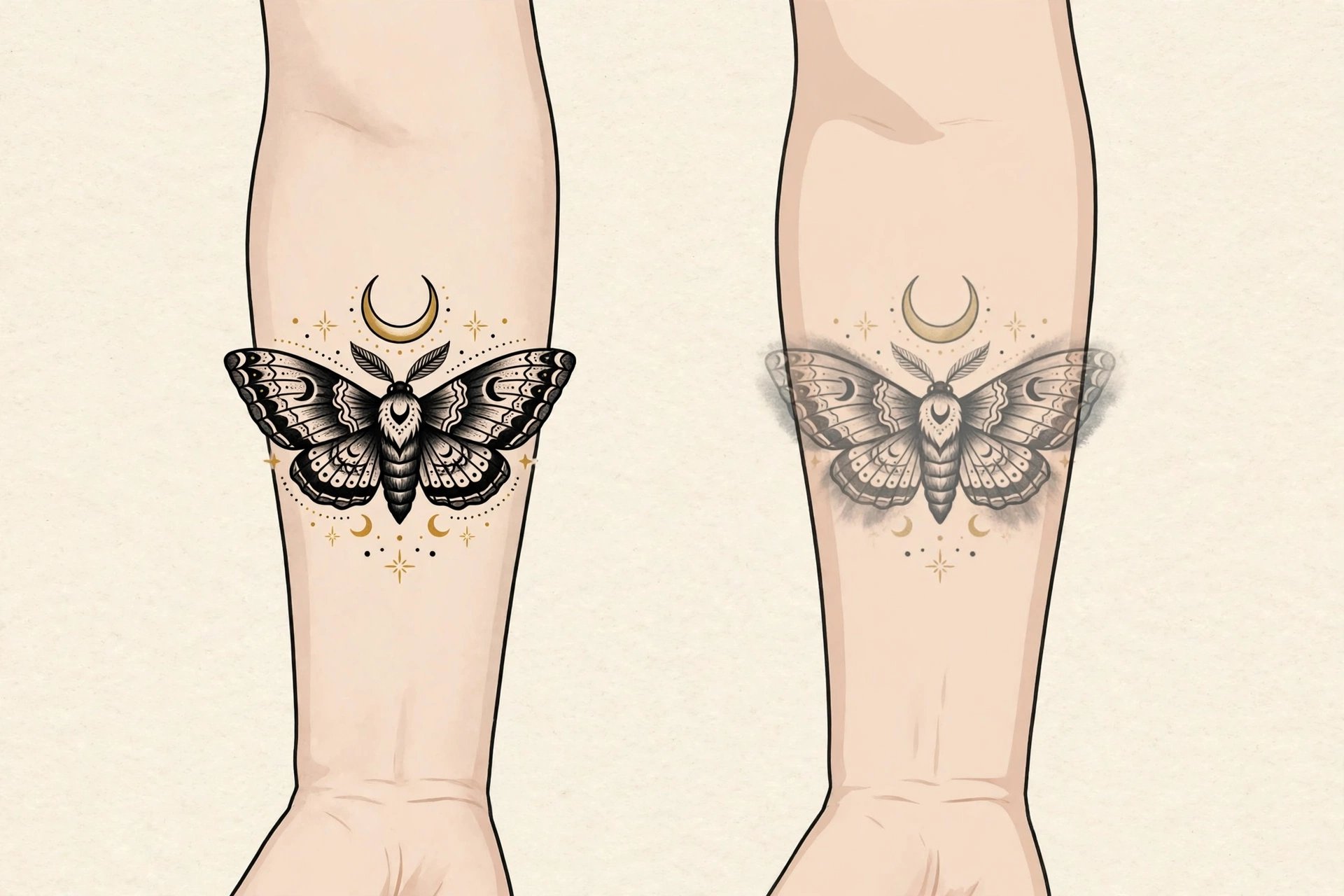
Side-by-side illustration of the same moth and moon tattoo on two forearms — fresh and crisp on the left, faded and softened after years of aging on the right — AI-generated

How a tattoo actually ages

A healed tattoo does not sit on the skin — the ink sits in the dermis, and the body spends years trying to clear it. Immune cells slowly break down and carry away ink particles, which is why even a well-done tattoo softens over time. Four changes do most of the visible work:

  • Fade. Ink density drops, so deep blacks soften towards grey and colours lose their punch. Sunlight speeds this up more than anything else — UV breaks down pigment, which is why uncovered tattoos fade first.
  • Line spread. Lines do not stay needle-sharp. Ink settles and spreads slightly in the skin over the years, so fine lines thicken and very close lines can merge into each other.
  • Contrast loss. As blacks lighten and skin tone shifts, the gap between the darkest and lightest parts of a design narrows — small detail disappears first.
  • Skin change. Skin loses elasticity and can stretch or wrinkle with age and weight change, which gently distorts the design sitting in it.

The simulator above applies the first three effects — fade, spread and contrast loss — to your photo. It cannot model your skin, your sun habits or your artist's depth, which is why it is labelled a simulation, not a prediction.

Why placement changes how a tattoo ages

Where a tattoo sits matters as much as how it was done. Our placement guides track fading for all 23 placements, and the pattern is consistent: friction, washing and sun exposure age a tattoo fastest.

  • Fastest: fingers and hands. Our finger placement guide puts it plainly — expect fading in 6–12 months — and the hand guide blames sun and washing. Ankles and feet fade fast from shoe and sock friction, and knees and elbows from constant movement.
  • Middle: wrists (sun, soap and watch straps), neck, ribs, sternum and collarbone — a mix of sun exposure and thinner skin.
  • Slowest: covered, low-friction skin. The upper arm is one of the best-aging spots on the body, and the back, chest, hips and forearm all age slowly — on the forearm, sun is the main risk.

The preview weights its effects by the placement you pick, using these same guide notes — the note under your result is quoted from that placement's guide. For the pain side of the same decision, see the Placement Pain Guide.

What slows tattoo aging down

You cannot stop a tattoo aging, but the difference between a tattoo that is cared for and one that is not is large — and most of it is sun discipline:

  • Heal it properly first. A tattoo that heals cleanly starts with more ink in place. Follow your artist's aftercare — our Aftercare Checklist walks through each stage.
  • Protect it from the sun. Once healed, sunscreen on the tattoo whenever it is uncovered, and shade or clothing for long exposure. This is the single biggest lever on fade.
  • Moisturise and be gentle. Dry, damaged skin makes ink look duller; regular moisturiser keeps the design reading clearly.
  • Plan for touch-ups. A short touch-up session years later can restore line weight and contrast. Ask about touch-up policy before you book — it is part of the real cost of the tattoo.

How to use this preview with an artist

Bring the simulation to your consultation — it turns a vague worry ("will this still look good?") into specific questions:

  • Line weight: if the 20-year preview merges your fine lines, ask for slightly bolder lines or more space between them.
  • Size: small, dense detail ages worst. Going one size up is the cheapest insurance a design can have.
  • Placement trade-offs: if you are torn between a fast-fading and a slow-fading spot, run both previews and compare.

Already have a faded tattoo? The same thinking runs in reverse — see what a cover-up could do with it, or preview how much further laser removal could fade it.

How it works

  1. Upload a photo of your tattoo, or just use the sample design. Your photo is processed on a canvas in your browser and is never uploaded or stored.
  2. Choose your placement and move the years slider — the preview applies ink fade, line spread and contrast loss, weighted by how fast that placement is known to fade.
  3. Read your placement's fading notes under the preview, then take the simulation to your artist to talk about line weight, spacing and touch-ups.

Related tools

Frequently asked questions

Is my photo uploaded or stored anywhere?

No. Your photo is loaded into a canvas in your own browser and every effect is applied there. Nothing is sent to or stored on a server — the same local-only approach as the Virtual Try-On in our tattoo generator. Close the tab and the photo is gone.

Is this what my tattoo will actually look like in 20 years?

No — it is an illustrative simulation of the three best-known visual effects of aging: ink fade, line spread and contrast loss. Real aging also depends on your skin, sun exposure, the artist's technique and how the tattoo healed, none of which a photo filter can know. Use it to compare placements and line weights, not as a promise.

Why is there no longevity score any more?

The old version of this tool showed a score out of 100. We removed it because a single number pretends to a precision nobody honestly has — two tattoos of the same age on the same person can age very differently. Instead you get the visual simulation plus the real fading notes for your placement from our placement guides.

Which placements fade the fastest?

Fingers and hands fade fastest — our finger guide says to expect fading in 6–12 months, driven by washing, friction and sun. Ankles, feet, knees and elbows also fade quickly. Covered, low-friction placements such as the upper arm, back and chest age the slowest.

Can I stop my tattoo from aging?

You cannot stop it, but you can slow it down a lot. Heal it properly, then protect it from the sun — sunscreen whenever it is uncovered is the single biggest factor — keep the skin moisturised, and budget for a touch-up years later to restore line weight and contrast.

My tattoo has already faded. What are my options?

Three honest routes: a touch-up to rework the existing lines, a cover-up that builds a new design over the old one (try the Tattoo Cover-Up Advisor), or laser sessions to lighten it first (preview the idea with the Laser Removal Preview). A good artist will tell you which route your tattoo is actually suited to.