Tattoo Cost Estimator
Size (Tiny to Extra Large) and style in, cost range out. Ranges are estimates — an artist quote wins. A 20% tip is shown separately.
All 23 placements from our placement guides — pick a spot, optionally compare a second one, and see its pain range, healing time, fading and size guidance, quoted from the same guide data, with a link to the full placement guide. Ranges only — sources disagree, no single decimal is a fact.
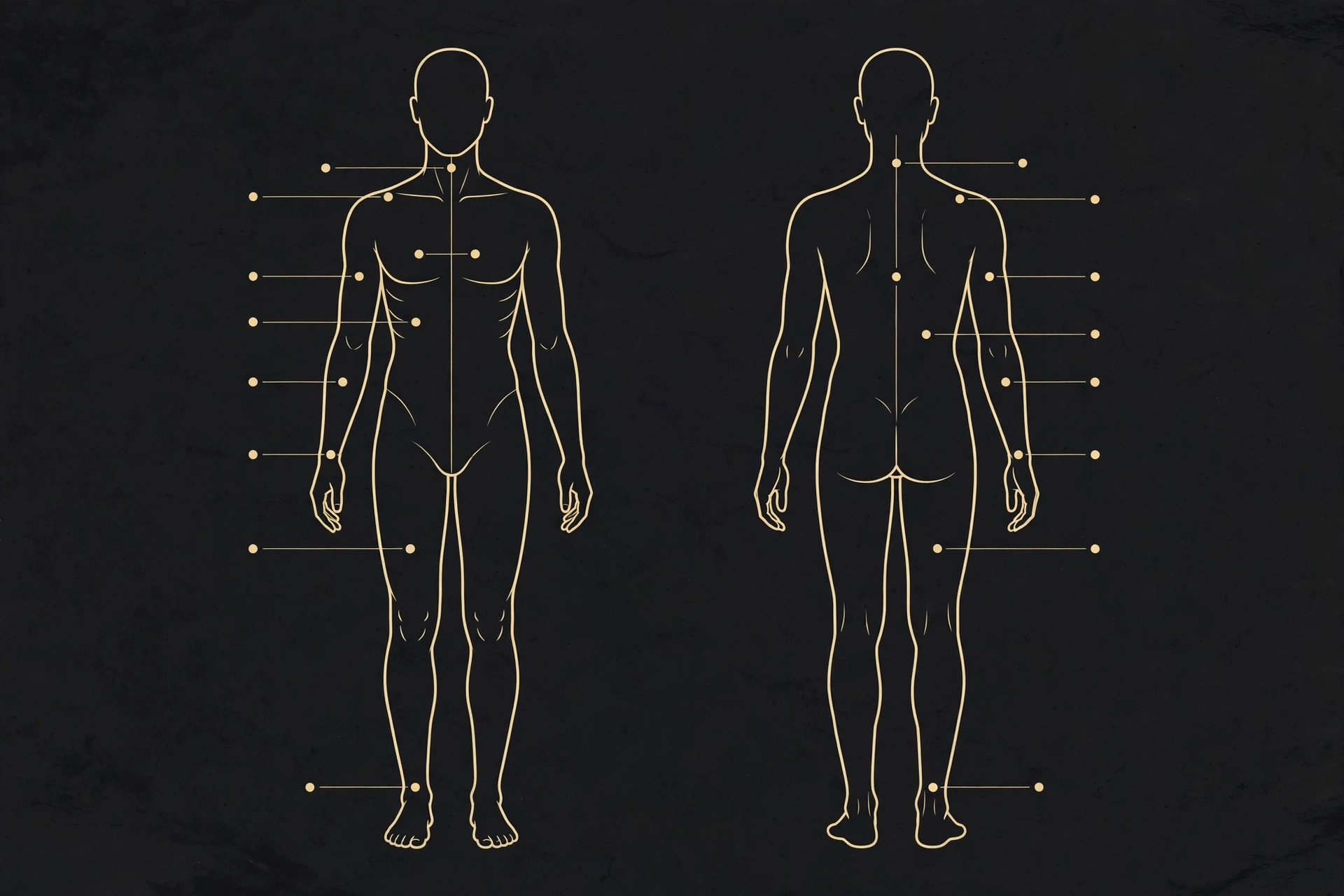
The needle does the same work everywhere — what changes is the skin it works on. Three things decide how a placement feels. First, skin thickness and what sits under it: where skin is thin and stretched over bone, with little muscle or fat to cushion it, the needle's work is felt sharply. Second, nerve density: some areas simply report more, which is why hands, feet and the head end of the body feel intense out of proportion to their size. Third, how much the area moves and rubs — that one matters less during the session and more during healing.
You can see the pattern in the guide data above. The sharpest placements — ribs at 8.5/10, sternum at 8-8.5/10, elbow at 8/10 — are all thin skin over bone. The mildest — forearm at 3.5-4.5/10, shoulder at 3.5-4/10 — are fleshy, muscular and well cushioned. Same person, same artist, same day: the spot is most of the difference.
Sharpest end. Ribs (8.5/10), sternum (8-8.5/10) and elbow (8/10) top the guide data, followed by a 7.5/10 group: spine, neck, hand and foot. Studio guides describe the collarbone and knee as simply "high" — the collarbone grouped with the sternum, the knee with the elbow — rather than giving them a number.
Mildest end. The forearm (3.5-4.5/10), the shoulder (3.5-4/10), the outer upper arm (around 3, within a 3-6/10 range — the inner bicep is the tender part), the outer thigh (4-4.5/10) and the back (4.5-5.5/10) are the forgiving placements, and the usual first-tattoo territory.
Placements are zones, not points. A single range can hide a lot: the leg runs from the thigh at 4.5/10 to the shin at 7.5/10, and a full sleeve is 3-8/10 depending on which part of the arm is being worked. When a placement's range is wide, the guide for that placement breaks down which part of it the number belongs to.
Pain is only the first of three separate questions, and the guide data shows they do not move together. The finger is the clearest example: mid-to-high pain (6.5-7.5/10) and a quick 2-3 week heal, but the fastest fading on the body — expect visible softening in 6-12 months, because hands are washed, rubbed and sunned all day. The hand tells the same story: fast, at the fastest end, from sun and washing.
Movement is the other upkeep driver. The knee heals more slowly than most spots because the joint never stops bending, and its ink fades fast because that movement cracks it; ankles and feet fade fast from shoe and sock friction. At the other corner sits the hip: mid-range pain (6.5/10), the slowest healing bracket in the data (4-6 weeks), but slow fading once healed. And the forearm is the low-maintenance corner on all three scales — low pain, a standard 2-3 week heal, and slow fading where sun is the main risk. That is why this tool prints all four figures for every spot instead of a pain score on its own.
Preparation is unglamorous and it works: sleep properly the night before, eat a normal meal before the session, bring water, and tell your artist if it is your first tattoo or a placement you are nervous about — pacing a session, with breaks, is something artists do every day. On a high-pain placement, a smaller design or splitting the work into shorter sessions is a legitimate plan, not a compromise. If the spot heals awkwardly around your job — hands and feet especially — timing the appointment before quieter days is worth more than any product.
The honest limits: every figure in this tool is a range from artist and studio-guide consensus, not a measurement. No peer-reviewed ranking of tattoo placement pain exists, and sources sometimes disagree — chest pain is reported as 4-6.5/10, spine healing as anything from 3 to 4-6 weeks — which is why some entries above say so in the figure itself. Your own tolerance, the design's size, the session's length and the artist's hand all move your experience. Treat this guide as the typical picture for each spot, not a promise about your skin — and treat anything that looks infected or heals abnormally as a job for a medical professional, not a web page.
On our guide data the ribs sit at the top at 8.5/10, with the sternum at 8-8.5/10 and the elbow at 8/10 close behind. All three are thin skin worked close to bone, which is why studio guides consistently put them at the sharp end. These are consensus ranges, not measurements — your session length and design will move your own experience inside, or outside, the range.
The forearm is the mildest spot in our guide data at 3.5-4.5/10, followed by the shoulder at 3.5-4/10 and the outer upper arm at around 3 (the upper arm's full range is 3-6/10 — the inner bicep sits near the top of it). These are fleshy, muscular areas with skin well cushioned from bone, which is why they are the classic first-tattoo placements.
Because the numbers behind this guide are artist and studio-guide consensus, not measurements, and the sources do not always agree — chest pain is reported anywhere in a 4-6.5/10 range, and spine healing is given as anything from 3 to 4-6 weeks. No peer-reviewed pain ranking of tattoo placements exists. A single score like 7.3/10 would pretend to a precision nobody has, so the guide shows the range and says so when sources disagree.
More than their size suggests: pain is reported in the 6.5-7.5/10 range, because the skin is thin and sits directly over bone. Healing takes about 2-3 weeks, but fading is the real cost — finger tattoos fade very fast, with visible softening expected in 6-12 months from constant washing, friction and sun, and most people plan touch-ups every 1-2 years to keep a design crisp.
Not necessarily — in the guide data the three scales move independently. The knee's healing is slower because the joint never stops moving, and the hip takes 4-6 weeks to heal despite a mid-range pain level of 6.5/10. The finger heals in 2-3 weeks but fades faster than any other placement. That is why this tool shows healing and fading next to pain instead of treating them as the same thing.
Plan the session, not just the spot. On a high-pain placement, a smaller design or splitting the work into shorter sessions keeps any one sitting manageable, and artists pace breaks through a session as a matter of routine — tell yours it is a placement you are worried about. Arrive rested and having eaten normally, and be honest about the sitting time you can handle: an artist would rather schedule two calm sessions than push through one miserable one.