AI Tattoo Generator
Generate a design for this placement — your sign, your intention, your style. Free, no sign-up.
sternum tattoos
Sternum tattoos: symmetrical ornamental and mandala ideas, pain 8-8.5/10, healing 3-5 weeks. Small to medium, symmetrical designs suit it best.
Generate a design for this placement →
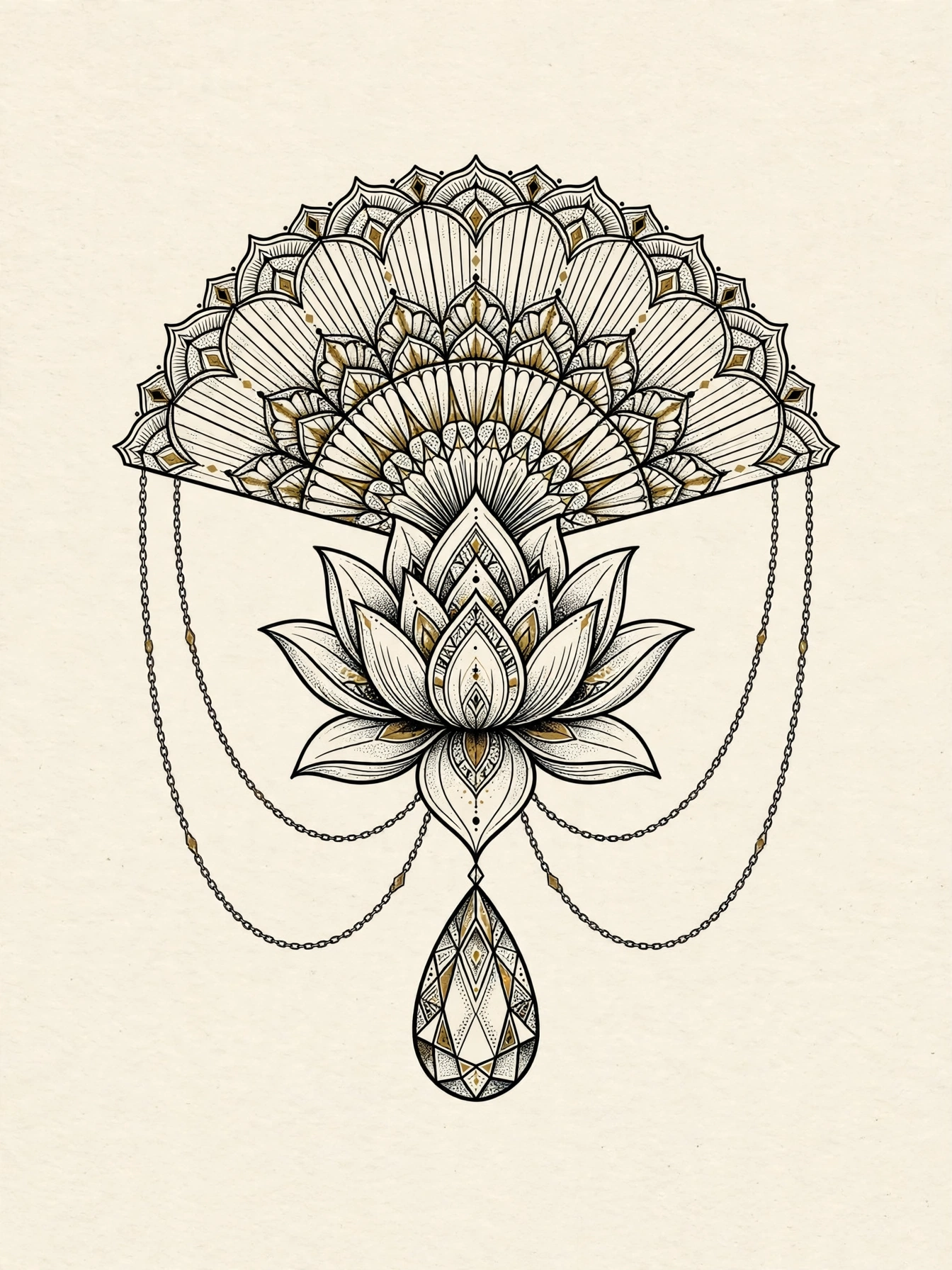
A sternum tattoo is a symmetrical, ornamental design worn down the centre of the chest, over the breastbone — a mandala, a piece of jewellery-like linework, or an under-boob design that follows the body's centre line. It suits people who want an elegant, mostly hidden piece with real impact, and who are ready for high pain, reported at 8–8.5/10.
Key takeaways
| What | What to expect |
|---|---|
| Size | 8-20 cm |
| Pain | 8-8.5/10 |
| Healing | 3-5 weeks |
| Fading | Moderate |
Pain is a consensus range — artists and charts disagree on the exact number, so treat it as a range, not a measurement. Only a licensed artist who sees the design and the body part can give you a real quote.
Small to medium, symmetrical and ornamental designs suit the sternum best — a mandala centred on the breastbone, a piece of fine ornamental linework, or an under-boob design that frames the centre line. The sternum is a narrow, vertical strip, so designs that mirror themselves left and right look deliberate and balanced here.
Symmetry is what makes a sternum tattoo work. The breastbone runs straight down the middle of the chest, and a design built around that centre line — a mandala, a lotus, a piece of ornamental jewellery — looks like it belongs there in a way an off-centre design never will. The classic sternum tattoo is a mandala or an ornamental panel, 8–20 cm tall, with its centre sitting on the breastbone and its edges spreading evenly to each side.
Under-boob designs are the close cousin of the sternum tattoo, and the two often blend into one piece. An under-boob tattoo sits below the bust, following the curve underneath, and it suits the same ornamental style — fine linework, small dots, a crescent or a lotus that frames the body's shape. Many people have a single design that starts on the sternum and flows down into an under-boob piece, which gives a longer, more dramatic result while keeping the same symmetrical language.
What does not suit the sternum is a wide, pictorial design. A portrait, a landscape or a large animal needs width the sternum does not have, and it will either shrink until the detail vanishes or spill off the centre line onto the breasts. Keep the design narrow, symmetrical and ornamental, and let the body's own centre line do the work — the placement is the statement, and the design should serve it rather than fight it.
Yes — a sternum tattoo is high pain, reported at 8–8.5/10. The needle works directly over the breastbone, which is bone with thin skin over it, and the area is rich in nerves, so the pain is sharp, intense and close to the bone for the whole session.
The pain comes from anatomy. The sternum is a flat bone that runs down the centre of the chest, and the skin over it is thin with very little fat or muscle to cushion the needle. The breastbone also carries vibration well, so the buzz of the needle travels through the bone and into the chest — many people describe feeling it in their ribs and their throat as much as at the needle itself. The centre of the chest is also dense with nerve endings, which is why the pain is described as sharp rather than dull.
The session is usually shorter than a large chest piece, because sternum designs are small to medium — but the intensity is high for every minute of it. Breathing matters here in a way it does not on an arm: the chest rises and falls with every breath, and the artist works with that rhythm, so slow, steady breathing helps the session go smoothly. Holding your breath makes the chest rigid and the work harder, so breathe normally and let the artist time their passes to your rhythm.
If you are considering a sternum tattoo as a first tattoo, think carefully. It is one of the most painful placements, it sits in a sensitive and intimate area, and it is hard to watch or to reach for aftercare. People who already have tattoos and know how they handle intense pain are better placed to judge — and if you do go ahead, plan a short session, bring water, and agree a break signal with your artist before they start.
Yes, in low necklines — and that is the point for many people. A sternum tattoo shows whenever you wear a top with a low or open neckline, and it hides completely under a normal crew-neck shirt. Plan the visibility before you commit, because the reveal is part of the design.
The visibility of a sternum tattoo is a dial you control with your wardrobe. A crew-neck t-shirt hides it entirely; a v-neck shows the top of it; a low-cut top or a dress with a plunging neckline shows the whole piece. That makes it one of the most flexible visible placements: it is a private tattoo in most settings and a statement piece when you choose to show it, and you decide which version of it the world sees.
That flexibility is also why it is popular as a piece with personal meaning. A sternum tattoo sits close to the heart, it is rarely seen by strangers, and the people who do see it are usually people you have chosen to show it to. Many people pick designs with that in mind — a symbol that matters to them, a date, a small piece of ornamental work that feels like jewellery rather than a picture.
Think about the top edge before you commit. A design that starts high on the sternum will peek out of more necklines than one that starts lower, and a design that extends upward toward the throat is visible in almost any top. Talk to your artist about where the design starts and ends, and try it on with the necklines you actually wear — a tattoo that only shows in a dress you wear twice a year is a different tattoo from one that shows every day.
A sternum tattoo sits on the breastbone, centred on the chest, while an under-boob tattoo sits below the bust, following the curve underneath. They share the same ornamental style and the same symmetry, and many people combine them into one design that flows from the sternum down under the bust.
The sternum piece is the more visible of the two. It sits on the centre of the chest, it shows in low necklines, and it is built around the straight line of the breastbone — mandalas, lotus flowers and ornamental panels all suit it. The under-boob piece is more private: it sits below the bust, it is hidden by almost any top, and it follows a curve rather than a straight line, so it suits designs that arc — a crescent, a row of small flowers, a line of dots that follows the body's shape.
Pain is similar in both spots, and both are rated high, because both sit over bone with thin skin. The under-boob area can be slightly more sensitive for some people because the skin there is soft and the area moves with breathing, but the difference is small — if you can handle one, you can handle the other, and neither is a gentle introduction to tattooing.
Combining them is common and often beautiful. A single design that starts as a mandala on the sternum and flows down into an ornamental under-boob piece reads as one composition, and it uses the whole centre of the torso instead of leaving a gap. If you think you might want the combination one day, tell your artist at the start — they can design the sternum piece so the under-boob work joins it cleanly later, rather than colliding with it.

A mandala centred on the breastbone, radiating outward in fine, even rings.
An ornamental lotus flower on the sternum, petals opening downward toward the stomach.
A delicate piece of jewellery-style linework, like a necklace drawn in ink down the centre of the chest.
A crescent moon centred on the sternum, with small stars scattered on either side.
A symmetrical floral design with a rose at the centre and mirrored leaves spreading left and right.
A small zodiac wheel centred on the sternum, ringed by the twelve glyphs in order.
An under-boob crescent following the curve below the bust, with a small lotus at its centre.
A fine-line dreamcatcher on the sternum, with three small feathers hanging down.
A symmetrical pair of wings meeting at the centre of the sternum, feathers in fine blackwork.
A small ornamental sun with radiating rays, centred on the upper sternum where it peeks from a v-neck.
The sternum is one of the most elegant places on the body for a zodiac design, because its narrow, symmetrical strip suits round and centred ideas. A zodiac wheel fits here beautifully — a small circle centred on the breastbone, ringed by the twelve glyphs in order, with your sun sign at the top, showing first in a low neckline. A single glyph also works, drawn as symmetrical ornament: your sign's symbol at the centre, flanked by mirrored linework like jewellery on the skin. Keep the lines fine but not hairline-thin, because the skin here moves with every breath, and treat the sign as personal symbolism — a mark of identity that shows when you choose to show it.
Generate a design for this placement — your sign, your intention, your style. Free, no sign-up.
Size (Tiny to Extra Large) and style in, cost range out. Ranges are estimates — an artist quote wins.
12 placements: Wrist, Forearm, Upper Arm, Chest, Back, Ribs, Thigh, Ankle, Neck, Hand, Foot, Inner Arm. Shows pain range, healing and fading for the chosen spot. Ranges only — sources disagree, no single decimal is a fact.
Chest tattoos: symmetrical panel ideas, pain reported 4-6.5/10 (sources disagree), healing 3-5 weeks. Large flat canvas, best for symmetry.
Yes — high pain, reported 8-8.5/10. Bone and nerves.
Small to medium, symmetrical and ornamental designs suit it best.
Yes in low necklines. Plan visibility before you commit.
Healing takes 3–5 weeks. The area moves with every breath, so it heals a little slower than a still spot, and clothing friction is the main problem — wear soft, loose tops and avoid anything that presses on the fresh ink while it heals.
Choose a soft, wireless bra or go without one if you can while it heals. Underwires and tight bands sit exactly across the sternum and the under-boob area, and they rub the fresh tattoo all day. A soft bralette that does not press on the design is the kindest option.
Fading is moderate. The sternum is usually covered by clothing, which protects it from the sun, but the skin moves constantly with breathing and the area takes friction from clothing. Sunscreen once healed, and bold enough lines, keep it looking sharp for years.
AI designs are for inspiration only. Always consult a licensed tattoo artist. This page does not provide medical advice. Last reviewed: 24 November 2026.