AI Tattoo Generator
Generate a design for this placement — your sign, your intention, your style. Free, no sign-up.
rib tattoos
Rib tattoos: long vertical ideas, pain 8.5/10, healing 3-6 weeks. High pain — thin skin over bone, and breathing moves the area.
Generate a design for this placement →

A rib tattoo is a design worn along the side of the torso, following the curve of the ribs from under the arm toward the hip. It suits people who want a large, mostly hidden piece with real presence — and who are ready for high pain, reported at 8.5/10, and a healing period where every breath moves the tattoo.
Key takeaways
| What | What to expect |
|---|---|
| Size | 12-30 cm |
| Pain | 8.5/10 |
| Healing | 3-6 weeks (sources give 3-4 to 4-6 weeks) |
| Fading | Moderate |
Pain is a consensus range — artists and charts disagree on the exact number, so treat it as a range, not a measurement. Only a licensed artist who sees the design and the body part can give you a real quote.
Large or narrow vertical designs only — long vines, snakes and script that follow the rib curve. The ribs give you a tall, narrow strip that runs from under the arm to the hip, so designs that grow downward along the body work, and anything wide, round or horizontal fights the shape.
The rib cage is a curved wall, and the designs that suit it are the ones that flow with the curve instead of against it. A long vine climbing from the hip toward the ribs, a snake winding down the side, a line of script that reads top to bottom — all of these follow the body's own lines, and they look like they belong there. A constellation running vertically down the ribs works the same way, with the stars spaced along the curve.
What does not work is width. A wide design has to wrap around the curve of the torso, which distorts it and makes part of it invisible from any single angle. Round designs suffer the same problem: a mandala or a portrait built for a flat surface will bend at the edges and lose its shape. The ribs reward length, not breadth — a piece 12–30 cm tall and only a few centimetres wide will look bigger and bolder than a wide piece twice its area.
Script deserves a special note here, because the ribs are one of the most popular places for a long quote. A single column of text down the ribs reads beautifully, but the letters must be sized for the curve: too small and they blur into each other as the skin moves, too large and the quote runs out of room. Ask your artist to stencil the full text and have you breathe, twist and bend before they start — a quote that reads perfectly while you stand still can bunch up the moment you move.
Rib tattoos are high pain, reported at 8.5/10 — the highest on this list. The skin is thin, the bone sits right underneath, and breathing moves the area constantly, so the needle works over bone that never stops shifting, and there is no comfortable position to escape it.
The pain is a combination of three things, and each one alone would be enough. First, the skin over the ribs is thin, with very little fat between the surface and the bone — the needle is effectively working on a drum skin stretched over a hard frame. Second, the bone is right there: every pass of the needle vibrates against the ribs themselves, and the sensation travels along the whole rib cage. Third, and most unusually, the area never stops moving — every breath lifts and lowers the ribs, so the artist is tattooing a surface that shifts under the needle.
That movement shapes the whole session. Most artists work with your breathing, tattooing on the exhale and pausing on the inhale, which slows the session down and means you need to stay calm and breathe steadily for a long time. Laughing, coughing or flinching moves the canvas sharply, so a rib session is as much about staying still as it is about enduring pain. People who have rib tattoos often say the hardest part was not a single moment of pain but the slow accumulation of it over a long session.
If you want a rib tattoo, go in with a plan. Eat well beforehand, bring water, agree break signals with your artist, and expect a long appointment. Large rib pieces are often split into sessions, and that is a sensible choice rather than a sign of weakness — the second half of a rib tattoo done on exhausted, swollen skin will not look as clean as the same work done fresh.
Rib tattoos take 3–6 weeks to heal — sources give a range from 3–4 to 4–6 weeks — and the healing is slower than on a still area, because the skin stretches constantly here. Every breath, every twist and every reach pulls at the fresh ink, so the healing takes longer and needs more care.
The first rule is loose clothing. Waistbands, bra straps and tight tops all cross the ribs, and anything that presses or rubs the fresh tattoo will irritate it and slow the healing. Wear soft, loose tops for the first two weeks, and choose underwear and waistbands that sit above or below the tattoo rather than across it. If the design runs low toward the hip, low-rise bottoms help; if it runs high under the arm, a soft bralette or no bra at all is kinder than an underwire.
Sleeping needs thought too. Lying on the tattooed side presses it into the mattress all night, so sleep on the opposite side or on your back while the surface heals. Clean, soft bedding matters — rough sheets catch on fresh ink — and a thin layer of moisturiser before bed keeps the skin from drying out overnight. Expect the healing to feel slow in the last week: the surface can look finished while the deeper skin is still settling, and the full 3–6 weeks is the honest range.
Watch for trouble the same way you would with any tattoo, and give it a little extra attention because the area moves so much. See a healthcare professional if the skin is not healing, a rash appears, or you develop a fever — and get urgent care for spreading redness, pus, red streaks or worsening pain. This page is general information, not medical advice; your artist's aftercare instructions come first.
Vertical flow suits the ribs — designs that run from under the arm down toward the hip, following the body's length. Horizontal designs fight the rib curve, wrap awkwardly around the torso, and end up partly hidden from every angle, so they rarely look as good as they do on paper.
The reason is geometry. The ribs run in a tall, narrow band, and the torso curves around them — a vertical design follows the band and stays visible from the side in a single glance, while a horizontal design has to bend around the curve and disappears around the front and back. A snake, a vine, a column of script or a vertical constellation all read instantly from the side, which is how a rib tattoo is actually seen.
There is one exception, and it is a deliberate one: a design that wraps all the way around the torso, from the ribs across the stomach or the back, can work horizontally — but that is a much bigger commitment, a longer session, and a design that needs to be planned as a wrap from the start. A short horizontal design that stops halfway around the side will look unfinished, like a sentence that ends mid-word.
When you plan the flow, think about how you will actually see it. A rib tattoo is mostly for other people and for the mirror — you will see it from the side, in profile, and rarely straight on. Ask your artist to stencil it and then look at it in a mirror from the side, not just from the front, and check how it moves when you raise your arm or twist. A vertical design that follows your body's lines will look right from every angle you actually use.
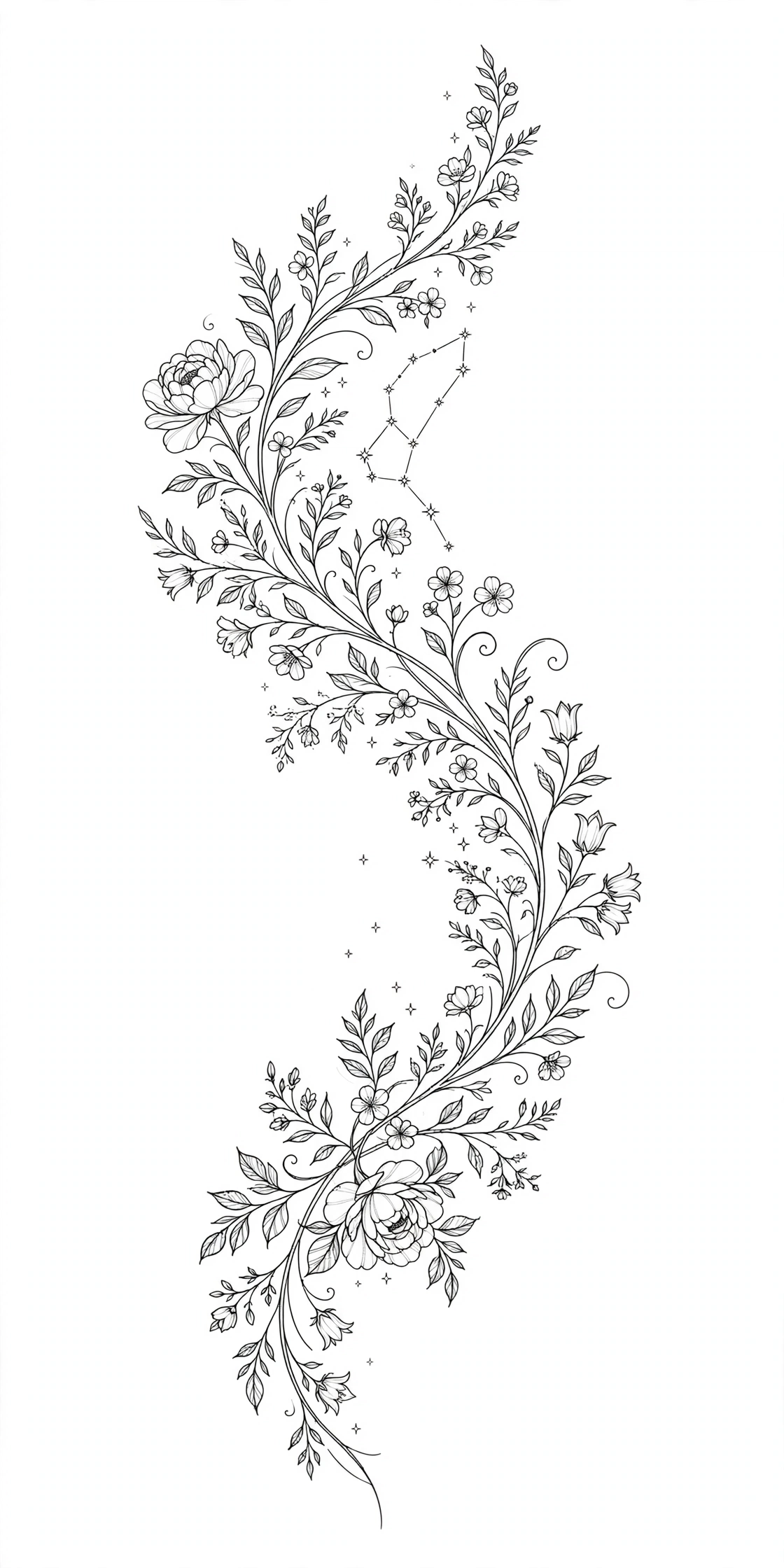
A long vine climbing from the hip up along the ribs, with leaves and one open flower.
A snake winding down the side of the torso, head near the underarm and tail at the hip.
A single column of script running down the ribs, one line of a quote you love.
A constellation running vertically down the ribs, stars spaced along the curve.
A large feather following the rib curve, barbs in fine blackwork, quill pointing down.
A flowering branch with cherry blossom, petals drifting downward along the side.
A moon-phase sequence running down the ribs, from crescent at the top to full moon below.
A dragonfly with long, narrow wings stretched along the ribs.
A koi fish swimming upward along the side, tail at the hip and head near the ribs.
A row of small birds flying upward in a loose vertical line along the ribs.
The ribs suit zodiac designs that are long and vertical, because it gives you a tall strip that follows the body's own lines. A constellation can run down the ribs star by star, with your sign's stars spaced along the curve so the figure reads from the side. A moon-phase sequence also belongs here, running from crescent at the underarm to full moon at the hip, and a single column of script — your sign's name, a date, a short line — reads beautifully down the ribs. Keep the stars and letters bold enough to survive the skin's constant movement, and treat the astrology as personal symbolism: the design marks who you are, not what the stars planned.
Generate a design for this placement — your sign, your intention, your style. Free, no sign-up.
Size (Tiny to Extra Large) and style in, cost range out. Ranges are estimates — an artist quote wins.
12 placements: Wrist, Forearm, Upper Arm, Chest, Back, Ribs, Thigh, Ankle, Neck, Hand, Foot, Inner Arm. Shows pain range, healing and fading for the chosen spot. Ranges only — sources disagree, no single decimal is a fact.
How old is your tattoo? Dropdown with 6 ages. Returns a dated aftercare guide for that stage. Artist instructions win over any checklist; red-flag list included.
Sternum tattoos: symmetrical ornamental and mandala ideas, pain 8-8.5/10, healing 3-5 weeks. Small to medium, symmetrical designs suit it best.
Collarbone tattoos: horizontal script and floral ideas, high pain along the bone, healing moderate. Keep lettering spaced — bone curvature distorts tight script.
Hand tattoos: back-of-hand ideas, pain 7.5/10, healing 2-3 weeks, fastest fading. Highly visible — a job-stopper for many people.
Yes — high pain, reported 8.5/10. Thin skin over bone, and breathing moves the area constantly.
Large or narrow vertical designs only. Long vines, snakes and script follow the rib curve.
Sources give 3-6 weeks. Skin stretches constantly here, so healing takes longer.
Yes — and you should. Slow, steady breathing is the best thing you can do, because it keeps the ribs moving in a predictable rhythm your artist can work with. Most artists tattoo on the exhale and pause on the inhale, so breathing with them, rather than holding your breath, makes the session smoother.
Usually not. At 8.5/10 it is one of the most painful placements, the session is long, and the healing is slower than on a still area. A smaller tattoo somewhere less painful is a kinder first experience — come back to the ribs once you know how you handle a long, intense session.
Sleep on the opposite side, or on your back, so you are not pressing the fresh tattoo into the mattress. Use clean, soft bedding, keep the area lightly moisturised, and wear a loose, soft top to bed so nothing rubs the fresh ink overnight.
AI designs are for inspiration only. Always consult a licensed tattoo artist. This page does not provide medical advice. Last reviewed: 24 November 2026.