AI Tattoo Generator
Generate a design for this placement — your sign, your intention, your style. Free, no sign-up.
spine tattoos
Spine tattoos: long narrow vertical ideas, pain 7.5/10, healing 3-6 weeks (sources disagree). Narrow and long only — split large pieces into sessions.
Generate a design for this placement →
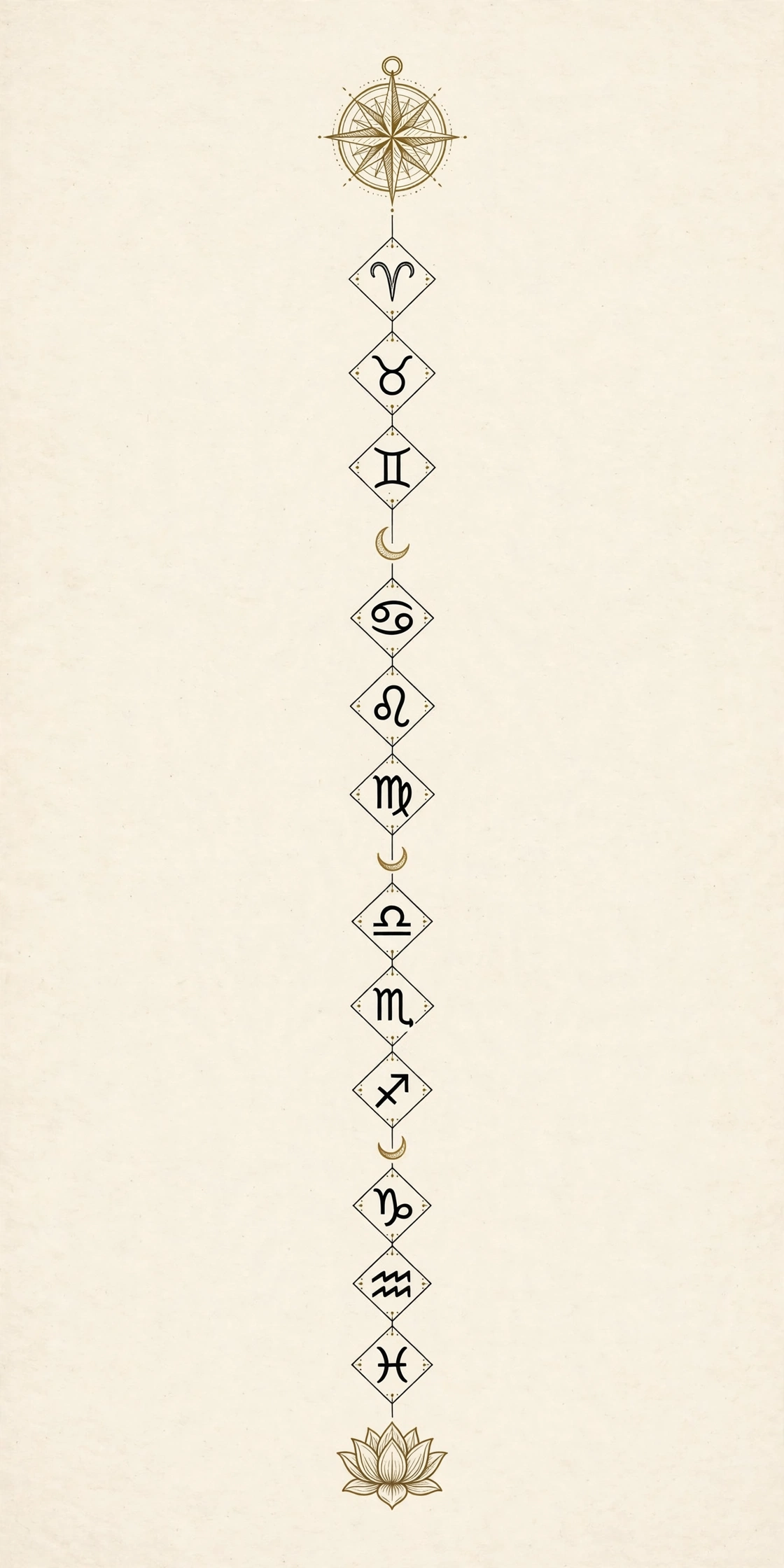
A spine tattoo is a long, narrow design that runs down the centre of the back, following the line of the vertebrae from neck to lower back. It suits people who want a statement piece they can hide under a shirt and reveal with an open back — and who are ready for a long session and serious pain.
Key takeaways
| What | What to expect |
|---|---|
| Size | 15-40 cm |
| Pain | 7.5/10 |
| Healing | 3-6 weeks (sources disagree: 3 vs 4-6 weeks) |
| Fading | Slow to moderate |
Pain is a consensus range — artists and charts disagree on the exact number, so treat it as a range, not a measurement. Only a licensed artist who sees the design and the body part can give you a real quote.
Long, narrow designs work best on the spine — vertical script, a constellation running down the back, a moon-phase sequence, or a vine or snake that follows the body's centre line. Wide or round designs fight the shape of the back and usually end up looking squeezed.
The spine gives you length, not width. Most spine tattoos are 15–40 cm tall and only a few centimetres wide, so the design has to earn its place in a single vertical strip. Lettering is the classic choice: a quote, a name, or a line of poetry stacked down the centre reads naturally here because the eye already travels down the back. A constellation that runs from the neck to the lower back works the same way, with each star landing on a different vertebra.
Nature designs suit the strip too, as long as they grow vertically. A snake coiling gently down the spine, a flowering stem with buds opening as it descends, or a chain of small mandalas all use the length instead of fighting it. What does not work is a design built for a flat, wide canvas — a portrait, a wide landscape, or a round mandala will either shrink until its detail vanishes or spill off the centre line onto the shoulder blades.
Big pieces need a plan before the needle starts. The record for this placement is clear: split pieces larger than a handspan into two sessions. That is not a suggestion for comfort alone — a long spine session means lying face down for hours while the artist works over bone, and tired skin takes ink less cleanly. Agree the split with your artist in advance, usually linework first and shading second, so the finished piece reads as one design rather than two halves joined later.
Yes — a spine tattoo is high pain, reported at 7.5/10. There is bone the whole way down, very little fat or muscle padding, and the vibration of the needle carries along the vertebrae, so even people with other tattoos often find this one harder than they expected.
Pain on the spine comes from anatomy, not attitude. The needle works directly over the bony ridge of the vertebrae for the full length of the design, and the buzz travels through the bone itself — many people describe feeling the vibration in their teeth or chest as much as feeling pain at the needle. The upper spine, near the neck, and the lower spine, near the tailbone, tend to feel sharpest, because the bone sits closest to the skin there.
Breathing matters during a spine session in a way it does not on an arm or leg. You are lying face down, the artist is working on your back, and every deep breath moves the canvas. Most artists will work with your breathing, pausing on the inhale and tattooing on the exhale, and they will build in breaks. Do not try to power through without them: a break lets the skin settle and lets you reset, and the work comes out cleaner for it.
If this is your first tattoo, think twice before making it a spine piece. It is not only the pain score — it is the length of the session, the face-down position, and the fact that you cannot watch the work happening. People who already have a tattoo elsewhere and know how they handle a long session are better placed to judge whether they want their second or third piece here.
Spine tattoos take 3–6 weeks to heal, and sources disagree on the exact range — some say 3 weeks, others 4–6 — so treat that as a range, not a single number. The hard part is that you cannot see the tattoo yourself, and clothing, chairs and beds all rub against it.
The first problem is access. You cannot look at your own spine, so checking the tattoo means a mirror, a phone camera, or a second person — and washing and moisturising it means reaching behind you or asking someone to help. That is normal for this placement, and it is worth sorting out before the appointment: decide who will help you with aftercare for the first week, and have them there when the artist explains the routine.
The second problem is friction. Waistbands, bra straps, chair backs and bedsheets all cross the spine, and tight clothing can rub a fresh tattoo raw. Wear loose, soft tops for the first two weeks, and sleep on your side or front rather than on your back while the surface heals. If you work at a desk, a soft cushion or a folded towel behind you takes the pressure off the fresh ink during the day.
Watch the healing the way you would any tattoo, with one extra caution: because you cannot see it, ask your helper to check for anything that looks wrong. See a healthcare professional if the skin is not healing, a rash appears, or you develop a fever — and get urgent care for spreading redness, pus, red streaks or worsening pain. This page is general information, not medical advice; your artist's aftercare instructions come first.
For anything larger than a handspan, yes — split it into two sessions. A full spine piece done in one sitting means hours face down over bone, and the second half of the work is done on tired, swollen skin. Two shorter sessions give you cleaner lines and a much easier day.
The usual split is simple: linework in the first session, shading and detail in the second, once the lines have settled. That gives the artist a stable base to shade over, and it gives you a finished-looking piece between appointments rather than a half-shaded one. Agree the split before the first session so the artist designs for it — a design drawn as one pass and then stopped halfway can leave an awkward break point in the middle of a word or a motif.
Time between sessions is healing time, not waiting time. The first session needs to heal fully before the artist goes over it again, so expect a gap of several weeks — your artist will tell you when the skin is ready. Use that gap to live with the linework: you will see how it sits when you move, and you can ask for small adjustments to spacing or shading before the second pass locks the design in.
Cost follows size and sessions, and a two-session piece will cost more overall than a single small one — that is the honest trade-off for a long spine design. Ask for the full picture up front: how many sessions, what each one covers, and what a touch-up costs if a line needs sharpening later. A clear plan beats a surprise bill, and a good artist will be glad to spell it out.
A single line of vertical script running from the base of the neck to the lower back, in a clean serif font.
A moon-phase sequence down the spine, from new moon at the top to full moon at the bottom.
A fine-line constellation that follows the spine, with one small gold star marking your birth sign.
A snake coiling gently down the centre of the back, head at the shoulders and tail near the waist.
A flowering stem with buds that open as it descends, leaves alternating left and right.
A chain of three small mandalas stacked down the spine, each one slightly larger than the last.
A row of seven small chakra symbols spaced evenly from neck to lower back.
A single continuous line drawing of a spine, drawn in fine blackwork over the real one.
An ornamental dagger or sword running vertically, hilt at the neck and tip at the lower back.
A vertical row of tiny stars that fades from solid black at the top to fine dots at the bottom.
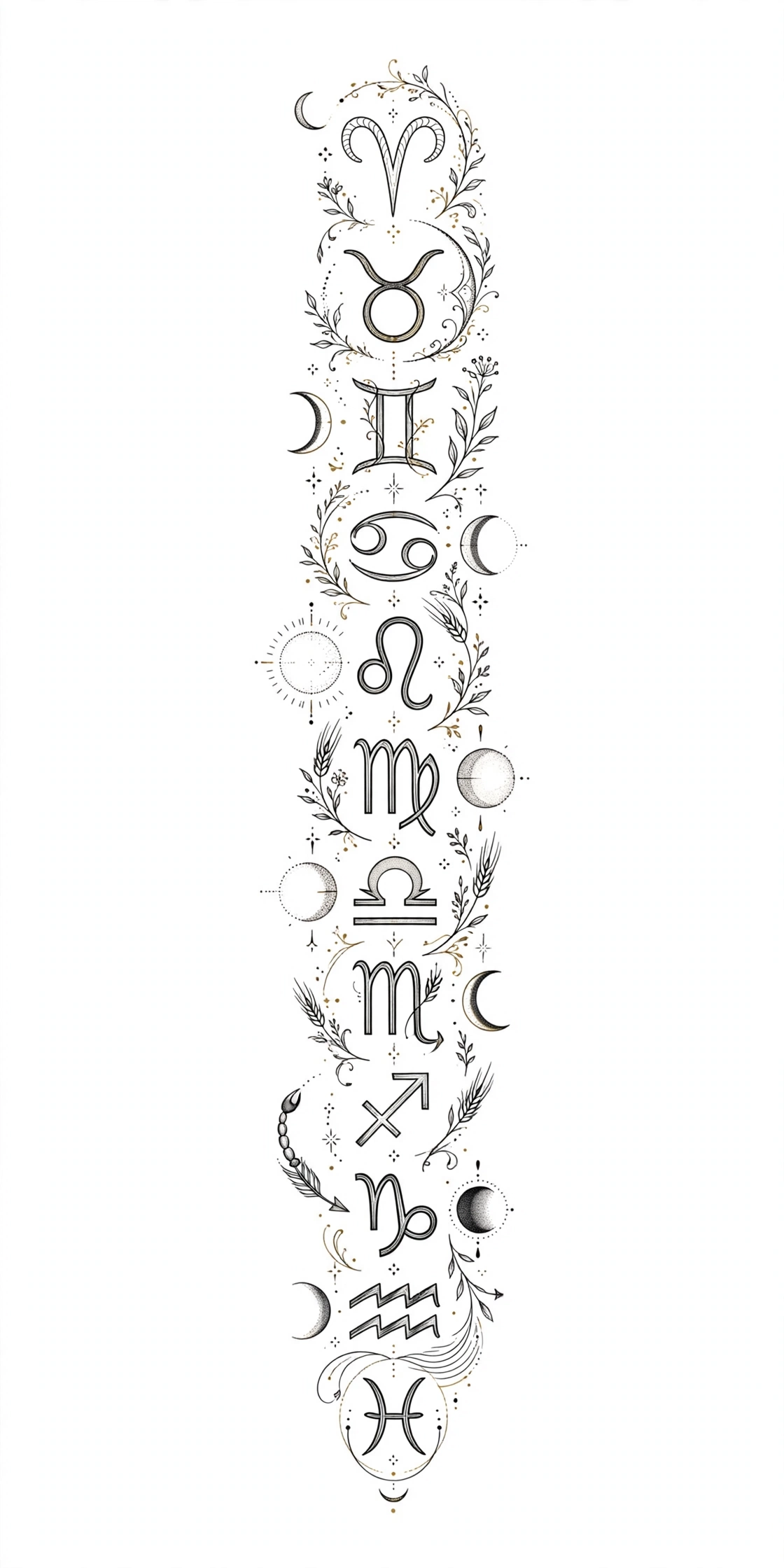
The spine is one of the best places on the body for a zodiac design, because it gives a long vertical strip that suits the sky. A constellation can run down the back star by star, with your sign's stars in their natural places, and a moon-phase sequence — new moon at the neck, full moon at the lower back — reads as a piece of the night sky worn on the body. A single glyph also works, placed between the shoulder blades where it peeks from an open-backed top. Treat the astrology as personal symbolism, not a prediction — the meaning is the one you bring to it, and keep the glyphs bold and simple so they stay readable.
Generate a design for this placement — your sign, your intention, your style. Free, no sign-up.
Size (Tiny to Extra Large) and style in, cost range out. Ranges are estimates — an artist quote wins.
12 placements: Wrist, Forearm, Upper Arm, Chest, Back, Ribs, Thigh, Ankle, Neck, Hand, Foot, Inner Arm. Shows pain range, healing and fading for the chosen spot. Ranges only — sources disagree, no single decimal is a fact.
Back tattoos: full-back and upper-back ideas, pain 4.5-5.5/10, healing 3-5 weeks. Best canvas for symmetry and large scenes, including birth-chart wheels.
Yes — high pain, reported 7.5/10. Bone the whole way, and vibration carries.
Sources give 3-6 weeks. Treat it as a range, not a single number.
Narrow and long only. Split pieces larger than a handspan into two sessions.
Usually not. The pain is high at 7.5/10, the session is long and face down, and you cannot watch the work or reach it for aftercare. A smaller tattoo somewhere you can see is a kinder first experience — come back to the spine once you know how you handle a long session.
Not for the first couple of weeks. Sleeping on your back presses the fresh tattoo into the mattress all night. Sleep on your side or front while the surface heals, and use clean, soft bedding so nothing catches on the fresh ink.
The spine is a fairly stable area compared with the stomach or upper arms, so small weight changes rarely distort it. Large or rapid weight changes can still stretch any tattoo, so keep the design simple and bold rather than packed with fine detail that would show distortion first.
AI designs are for inspiration only. Always consult a licensed tattoo artist. This page does not provide medical advice. Last reviewed: 24 November 2026.