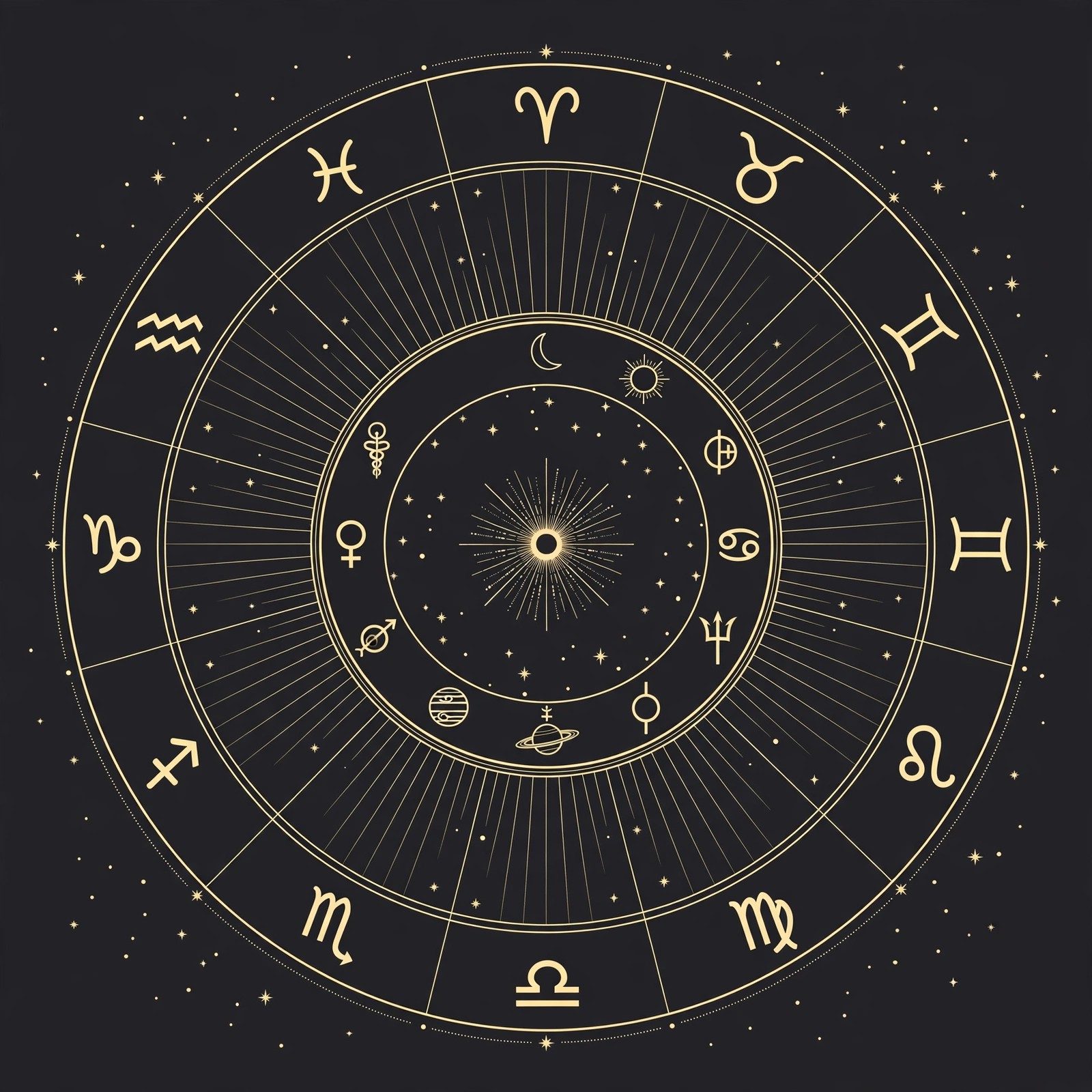
Draw your birth-chart wheel from your birth date and time: the Sun, Moon and all eight planets computed for the moment you were born and plotted on the zodiac wheel, with a placements table. No houses — those need a birthplace, and this tool does not ask for one.
Accuracy depends on correct birth data. Wheel needs 12 cm or more to stay readable in a tattoo.
What this wheel shows — and what it does not
A birth-chart wheel is a map of the sky at the moment you were born, drawn as a circle of the twelve zodiac signs. This one plots the ten bodies a chart is built from — the Sun, the Moon, Mercury, Venus, Mars, Jupiter, Saturn, Uranus, Neptune and Pluto — each at the position it actually occupied for your birth moment, worked out from your date and time rather than placed decoratively. The table under the wheel lists every placement: the body, its sign and its degree within the sign.
If you add a birth time, the wheel also marks your Ascendant — the sign rising on the eastern horizon at that moment — with a gold ASC marker on the rim. What the wheel deliberately does not show is houses. The twelve houses are divisions of your local sky, and their cusps are cast from the birthplace: the same birth moment produces different houses in different cities. This tool does not ask where you were born, so it draws no houses rather than inventing them. Older wording on this page implied a place was part of the calculation; it never was, and the page now says so plainly.
How the positions are computed
Every position is computed in your browser, from your date and time, using Paul Schlyter's published method for planetary positions: each body's orbital elements give a heliocentric position, which is then referred to the Earth to get the geocentric ecliptic longitude that astrology uses. Neptune and Pluto are computed from E. M. Standish's approximate elements (JPL) through the same solver. Nothing is uploaded, stored or looked up — refresh the page and the inputs are gone.
It is still an approximation, and the wheel says so on its face: a professional ephemeris can differ slightly, most for Pluto — the slowest and most distant body — and for any planet sitting near a sign boundary, where a fraction of a degree changes the sign shown. The classical planets are typically accurate to well within a degree. If no birth time is given, the chart is read at midday: fine for the slow planets, but the Moon moves about 13° a day, so its sign can differ from a timed chart near a changeover, and no Ascendant is shown at all.
Reading your wheel
Start with the table. Each row gives a body, the sign it falls in, and its degree within that sign — 0° is the very start of a sign, 29° the very end. The one-line note beside each planet says what that body is traditionally said to govern: the Moon for feelings and needs, Venus for love and beauty, Saturn for work, limits and time, and so on. Those lines are the traditional vocabulary of astrology, offered as interpretation — they tell you what a placement is said to mean, not what it proves.
The wheel itself is the same information drawn round: planets bunched together were travelling together in your sky, and planets opposite each other sat on opposite sides of it. For written readings of the three placements most people tattoo — the Sun, Moon and Rising signs, each with its symbol and design angle — use the Birth Chart Generator, which works from the same birth data.
From wheel to tattoo
A full wheel is a natural tattoo: personal by construction, geometric, and readable at a glance to anyone who knows the glyphs. It needs room — the record of hard experience behind this page's guidance is that a wheel wants 12 cm or more across for its glyphs and ring divisions to stay legible as the tattoo ages, which points to the back, chest, thigh or upper arm rather than a wrist or ankle. Take the placements table to your artist along with the wheel, so every glyph can be checked against its computed position before it is inked.
If a full wheel is more chart than you want on skin, the Sun + Moon + Rising Fusion tool distils the big three into one design, and the star sign tattoo pages collect single-sign designs for every placement on your wheel.
How it works
Enter your date of birth — and your birth time if you know it.
The tool computes the geocentric ecliptic longitude of the Sun, Moon and all eight planets for that moment, in your browser (Schlyter's method; Standish's JPL elements for Neptune and Pluto), and plots each one on the zodiac wheel.
Read the placements table under the wheel — body, sign and degree — and, with a birth time, find the Ascendant marked ASC on the rim. No houses are drawn: they need a birthplace.
Your Sun, Moon and Rising signs from your birth date and time — all three computed in your browser, with the Moon and Rising honestly labelled approximate. Each sign comes with a short traditional reading and a tattoo angle, plus links to its sign guide and to the wheel and fusion tools.
One tattoo design built from your Sun, Moon and Rising signs. Work the three signs out from your birth date (with a birth time for the Rising) or pick them yourself if you already know them — then get a fusion emblem, a design concept woven from the three symbols, style and placement notes, and a ready-to-copy brief for your artist or the AI Tattoo Generator.
Two sun signs in, an honest reading out — no invented percentages. The tool compares the two signs' elements and ruling planets, tells you where the pairing clicks and where it rubs, and turns it into a matching-tattoo idea with links to both sign guides.
Because houses are cast from the birthplace, and this tool does not ask for one. House cusps depend on the latitude of the place of birth and on the exact local time there — the same birth moment gives different houses in different cities. Rather than invent twelve cusps it cannot honestly compute, the wheel shows what your date and time alone fix: the planets' signs and degrees, and the Ascendant when a birth time is given.
How accurate are the positions on the wheel?
They are computed with a published approximation method — Paul Schlyter's, with Standish's JPL elements for Neptune and Pluto — and the wheel is labelled as such. The Sun, Moon and classical planets are typically accurate to well within a degree. A professional ephemeris can differ slightly, most for Pluto and for any body near a sign boundary, where a fraction of a degree can change the sign shown. For a tattoo, the positions are far more precise than the linework; for a formal chart, confirm with a full ephemeris.
Why does the birth time change the wheel?
Two placements move fast. The Moon travels about 13° a day, so its sign can change between morning and evening of the same birthday. The Ascendant moves through a whole sign roughly every two hours, which is why it is only marked when a birth time is entered. The slow planets barely notice a few hours — Saturn can sit in the same degree for days — so an untimed chart is still right about most of the wheel.
What does the degree next to each planet mean?
It is the planet's position inside its sign, from 0° at the sign's start to just under 30° at its end — Mercury at 10.2° Capricorn sits about a third of the way through Capricorn. Traditional readings treat early and late degrees differently, and a degree near 0° or 29° means the body is near a sign boundary, where the approximation behind this wheel matters most.
Why is there no Ascendant marker on my wheel?
Because no birth time was entered. The Ascendant is the sign rising at your birth moment and changes about every two hours, so without a time any marker would be a guess. Add your birth time and draw the wheel again — the Ascendant appears as a gold ASC marker on the rim, labelled approximate, since it is worked out from the time exactly as entered, at zero longitude and with no birthplace latitude.
Can I tattoo this wheel?
Yes — a birth-chart wheel is a classic chart tattoo, and because every glyph sits at its computed position it is unique to your birth moment. Give it room: 12 cm or more across, so the glyphs and sign divisions stay readable as the tattoo ages. Take the placements table from this page to your artist so each glyph can be checked before inking, and if the full wheel is more than you want on skin, the Sun + Moon + Rising Fusion tool turns the big three into a single design.