Tattoo Cost Estimator
Size (Tiny to Extra Large) and style in, cost range out. Ranges are estimates — an artist quote wins. A 20% tip is shown separately.
Northern sky
A Cassiopeia tattoo is five stars in a W, the vain queen's crown in the northern sky. See 12 designs, the queen's myth, placements and costs.
Cassiopeia is the W in the northern sky — five bright stars in a zigzag that never sets, turning overhead all year round. As a tattoo it is a crown in stars: the shape reads as a throne, a crown, or a letter, depending on how you look at it, and the story behind it is one of the sharpest in Greek myth. This page shows you how the pattern looks on skin, which stars make the W, what the vain queen adds to it, and which placements keep the zigzag readable.
This page sits under constellation tattoos and Leo constellation tattoo.
Key takeaways
Look up on a clear northern night and Cassiopeia is easy to find: five bright stars in a W, or an M when it turns upside down as it circles the pole. The W is made of Caph, Schedar, Gamma Cassiopeiae, Ruchbah and Segin, running in a zigzag with Schedar in the middle. It never sets in the northern sky — it turns around the North Star all year, so it is there every night, sometimes as a W and sometimes as an M. Tattoo artists draw it as five dots joined by thin lines, keeping the zigzag even. The evenness is the whole design: if one point of the W sits too high or too low, the shape turns into a random scatter. The five stars do the work on their own.
Cassiopeia has no single star that outshines the rest — the shape is the star. Five bright stars make the W: Caph, Schedar, Gamma Cassiopeiae, Ruchbah and Segin, running in a zigzag that reads as a W in the sky and an M when it turns upside down. Schedar sits in the middle of the W, and most artists make it slightly larger as the anchor. Gamma Cassiopeiae sits in the centre and is a variable star, brightening and dimming over time — some designs mark it with a slightly different dot. The five stars are bright enough to read at a small size, so artists keep them even and let the zigzag do the work.
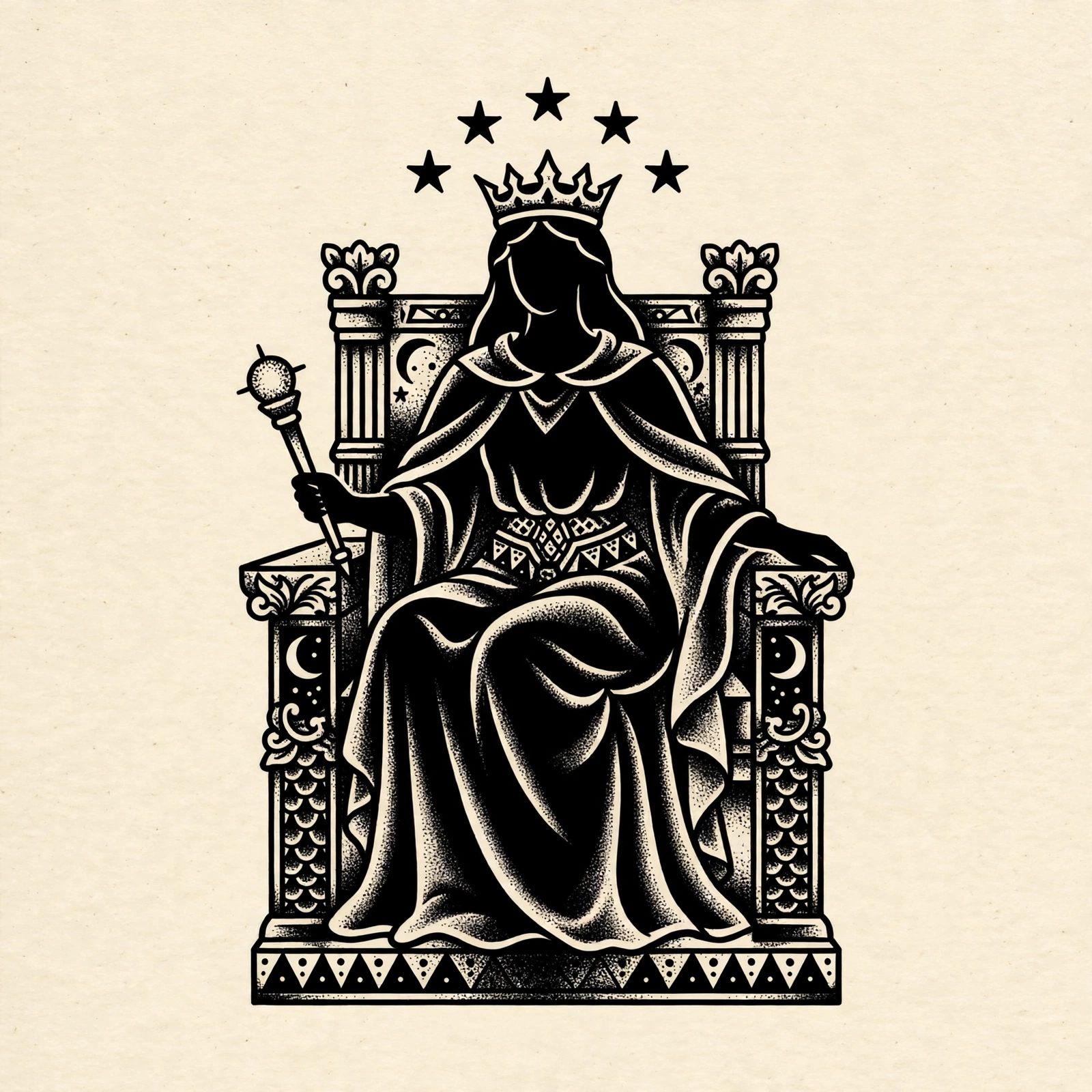
Cassiopeia was a queen in Greek myth, the wife of King Cepheus and the mother of Andromeda. She boasted that she — or her daughter, in some versions — was more beautiful than the sea nymphs, the Nereids, and the sea god Poseidon heard the boast. He sent a flood and a sea monster to punish the kingdom, and the only way to stop it was to chain Andromeda to a rock as an offering. Perseus rescued her, but Cassiopeia's punishment stayed: Zeus placed her in the sky on her throne, and because she circles the north pole she spends half the year upside down — a queen humbled in the stars. For a tattoo, the myth gives you a crown, a boast, and a throne turned over — most designs keep it light.
A Cassiopeia tattoo usually means pride and being seen — the queen who boasted about her beauty, drawn as stars instead of a portrait. It suits people who own how they look and refuse to shrink: the W is a bold shape, and it reads from across a room. The pattern also reads as a crown, so the design carries royalty with it — a throne in the sky, worn on skin. There is a second meaning in the myth too: the queen's boast is what put her in the sky, upside down for half the year, so the design can also mean that pride has a price. Some wear it as a warning to themselves; others wear it as a celebration. Either way, the W says the same thing: here I am.
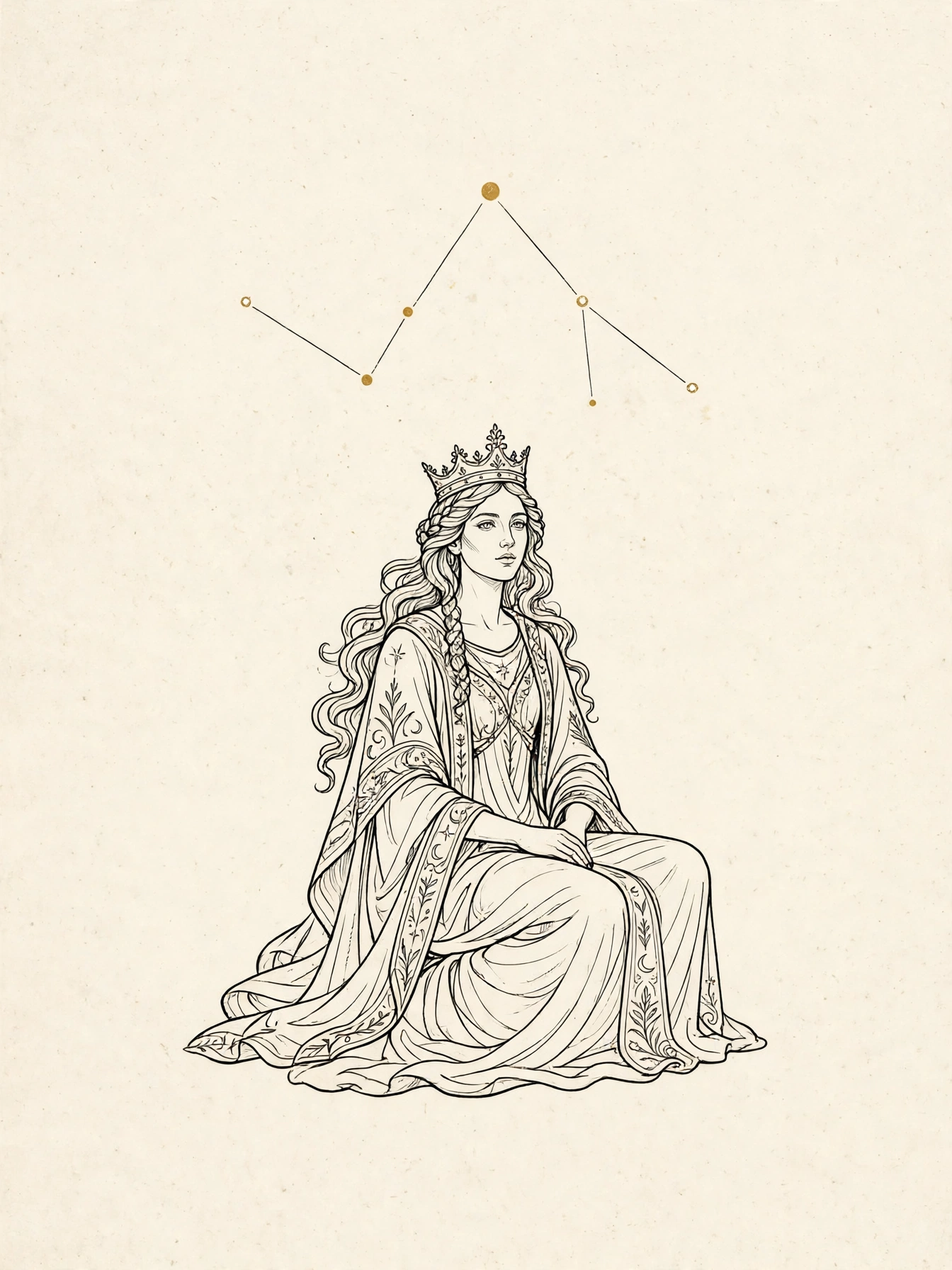
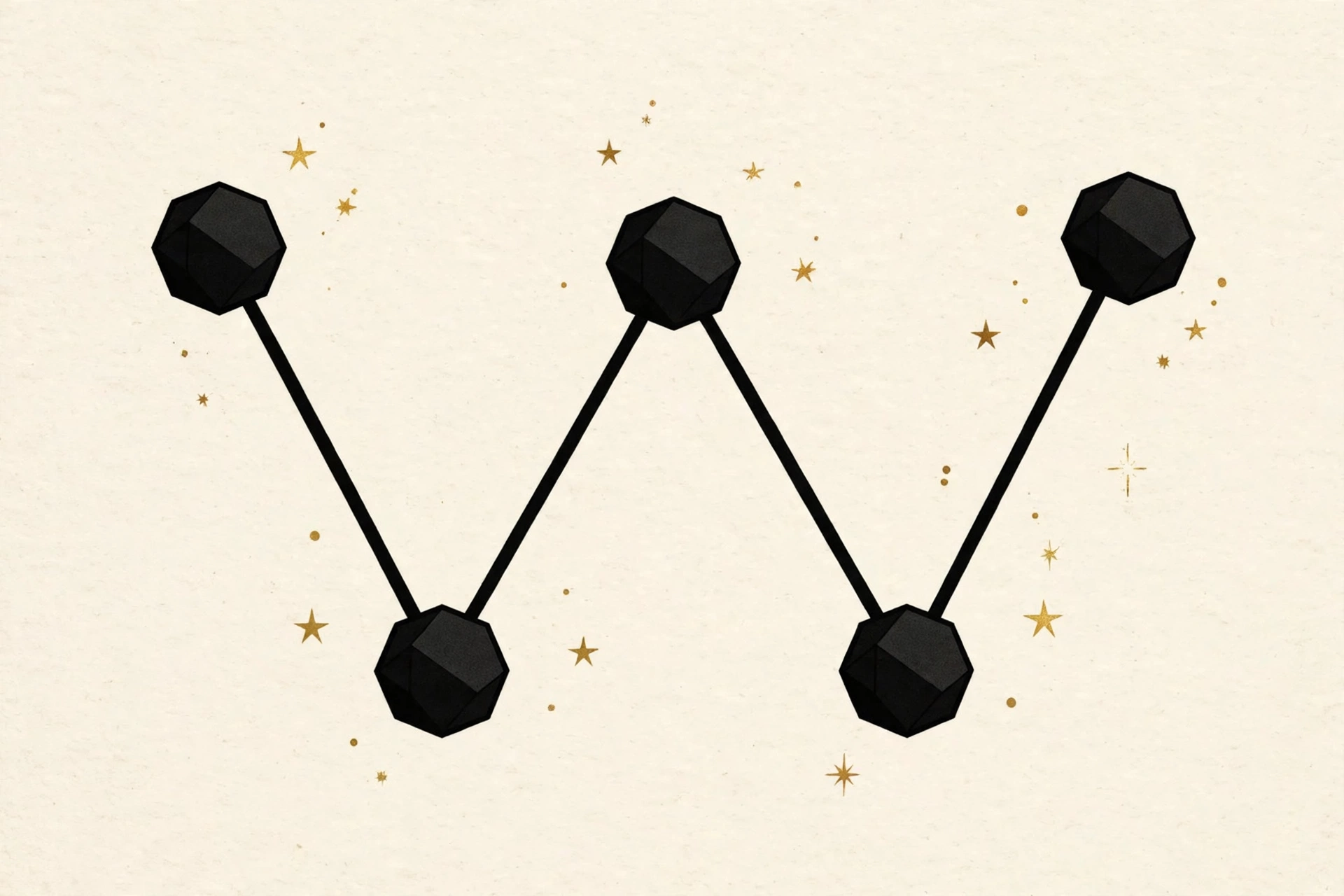
Five dots in a W on the forearm, thin black line, Schedar as a slightly larger dot in the middle.
A small W on the inner wrist, five even dots, no frame, just the zigzag.
The W on the collarbone, sitting in the hollow, with a tiny crown above it.
A minimal W behind the ear, five tiny dots following the curve of the ear.
The W on the shoulder blade with a fine-line crown above it, the queen's crown in stars.
The zigzag on the ankle, following the ankle bone, with the W turned to read as an M.
A dotwork version: the W made of dots only, no solid lines, like a star chart on skin.
The W paired with a throne outline underneath, the queen seated on her throne, on the upper arm.
A geometric W in blackwork, sharp angles, with the five stars as negative space.
The W with the date of a northern night in small roman numerals underneath, marking a birthday.
The zigzag as a bracelet: five dots and lines wrapping the wrist, the W on the outside.
The W with a small crescent moon beside it on the forearm, the queen's crown under a night moon.
Fine-line is the natural style for a Cassiopeia tattoo. The pattern is five dots and thin lines in a zigzag, and fine-line keeps it delicate and exact. Dotwork is a good second choice: the connecting lines become trails of tiny dots, which looks more like a real star map and softens the design. Blackwork geometric suits a bigger version, with the W as a bold zigzag — sharp angles, solid black, and the stars as negative space. One accent colour works well: gold on Schedar only, so the middle of the W reads as the anchor. Avoid heavy shading and thick outlines on a pattern this small; they crowd the points and the W disappears. Keep colour to one star, and the rest black, so the zigzag stays the star of the show.
| Style | Best size | What to ask your artist |
|---|---|---|
| Fine-line minimal | 2–5 cm | The zigzag stays crisp at small sizes and the five points stay distinct. |
| Dotwork | 3–6 cm | A trail of dots instead of a solid line reads like a real star map. |
| Fine-line with one gold dot | 3–5 cm | Gold on Schedar only marks the middle of the W without crowding it. |
The W is a compact zigzag, so it suits any small, fairly flat stretch of skin. The forearm is the classic spot: the W running along the arm, the points following the arm's line. The collarbone suits a small W sitting in the hollow, since the skin there is smooth and flat. The shoulder blade takes a larger version with a crown above it, and the upper arm suits a W with a throne outline underneath. The wrist takes the smallest version, though the zigzag needs room — squeeze it and the points merge. Behind the ear works for the tiniest W, five dots following the curve of the ear. Avoid the sides of the fingers; the W needs five points, and fingers give it no room.
A small Cassiopeia tattoo is a quick job. Five dots on the wrist usually take well under an hour, and the pain is mild — the wrist and forearm are forgiving spots. A larger version with a crown or a throne takes longer, and a back piece with shading costs more. Cost follows size and time rather than the pattern: a tiny W is a shop-minimum job in most studios, while a detailed version with extra work costs more. Ask for the price before you book, and check whether a touch-up is included.
Plan the numbers properly: try the Cost Estimator for a size-and-style estimate, and read the Placement Pain Guide before you pick a spot. Only a licensed artist who sees the design and the body part can give you a real quote.
See also: tattoo cost estimator · tattoo placement pain guide.
Keep the zigzag even. Cassiopeia reads as a W, so the five dots must sit at even heights — if one point of the W is too high or too low, the shape turns into a random scatter. Ask your artist to mark the five points first and check the W before adding lines.
Once you know where the W goes, try the design on your own sign. The generator builds a design from your birth date so you can see it on skin before you book: /tattoo-generator/.
The generator reads your birth date, your intention and your style, so the design it makes is yours, not a copy of someone else's.
Size (Tiny to Extra Large) and style in, cost range out. Ranges are estimates — an artist quote wins. A 20% tip is shown separately.
All 23 placements from our placement guides — pick a spot, optionally compare a second one, and see its pain range, healing time, fading and size guidance, quoted from the same guide data, with a link to the full placement guide. Ranges only — sources disagree, no single decimal is a fact.
Two sun signs in, an honest reading out — no invented percentages. The tool compares the two signs' elements and ruling planets, tells you where the pairing clicks and where it rubs, and turns it into a matching-tattoo idea with links to both sign guides.
Your Sun, Moon and Rising signs from your birth date and time — all three computed in your browser, with the Moon and Rising honestly labelled approximate. Each sign comes with a short traditional reading and a tattoo angle, plus links to its sign guide and to the wheel and fusion tools.
See the full list on the Constellation Tattoos pillar page.
A Big Dipper tattoo is seven stars in a ladle shape, and its pointers lead to the North Star. See 12 designs, the pattern, placements and costs.
A North Star tattoo is one fixed star — the point sailors steered by while the sky turned. See 12 designs, the meaning, placements and costs.
An Orion constellation tattoo is the hunter's Belt of three stars, led by Betelgeuse and Rigel. See 12 designs, the hunter myth, placements and costs.
A Leo constellation tattoo shows the Sickle and the little king Regulus. See 16 star map designs, the lion story, best placements and styles.
It usually means pride, beauty and being seen — Cassiopeia was a queen who boasted about her beauty, so the design suits people who own how they look and refuse to hide it. The W shape adds its own meaning: a crown, or a throne seen from above. Some wear it as a reminder that pride has a price, since the queen's boast is what put her in the sky.
Five stars make the W: Caph, Schedar, Gamma Cassiopeiae, Ruchbah and Segin. Some designs add fainter stars around them, but five dots are enough — the W reads clearly with five. More than five crowds the zigzag, since the pattern is compact by nature.
The forearm suits a W running along the arm, with the points of the W following the arm's line. The shoulder blade takes a larger version, and the collarbone suits a small W sitting in the hollow. The wrist takes the smallest version, though the zigzag needs room — squeeze it too small and the points merge.
Cost and pain come from size and placement, not from the pattern. A small W on the wrist is quick and mild, usually a shop-minimum job. A larger version with a crown or a throne takes longer and costs more. Forearms and shoulders are forgiving; ribs and the spine sting more.
Yes — the queen's story is a crown story, so a small crown above the W reads naturally. Some add a throne outline under the W, since the queen sits on her throne in the sky, upside down for half the year. Keep the crown fine and small, so it frames the W instead of crowding it.
Fine-line suits the pattern, since it is five dots and thin lines in a zigzag. Dotwork softens it and reads like a real star map. A blackwork version with the W as a bold zigzag works on a larger area. One gold dot on Schedar marks the middle of the W; keep the rest black so the zigzag stays the focus.
AI designs are for inspiration only. Always consult a licensed tattoo artist. Astrology on this site is for inspiration and self-expression. This page does not provide medical advice. Last reviewed: 22 November 2026.