Tattoo Cost Estimator
Size (Tiny to Extra Large) and style in, cost range out. Ranges are estimates — an artist quote wins. A 20% tip is shown separately.
zodiac forearm tattoo · Forearm Tattoos
Start a zodiac forearm sleeve the right way: one anchor piece, a constellation band, and room to grow. Layout, sizing and first-piece picks.
A zodiac forearm sleeve starts with one anchor piece — a birth-chart wheel, constellation strip or zodiac animal. The forearm's 10–25 cm strip is ideal: low pain at 4.5/10, a 2–3 week heal, and room to extend into a full sleeve. Start with the piece that matters most, leave space around it, and let the sleeve grow.
This page sits under Forearm Tattoos.
Key takeaways
| What | What to expect |
|---|---|
| Size | 10–25 cm |
| Pain | 4.5/10 (consensus range; inner/outer 3.5/10) |
| Healing | 2–3 weeks |
| Fading | Slow — sun is the main fading risk |
Pain is a consensus range — artists and charts disagree on the exact number, so treat it as a range, not a measurement. Only a licensed artist who sees the design and the body part can give you a real quote.
The forearm is the right place to start because it is the most forgiving large canvas: 10–25 cm of flat skin, low pain at 4.5/10, a 2–3 week heal, and a design you can show. A sleeve started here is one you will finish — unlike one on the ribs or shoulder, where pain slows you down.
The forearm also lets you test the sleeve idea at low risk. One anchor piece — a constellation strip, a moon-phase sequence, a zodiac animal — is a complete tattoo on its own, so if you stop after one piece, you still have a finished tattoo, not half a sleeve. And a long sleeve covers it completely, so you can build it in stages without it being visible at work in between.
The size helps too. At 10–25 cm the forearm is big enough for a real sleeve piece — a birth-chart wheel, a full constellation — but small enough that one session finishes it. That matters: a sleeve that starts with a finished piece builds momentum, while a sleeve that starts with an unfinished outline feels like a chore from day one.
Plan the sleeve as one design, even though you will tattoo it in stages: pick the anchor piece first — the birth-chart wheel, the constellation, the animal — then add connecting pieces (a constellation band, a moon-phase sequence, a star map) that link the anchors without crowding them.
The anchor is the piece that carries the meaning. For most people that is the birth-chart wheel — your Sun, Moon and Rising in one circular design — or your sign's constellation running down the arm, or your zodiac animal in blackwork. It should be the biggest, boldest piece, placed on the flattest skin, usually the outer forearm.
The connections come second, and they should be simpler than the anchor: a band of stars, a line of glyphs, a moon-phase sequence. Their job is to join the anchors visually, not to compete with them. Leave breathing room between pieces — blank skin is part of the design, and a sleeve with no space between its elements looks crowded within a year as the ink settles.
The strongest zodiac sleeve starters are a birth-chart wheel, a vertical constellation, a Sun+Moon+Rising trio, or a zodiac animal in blackwork. Each one is a complete tattoo alone and a natural anchor for a sleeve — and each one uses the forearm's length instead of fighting it.
A birth-chart wheel needs size — at least 12 cm — to read, because it holds three glyphs, a ring and often a star map inside it. On the forearm that means the outer forearm, where the skin is flattest and widest. It is the most personal anchor, since it is your chart, not just your sign.
A vertical constellation is the most flexible starter: your sign's stars running wrist to elbow, with the glyph at one end. It leaves room above and below for more pieces, and it connects naturally to a moon-phase sequence or a star map. A zodiac animal — a ram, a lion, a scorpion — is the boldest starter: a blackwork portrait that fills the forearm and sets the sleeve's style from the first session.
Leave room to grow: place the anchor where it can extend upward — toward the elbow and upper arm — and keep the wrist end open for a future piece. A sleeve planned with an exit grows gracefully; a sleeve that fills the forearm edge to edge has nowhere to go.
The practical rule is to leave a finger's width of blank skin at the wrist and the elbow, and to keep the design's style consistent — if the anchor is blackwork geometric, the next piece should be too, or the sleeve will look like two different tattoos sharing an arm.
Think about the upper arm now, even though you are not tattooing it yet. A zodiac sleeve that starts on the forearm usually grows upward: the forearm holds the constellation, the upper arm holds the animal or the wheel, and the elbow holds a small round piece that joins them. If your anchor is placed so it can connect upward, the extension is natural; if it is centred with no thought to the elbow, the extension will look pasted on. Talk to your artist about the full sleeve, even if you are only booking the first piece — a good artist will plan the exit before they start.
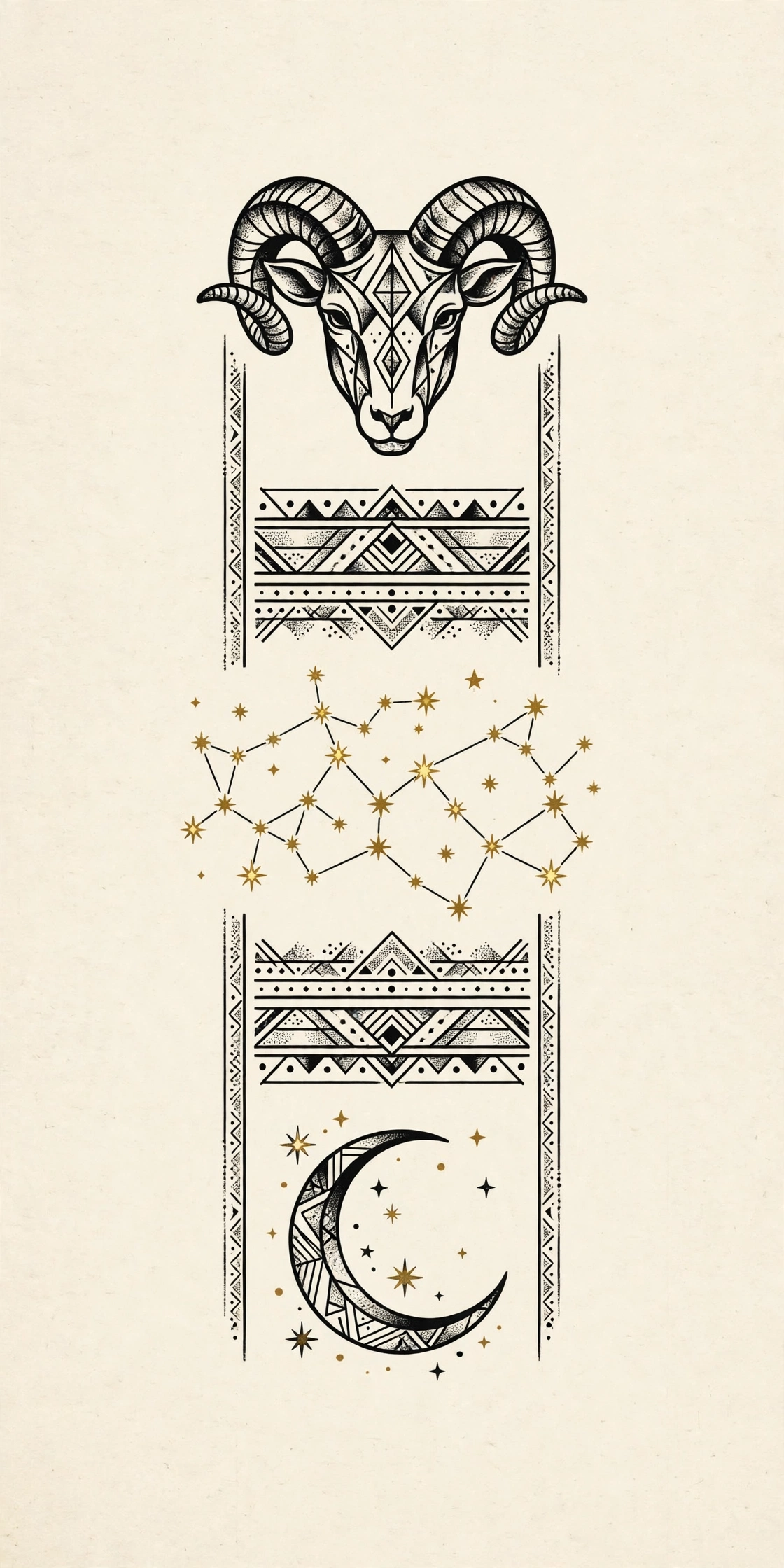
A birth-chart wheel in blackwork on the outer forearm, at least 12 cm, with gold star accents.
A vertical constellation running wrist to elbow, your sign's stars joined by thin gold lines.
A Sun+Moon+Rising trio spaced down the forearm, three bold glyphs with room between them.
A zodiac animal in blackwork — a ram, lion or scorpion — filling the forearm as the anchor.
A moon-phase sequence of five moons, a connecting piece that links the anchor to the next piece.
A glyph band around the forearm, your sign's glyph repeated in a clean geometric ring.
Element symbols in a row — flame, wave, leaf, breeze — marking your chart's balance.
A star map panel on the inner forearm, the sky on your birth date in fine gold stars.
Planet glyphs in a vertical line, marking the planets that matter most in your chart.
A sleeve cap on the elbow — a small round zodiac wheel that joins forearm to upper arm.
Plan the numbers properly: try the Cost Estimator for a size-and-style estimate, and read the Placement Pain Guide before you pick a spot. Only a licensed artist who sees the design and the body part can give you a real quote.
See also: Birth Chart Generator · Tattoo Generator · Tattoo Cost Estimator.
The generator reads your birth date, your intention and your style, so the design it makes is yours, not a copy of someone else's.
Size (Tiny to Extra Large) and style in, cost range out. Ranges are estimates — an artist quote wins. A 20% tip is shown separately.
12 placements: Wrist, Forearm, Upper Arm, Chest, Back, Ribs, Thigh, Ankle, Neck, Hand, Foot, Inner Arm. Shows pain range, healing and fading for the chosen spot. Ranges only — sources disagree, no single decimal is a fact.
Two zodiac signs in, compatibility score out. Tested live: Aries + Leo = 88% overall (Love 90%, Friendship 85%, Soul Bond 88%, Fire + Fire).
Date of birth plus optional birth time (default 06:00 AM). Generates Sun / Moon / Rising summary. This is the only tool that asks for birth time; the homepage DOB wizard does not.
See the full list on the Forearm Tattoos main page.
Forearm script tattoos: the long flat strip suits words, dates and lyrics. How to pick lettering, size it, and keep it readable for years.
Forearm tattoo cost depends on size, detail and the artist — not a flat price. What a 10–25 cm forearm piece costs and how to get a real quote.
Forearm tattoo ideas: vertical constellations, moon phases, florals and wraps at 10–25 cm. Designs that follow the arm and age well.
Inner vs outer forearm tattoo: inner is personal and fades slower, outer is visible and catches more sun. Pain, visibility and fading compared.
Start with one anchor piece — a birth-chart wheel, a vertical constellation or a zodiac animal — on the outer forearm. It is a complete tattoo alone, and it gives the sleeve a centre to grow around.
At least 12 cm, so the glyphs and the ring stay readable. Smaller and the detail crowds together; the outer forearm is the flattest spot with room for it.
Not much — 4.5/10 on the consensus range (inner/outer 3.5/10). The forearm is one of the calmest placements, which is why it is the best place to begin a sleeve.
Yes, if you plan for it. Leave blank skin at the wrist and elbow, keep the style consistent, and place the anchor so it can connect upward toward the upper arm.
Simpler pieces than the anchor: a constellation band, a moon-phase sequence, a glyph band or a star map. Their job is to join the anchors, not compete with them — and blank skin between pieces is part of the design.
Yes — the best. Low pain, a 2–3 week heal, easy to cover with a long sleeve, and one finished piece is a complete tattoo even if you never add to it.
AI designs are for inspiration only. Always consult a licensed tattoo artist. Astrology on this site is for inspiration and self-expression. This page does not provide medical advice. Last reviewed: 24 November 2026.