Tattoo Cost Estimator
Size (Tiny to Extra Large) and style in, cost range out. Ranges are estimates — an artist quote wins. A 20% tip is shown separately.
Linework Tattoos · Tattoo Styles
Linework tattoos explained — the line itself as the whole design, minimal shading. How the style ages, the placements that suit it, and design ideas to take to your artist.
A linework tattoo lets the line itself do all the talking: no heavy shading, no colour packing, just a confident drawn line that forms the whole image. It can be bold or delicate, single-weight or varied, but the drawing has nowhere to hide — which is exactly its appeal.
This page sits under Tattoo Styles.
Key takeaways
| What | What to expect |
|---|---|
| Line | The defining feature — single or varied weights, continuous or broken, with little or no shading |
| Colour | Almost always black; the style relies on line, not colour, for its effect |
| Aging | Solid mid-weight lines hold for decades; very fine lines soften and may need a touch-up sooner |
| Best placements | Forearm, upper arm, back, calf and thigh — anywhere a drawn design can sit flat and flow |
Linework is defined by economy: the image is built from line alone, with shading kept to a minimum or left out entirely. A face, an animal or a landscape is reduced to its essential contours, and the confidence and consistency of those lines are what make the piece succeed or fail.
Within the style there is a wide range. Some linework is drawn in one unbroken stroke, the artist lifting the needle as little as possible. Some uses several line weights, thick where the form turns toward you and thin where it recedes. Some is precise and geometric, and some is loose and sketchy on purpose. What they share is that nothing is hidden behind shading — every wobble shows.
That honesty is why choosing the artist matters so much here. Look at healed portfolios and zoom in on the lines: they should be even, fully saturated and steady, with clean joins where lines meet. A shaky line cannot be disguised in this style, and it will not improve as the tattoo settles.
Linework ages in proportion to its weight: bold and medium lines soften slightly but stay clear for many years, while the finest hairlines can fade, break or blur sooner, especially in sun or on high-wear skin. A design drawn with a confident mid-weight line is a safe long-term choice.
All tattoo lines spread a little as the skin ages, and linework is no exception. On a mid-weight line that spread is barely noticeable; on a hairline it can swallow the gaps between close parallel lines, which is why designs with lines packed tightly together age worse than open, spacious ones. Ask your artist to keep breathing room inside detailed areas.
The good news is that linework is among the easiest styles to refresh. A touch-up pass can re-darken softened lines and restore the crispness of the original drawing without changing the design. If you love a finer look, plan for that maintenance honestly rather than expecting a fresh-photo finish forever.
Linework suits almost any flat or gently curving area: the forearm and upper arm for visible everyday pieces, the back and thigh for large flowing designs, and the calf or ribs for vertical compositions. It follows the body's shape well because the design is drawn, not filled.
Long, flowing linework belongs on long canvases. A snake, a stem of flowers or a single-line figure reads beautifully down a forearm, along a spine or wrapping a calf, because the line can travel without interruption. On the back, linework can go genuinely large — a full outline composition that uses the whole space while staying light and open.
Smaller linework pieces do well on the inner arm, shoulder blade, ankle and behind the ear, as long as the lines are not drawn too fine for the spot. Skin over joints and on hands and feet wears faster, so lines there fade sooner; if you choose those areas, go a touch bolder than you first planned.
Linework usually falls in the Small to Medium bands — Small at $50–500 and Medium at $200–1000 — with Tiny pieces at $50–250 and shop minimums usually $80–$150. Because there is little shading or packing, sessions are often shorter than other styles, and the line-only work is comparatively gentle.
Cost still follows size and complexity more than style. A palm-sized outline is a short appointment; a full-back line composition is a Large piece at $500–$2000 and may be split into sessions so the drawing can be placed carefully. Intricate designs with many separate lines take longer than simple ones of the same size, because every line is placed individually.
For pain, most people find steady line work easier than long shading sessions, though a long continuous line over a tender area like the ribs or inner arm will still make itself known. Linework also tends to heal cleanly and quickly compared with heavily worked skin, since the needle passes over each area fewer times.
The best linework ideas are subjects that survive being reduced to a contour: animals, faces, flowers, snakes and celestial shapes all translate beautifully into pure line. The eight ideas below are drawn to stay open and spacious, so the lines keep their clarity instead of crowding together as they age.
When you are choosing, test the idea by imagining it as a single drawing on paper with no shading at all. If it still reads clearly, it will work on skin. Subjects with a strong silhouette — a heron's neck, a coiling snake, a profile — are natural fits, while busy scenes with lots of small detail usually need simplifying before they work as linework.
Bring reference drawings you like, but let your artist redraw the design in their own hand and at the right line weight for your placement. A line copied from a screen at the wrong weight is the most common reason linework disappoints; a line drawn for your body, by the person tattooing it, is how the style shines.
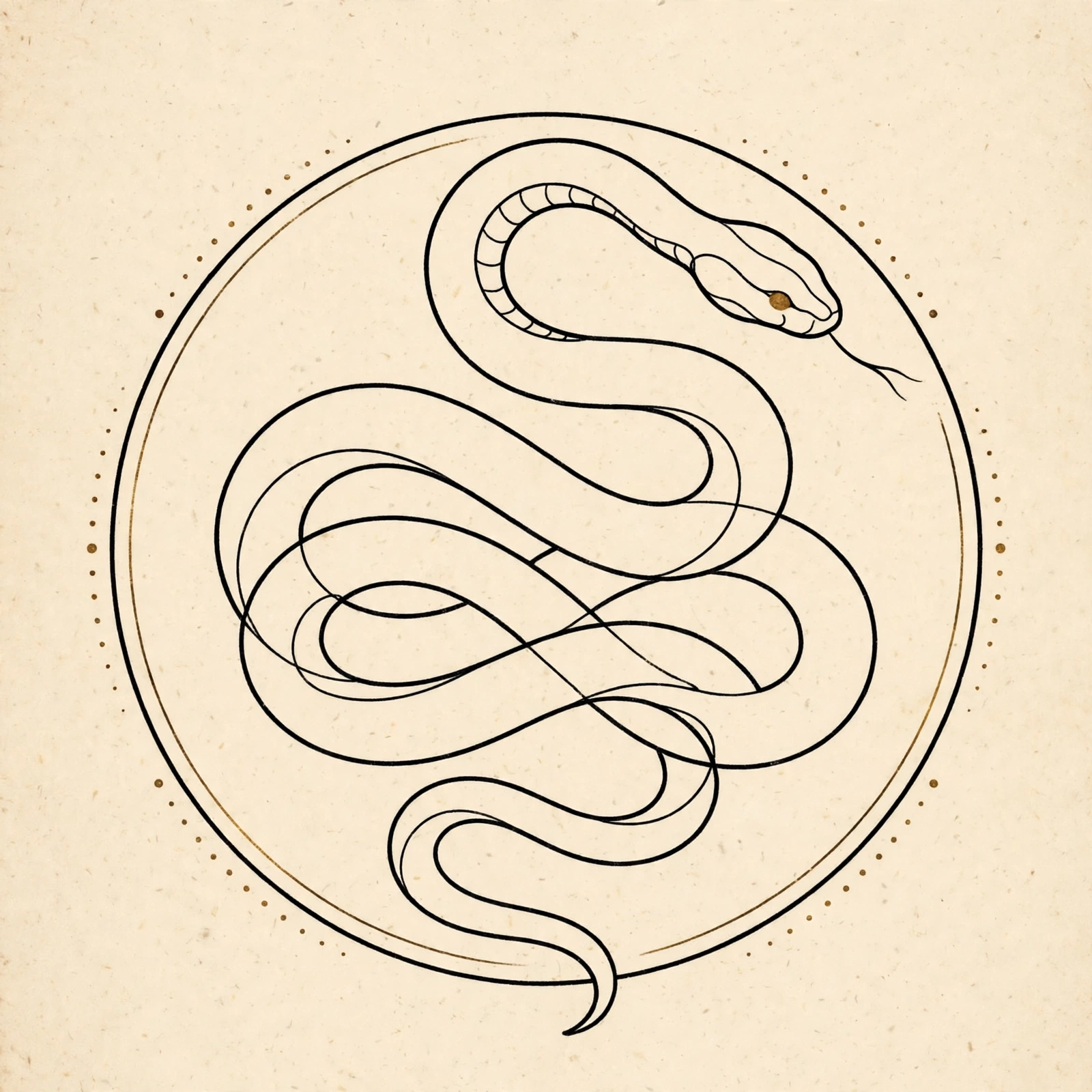
Continuous single-line snake coiling through a circle on the forearm, drawn without lifting the needle
One-line profile of a face with a flower growing from the hair, on the upper arm
Heron standing in reeds in clean varied-weight line down the calf
Mountain ridge and sun drawn as three simple lines across the shoulder blade
Botanical stem with leaves and one open flower running the length of the forearm
Two hands reaching toward each other in outline only, placed on the inner arm
Whale drawn in one flowing line with a small star above it, on the ribs
Abstract face made of overlapping contour lines on the thigh, bold weight for longevity
See also: Tattoo Style Finder Quiz · Tattoo Cost Estimator · All Tattoo Styles.
The generator reads your birth date, your intention and your style, so the design it makes is yours, not a copy of someone else's.
Size (Tiny to Extra Large) and style in, cost range out. Ranges are estimates — an artist quote wins. A 20% tip is shown separately.
All 23 placements from our placement guides — pick a spot, optionally compare a second one, and see its pain range, healing time, fading and size guidance, quoted from the same guide data, with a link to the full placement guide. Ranges only — sources disagree, no single decimal is a fact.
Two sun signs in, an honest reading out — no invented percentages. The tool compares the two signs' elements and ruling planets, tells you where the pairing clicks and where it rubs, and turns it into a matching-tattoo idea with links to both sign guides.
Your Sun, Moon and Rising signs from your birth date and time — all three computed in your browser, with the Moon and Rising honestly labelled approximate. Each sign comes with a short traditional reading and a tattoo angle, plus links to its sign guide and to the wheel and fusion tools.
See the full list on the Tattoo Styles main page.
Lettering & Script tattoos explained — words as the design — scripts, serif and handstyles. How the style ages, the placements that suit it, and design ideas to take to your artist.
Micro tattoos explained — tiny, highly detailed pieces at miniature scale. How the style ages, the placements that suit it, and design ideas to take to your artist.
Japanese (Irezumi) tattoos explained — dragons, koi, waves and wind bars in the irezumi tradition. How the style ages, the placements that suit it, and design ideas to take to your artist.
Minimalist tattoos explained — the fewest lines that still say it. How the style ages, the placements that suit it, and design ideas to take to your artist.
Fine line is one end of the linework family: very thin, delicate lines, often from a single needle. Linework is the broader style and includes medium and bold lines too. The bolder the line, the longer it tends to stay crisp, so linework at a confident weight is the safer long-term choice.
Not if the lines are properly saturated and sensibly weighted. Well-done mid-weight linework holds for many years with normal care and sun protection. Very fine lines and lines on hands, feet and joints fade sooner and may need a touch-up to restore their darkness.
Yes — linework scales up beautifully. Large outline compositions on the back, thigh or full arm are a strength of the style, because the open, unshaded design stays light even at big sizes. Large pieces simply take longer to draw and place well, so expect the price to follow the size band.
Many people find it more comfortable, because there is no repeated shading or colour packing over the same skin. A long line over ribs, spine or inner arm can still be sharp. Overall it is one of the gentler styles, and sessions are often shorter too.
Usually, yes. A clean line drawing is a good foundation, and shading, dotwork or colour can be added inside the outlines later if you want more depth. Decide with your artist, since adding shading changes the character of the piece — many people find the pure line version is the one they love.
Study healed work, not just fresh photos, and look closely at the lines: even weight, full black saturation, smooth curves and clean joins. In this style the drawing is everything, so an artist whose healed lines stay steady and dark is the one to book.
AI designs are for inspiration only. Always consult a licensed tattoo artist. Astrology on this site is for inspiration and self-expression. This page does not provide medical advice. Last reviewed: 25 November 2026.