AI Tattoo Generator
Generate a design for this placement — your sign, your intention, your style. Free, no sign-up.
chest tattoos
Chest tattoos: symmetrical panel ideas, pain reported 4-6.5/10 (sources disagree), healing 3-5 weeks. Large flat canvas, best for symmetry.
Generate a design for this placement →

A chest tattoo is a large, flat canvas worn across the upper body — the best place on the body for a symmetrical centrepiece or a wide panel design. It suits people who want a big, bold piece they can show off or cover with a shirt, and who are ready for a long session on a broad, flat surface.
Key takeaways
| What | What to expect |
|---|---|
| Size | 12-25 cm |
| Pain | 4-6.5/10 (sources disagree — report as a range) |
| Healing | 3-5 weeks |
| Fading | Slow |
Pain is a consensus range — artists and charts disagree on the exact number, so treat it as a range, not a measurement. Only a licensed artist who sees the design and the body part can give you a real quote.
The chest is best for symmetry and centrepieces. It is a large, flat canvas, 12–25 cm across, that suits designs built around a centre line — a symmetrical panel, an animal or floral centrepiece, or an ornamental design that mirrors itself left and right.
Symmetry is the chest's superpower. No other placement gives you a wide, flat surface split neatly down the middle by the breastbone, and designs that use that split look deliberate and powerful: a pair of wings spread across both pecs, a floral panel that mirrors itself, an ornamental design centred on the sternum with matching sides. A design that would look lopsided on an arm or a leg looks intentional here, because the body itself is symmetrical.
Centrepieces work here in a way they do not elsewhere. A large animal — a lion, an eagle, a wolf — can sit in the middle of the chest at full size, with the body of the animal following the body's own shape. Floral designs can spread wide without wrapping awkwardly, and ornamental work can build outward from the centre in rings and curves. If you have a design that needs room to breathe, the chest gives it that room.
The chest is also a good home for a piece that grows. Many people start with a centrepiece and add to it over the years — a panel that extends toward the shoulders, a design that reaches down toward the stomach, or a piece that connects to a sleeve. Plan the first piece with that in mind: leave clean edges where future work could join, and keep the centre strong so later additions frame it rather than compete with it.
A centre-chest design sits over the sternum and reads as one bold statement, while a side panel over one pec reads as a smaller, more contained piece. Centre designs suit symmetry and ornamental work; side panels suit single images like an animal, a flower or a portrait.
The centre of the chest is the statement spot. A design centred on the breastbone is visible from the front in a single glance, it uses the body's symmetry, and it is the natural home for ornamental and mandala work — which is why the sternum has its own dedicated placement and its own guide. If you want one design that defines your chest, the centre is where it goes.
A side panel over one pec is a quieter choice, and often a smarter first chest tattoo. It is a contained space with a clear edge, so a single image — a rose, a bird, a small animal — can sit there complete without needing to fill the whole chest. It also hurts less than the centre, because the pec is fleshier than the breastbone, and it is easier to cover or show depending on your shirt.
Some people do both over time: a centrepiece first, then a panel on each side that frames it, until the whole chest reads as one composition. That works best when the pieces are planned together, even if they are tattooed years apart. If you think you might want a full chest one day, tell your artist at the start — they can design the first piece so the later ones join it cleanly instead of colliding with it.
Sources disagree on chest pain — one chart gives 6.5/10 and another gives 4/10 — so report it as a range of 4–6.5/10, not a single number. Pain varies across the chest: the bony centre tends to hurt more than the fleshier sides, and the collarbone edge is the sharpest part.
The disagreement between sources is honest, because the chest is not one uniform surface. The centre, over the breastbone, is thin skin over bone and hurts the most — it is the same territory as a sternum tattoo, which is rated 8–8.5/10 on its own. The pecs are fleshier, with more muscle under the skin, and they are the gentlest part of the chest. Near the collarbone, the bone sits close to the surface again and the pain sharpens. So where your design sits matters more than the average number.
The session length matters too. A chest piece is often a large tattoo, and a long session on a broad area means hours of needle work — the skin gets sore as the session goes on, and the later hours hurt more than the first. Large chest pieces are commonly split into sessions for exactly this reason, with linework first and shading later, so neither session runs longer than the skin can take.
If you are deciding between chest placements, the pec is the gentler start and the centre is the bolder one — and that is a fair trade to weigh. A small side-panel tattoo lets you learn how your chest handles ink before you commit to a full centrepiece, and there is no penalty for starting small and building outward later.
Chest tattoos usually run 12–25 cm wide, and the right size is the one that fits your frame. A design that is too small floats lost on a broad chest, while one that is too large wraps awkwardly onto the shoulders or stomach — measure the design against your own body, not against a photo of someone else's.
Scale is the decision that makes or breaks a chest tattoo. The chest is wide, and a design that looks big on paper can look small once it is centred on a real torso — which is why artists stencil the full design and have you look at it in a mirror before they start. A centrepiece should span enough of the chest to look deliberate, usually at least 12 cm wide, and a full panel can run to 25 cm or more on a broader frame. Anything smaller than that reads as a chest tattoo only from close up, which is fine if that is what you want, but it will not read as a chest piece.
Sun and stretch are the two long-term risks here. The chest catches sun whenever you wear an open shirt or go without one, so fading is slow but steady without sunscreen — and the skin of the chest stretches with weight change and with age, which can distort a design over the years. Keep the design bold and the lines clean, and a chest piece will age well; pack it with fine detail, and the stretching will show sooner.
Healing takes 3–5 weeks, and the main problem is friction from clothing. Wear loose, soft shirts while it heals, and avoid tight straps or anything that rubs the fresh ink. Once healed, the chest is a low-maintenance placement — it is protected by clothing most of the time, it does not bend or crease the way a joint does, and with sunscreen it holds its colour for years.
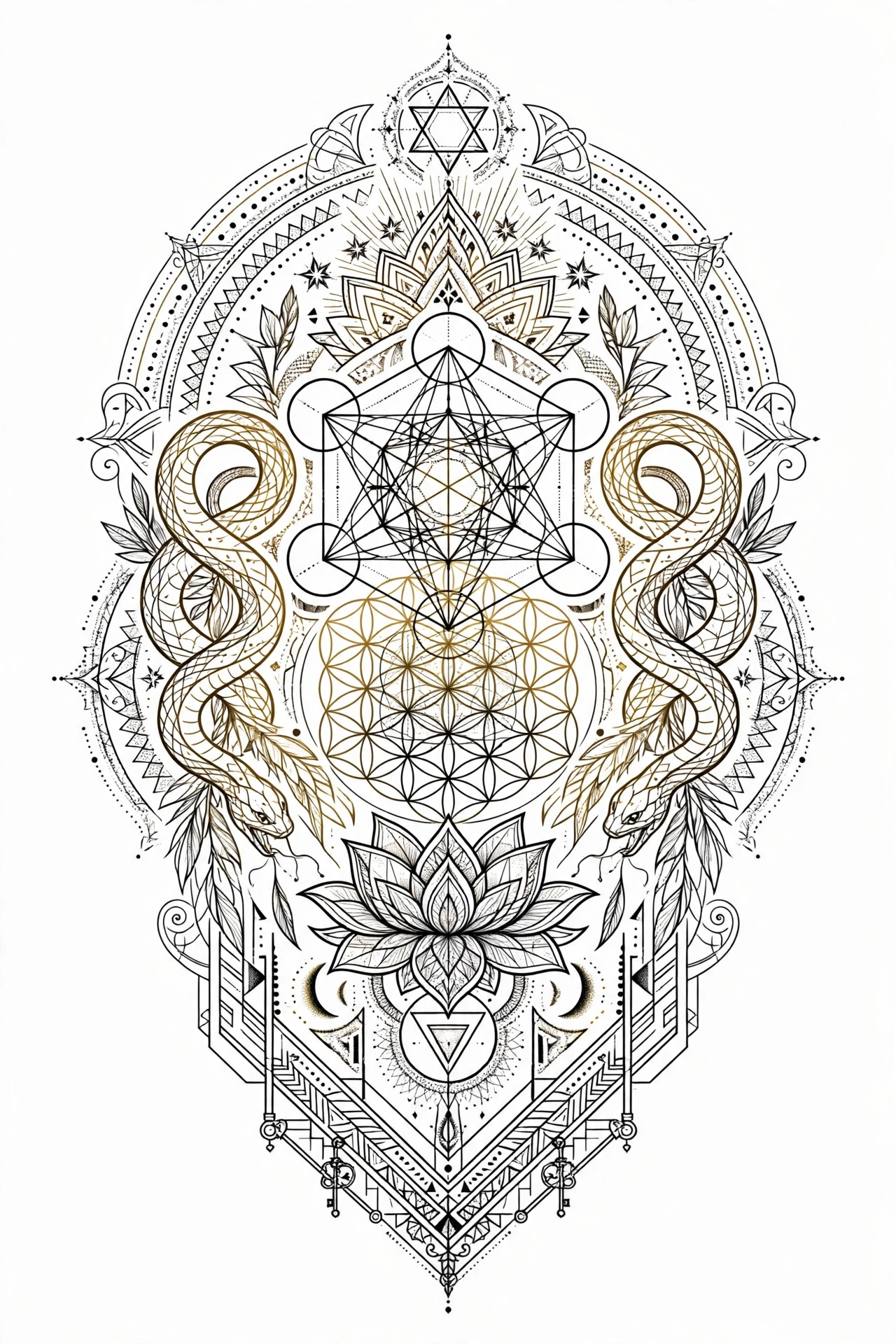
A pair of wings spread symmetrically across both pecs, feathers in detailed black and grey.
A lion's face as a centrepiece, mane flowing outward to frame the chest.
A symmetrical floral panel with a large rose at the centre and mirrored leaves on each side.
An eagle with wings outstretched across the full width of the chest.
A large ornamental mandala centred on the breastbone, radiating outward in rings.
A single red rose over one pec, with a short stem and two leaves, in bold colour.
A wolf's head on one side of the chest, facing inward toward the centre.
A full birth-chart wheel centred on the chest, with your sun sign at the top.
A phoenix rising from the lower chest toward the throat, wings spread wide.
A nautical compass rose as a centrepiece, with a banner and two swallows on either side.
The chest is the one place where a zodiac design can be as big and ambitious as the sky it comes from. A full birth-chart wheel fits here at a size where every symbol stays readable — sun, moon and rising signs in their proper places, ringed by the twelve glyphs in order. A symmetrical zodiac panel, with your sign's constellation mirrored across the centre line, uses the chest's natural symmetry the way no other placement can. A single large constellation also works, spread wide across both pecs so the stars have room to breathe. Keep the astrology itself as personal symbolism — a map of meaning, not a forecast of events.
Generate a design for this placement — your sign, your intention, your style. Free, no sign-up.
Size (Tiny to Extra Large) and style in, cost range out. Ranges are estimates — an artist quote wins.
12 placements: Wrist, Forearm, Upper Arm, Chest, Back, Ribs, Thigh, Ankle, Neck, Hand, Foot, Inner Arm. Shows pain range, healing and fading for the chosen spot. Ranges only — sources disagree, no single decimal is a fact.
Sternum tattoos: symmetrical ornamental and mandala ideas, pain 8-8.5/10, healing 3-5 weeks. Small to medium, symmetrical designs suit it best.
Sources disagree — one chart gives 6.5/10, another gives 4/10. Report it as 4-6.5/10, not a single number.
Large flat canvas, best for symmetry and centrepieces.
Sun and stretch are risks here. Protect it from sun while healing and after.
It can. The chest is one of the areas that changes with weight gain, muscle gain and age, and a design with very fine detail will show distortion first. Bold lines and a design with some room to breathe age better than a tightly packed, delicate piece.
Avoid anything tight or rubby for the first few weeks. Healing takes 3–5 weeks, and straps, underwires and tight collars all press on the fresh ink. Wear loose, soft tops, and if you wear a bra, choose a soft, wireless one that does not sit on the tattoo.
Your artist will shave the area as part of the preparation — do not shave it yourself the day before, because razor burn or nicks make tattooing harder. Chest hair growing back does not damage the ink, and the tattoo will still read clearly through normal hair.
AI designs are for inspiration only. Always consult a licensed tattoo artist. This page does not provide medical advice. Last reviewed: 24 November 2026.