Tattoo Cost Estimator
Size (Tiny to Extra Large) and style in, cost range out. Ranges are estimates — an artist quote wins. A 20% tip is shown separately.
tiny zodiac glyph finger tattoo · Finger Tattoos
A tiny zodiac glyph on your finger works at 1–5 cm — if you pick the bold version. Which glyphs hold, which blur, and the fine-line warning.
A tiny zodiac glyph on your finger can work beautifully — but only the bold version. At 1–5 cm, a thick-lined Aries, Leo or Scorpio glyph reads clearly and holds for a year or more, while a fine-line glyph with thin strokes blurs into a smudge within months. The glyph you choose matters less than the weight of the lines.
This page sits under Finger Tattoos.
Key takeaways
| What | What to expect |
|---|---|
| Size | 1–3 cm |
| Pain | 7.5/10 (consensus range; one source lists 6.5/10) |
| Healing | 2–3 weeks |
| Fading | Very fast — visible softening in 6–12 months |
Pain is a consensus range — artists and charts disagree on the exact number, so treat it as a range, not a measurement. Only a licensed artist who sees the design and the body part can give you a real quote.
A zodiac glyph works at finger size because it is a minimal mark: one or two strokes for a whole sign. Unlike a portrait or a flower, a glyph has no detail to lose — its shape is the design — so it survives fast fading on finger skin better than almost any other 1–5 cm tattoo.
The key is that the glyph is a symbol, not a picture. A ram's head needs horns, shading and space; the Aries glyph needs two curved strokes. That simplicity is what lets it live on a finger: there are no thin inner lines to merge, no shading to wash out, no small gaps to fill in as the ink spreads.
It also carries meaning without words. In traditional astrology, each glyph stands for a sign's character — Aries for drive, Leo for pride, Pisces for intuition — as an interpretation, not a prediction about personality. Wearing your sign's glyph is a quiet statement that people who know astrology will recognise, and that nobody else needs to decode.
Choose the bold glyph, not the fine-line one. A fine-line glyph looks elegant on day one and blurs into a smudge within months, because its thin strokes spread and merge on fast-regenerating finger skin. A bold glyph with thick lines has room to spread and still read.
This is the single most important decision for a finger glyph, and it is where most people go wrong. The fine-line version photographs beautifully — thin, delicate, minimal — and it is the version you will see most often online. But a finger is not a photograph: the skin regenerates fast, you wash your hands constantly, and thin lines are the first thing to go.
Ask your artist for the bold variant: lines at least a millimetre thick, with clear space between the strokes. It will look chunkier than the fine-line version you imagined, and that chunkiness is exactly what keeps it readable after a year. If your artist offers to do it fine-line, ask them how long they expect it to last — an honest artist will tell you the bold version lasts longer.
Glyphs with one or two thick strokes read best tiny: Aries, Leo, Taurus and Sagittarius hold well, while glyphs with fine inner detail or crossing lines — Virgo, Gemini, Pisces — blur faster and need bolder rework to survive on a finger.
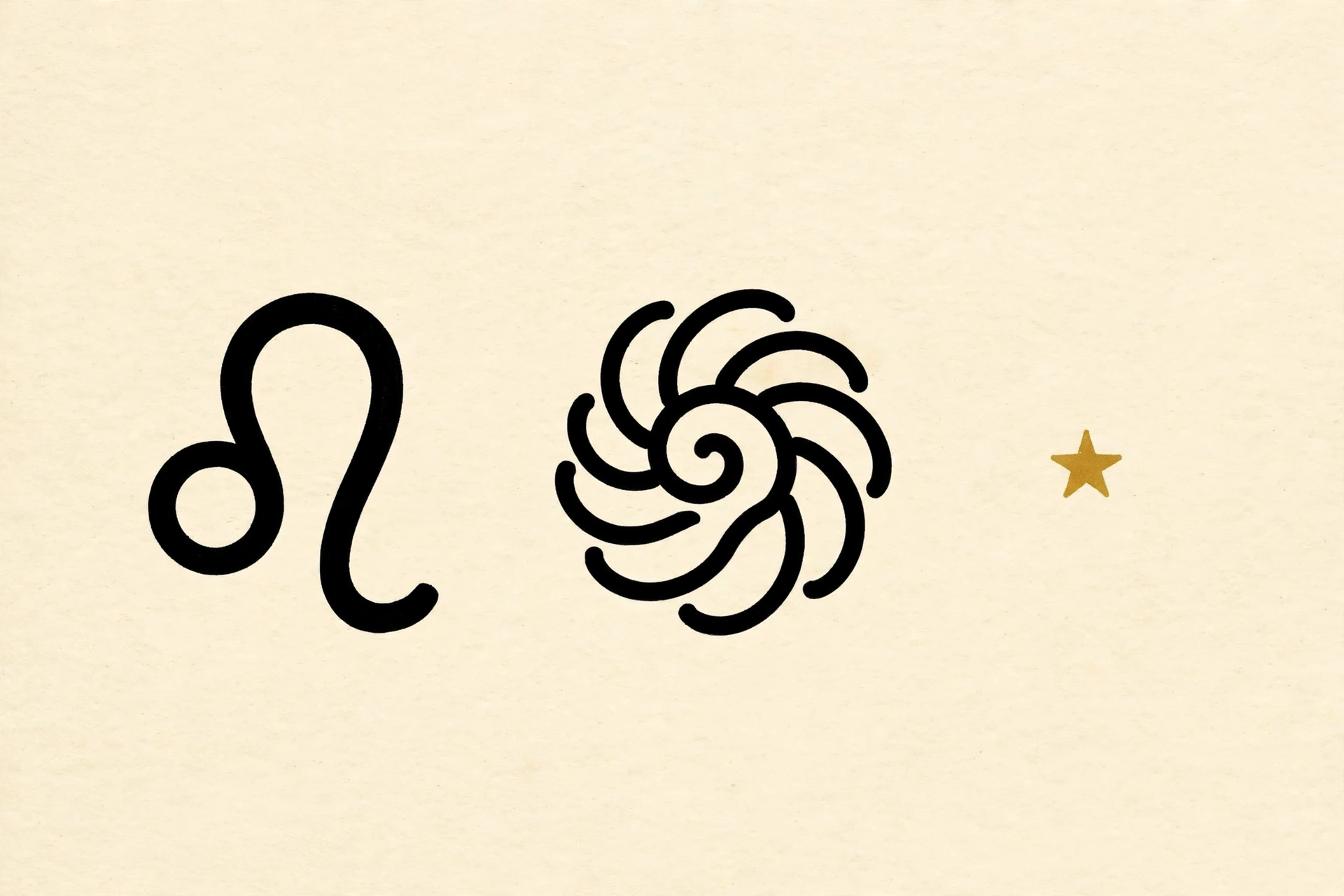
Aries is the strongest candidate: two bold curves that read instantly even at 1 cm, with no inner detail to lose. Leo is close behind — a single flowing shape that holds its form. Taurus is a simple circle with two horns, and Sagittarius is one bold arrow. All four are essentially one gesture, which is why they survive.
The harder glyphs are the ones with fine crossings or small inner marks. Virgo's loop-and-tail, Gemini's twin lines, and Pisces' two curves joined by a bar all have thin elements that merge as the ink spreads. They can still work — but only if the artist redraws them bolder than the standard glyph, thickening the thin parts and widening the gaps. If your sign is one of the harder ones, do not insist on the textbook glyph; let the artist adapt it.
Place a glyph on the side of the finger, not the top: the side bends less, rubs less, and holds ink slightly better. The ring finger is the classic spot for a sign glyph, but the index finger gives a little more room and shows the design more often.
The top of the finger is where most people imagine the glyph, because it is the most visible — but it is also where the skin stretches most when you bend the finger, and where the tattoo rubs against everything you grip. The side of the finger, facing your neighbour finger, is more sheltered, and the glyph reads just as well when you turn your hand.
Keep it to one glyph per finger. Two glyphs crowded onto one finger — your Sun and Moon signs, for example — will merge as they fade, and the result reads as a smudge rather than two symbols. If you want two signs, put one on each hand, or pair the glyph with a tiny star on a different finger. Healing takes 2–3 weeks, and during that time keep the hands clean, moisturise thinly, and do not pick at scabs.
Aries glyph in bold black strokes on the side of the ring finger, with a tiny gold star.
Leo glyph as one thick flowing shape on the index finger, instantly readable at 1 cm.
Taurus glyph — a bold circle with two horns — on the side of the middle finger.
Scorpio glyph in thick black lines on the ring finger, its tail curled into a bold curve.
Sagittarius glyph as a single bold arrow on the side of the index finger.
Capricorn glyph redrawn bold, its loop thickened so the shape holds on finger skin.
Aquarius glyph as two bold wavy lines on the middle finger, spaced wide apart.
Pisces glyph in thick strokes on the ring finger, the joining bar drawn bold, not fine.
Virgo glyph adapted bold by the artist, the thin tail thickened to survive fading.
Gemini glyph as two bold vertical lines joined by a thick bar, on the side of the finger.
Plan the numbers properly: try the Cost Estimator for a size-and-style estimate, and read the Placement Pain Guide before you pick a spot. Only a licensed artist who sees the design and the body part can give you a real quote.
See also: Tattoo Placement Pain Guide · Birth Chart Generator · Tattoo Generator.
The generator reads your birth date, your intention and your style, so the design it makes is yours, not a copy of someone else's.
Size (Tiny to Extra Large) and style in, cost range out. Ranges are estimates — an artist quote wins. A 20% tip is shown separately.
All 23 placements from our placement guides — pick a spot, optionally compare a second one, and see its pain range, healing time, fading and size guidance, quoted from the same guide data, with a link to the full placement guide. Ranges only — sources disagree, no single decimal is a fact.
Two sun signs in, an honest reading out — no invented percentages. The tool compares the two signs' elements and ruling planets, tells you where the pairing clicks and where it rubs, and turns it into a matching-tattoo idea with links to both sign guides.
Your Sun, Moon and Rising signs from your birth date and time — all three computed in your browser, with the Moon and Rising honestly labelled approximate. Each sign comes with a short traditional reading and a tattoo angle, plus links to its sign guide and to the wheel and fusion tools.
See the full list on the Finger Tattoos main page.
Are finger tattoos worth it? Only if you accept fast fading and regular touch-ups. The honest pros, cons and costs before you book.
Finger tattoo fading starts in 6–12 months: fast skin turnover, constant washing and friction. Why it happens and what actually slows it.
Finger tattoo ideas for women and men: 10 bold, simple designs at 1–3 cm that survive fading. Hearts, moons, glyphs and bands that hold.
Finger tattoo touch-ups every 1–2 years keep bold designs readable. When to book, what a touch-up can fix, and when to stop re-lining.
Ring finger tattoo ideas: thin bands, crescents, initials and zodiac glyphs at 1–3 cm. Bold, simple designs that survive daily wear.
Yes — at 1–5 cm a zodiac glyph is one of the best finger tattoos, because it is a single minimal mark with no detail to lose. Choose the bold version, not fine-line, or it will blur within months.
Glyphs with one or two thick strokes: Aries, Leo, Taurus and Sagittarius. They read instantly at 1 cm and hold longest. Glyphs with fine inner detail, like Virgo or Gemini, need bolder rework to survive.
Almost certainly, within months. Fine lines spread and merge on fast-regenerating finger skin. A bold glyph with lines at least a millimetre thick has room to spread and still read — ask for the bold variant.
Around 1–5 cm. Smaller than 1 cm and the strokes crowd together; larger than 5 cm and the glyph wraps around the finger. One glyph per finger — two crowded glyphs merge as they fade.
On the side of the finger, not the top. The side bends less and rubs less, so it holds ink slightly better. The ring finger is the classic spot; the index finger shows the design more often.
Expect visible softening in 6–12 months and touch-ups every 1–2 years, like all finger tattoos. Bold glyphs last longest; fine-line glyphs can need work within months.
AI designs are for inspiration only. Always consult a licensed tattoo artist. Astrology on this site is for inspiration and self-expression. This page does not provide medical advice. Last reviewed: 24 November 2026.