Tattoo Cost Estimator
Size (Tiny to Extra Large) and style in, cost range out. Ranges are estimates — an artist quote wins. A 20% tip is shown separately.
spine tattoo ideas · Spine Tattoos
Spine tattoo ideas that suit a long, narrow back: script, constellations, moon phases and fine-line florals. See what holds up and what to avoid.
The best spine tattoo ideas all share one shape: long and narrow. The spine gives you a natural vertical line from neck to lower back, and designs that follow it — script, constellations, moon phases, a single floral stem — look intentional and age well. Wide designs fight the curve of the back and distort.
This page sits under Spine Tattoos.
Key takeaways
| What | What to expect |
|---|---|
| Size | 15-40 cm |
| Pain | 7.5/10 (consensus range, sources disagree) |
| Healing | 4-6 weeks (some sources say closer to 3 weeks for small pieces) |
| Fading | Slow-moderate |
Pain is a consensus range — artists and charts disagree on the exact number, so treat it as a range, not a measurement. Only a licensed artist who sees the design and the body part can give you a real quote.
A spine tattoo idea works when it is narrow, vertical and simple enough to read at a glance. The spine is a column, not a canvas: designs that run down the centre line age well, while wide or heavily shaded designs warp as the back curves away on both sides.
Judge every idea against the shape of the back. The centre line of the spine moves least when you bend and twist, so linework placed there stays truer than work spread across the shoulder blades. That is why the classic spine pieces are all built from a single line: words, dots, small circles, a stem. Complexity should run down the length, not across the width.
Size matters more here than on most placements. A spine piece usually runs 15-40 cm, and the detail has to survive at that scale. One clear motif repeated down the spine beats ten different symbols crammed together.
In traditional astrology, the spine also suits designs that tell a sequence — a moon-phase cycle, a constellation, a birth-chart element running downward. The vertical format turns a list of symbols into a story, which is something a flat placement cannot do.
Plan a spine layout as one column with a clear start, middle and end. Put the most important symbol at the top or centre, let smaller elements step down toward the lower back, and leave breathing room between elements so the piece reads as one design instead of a random stack.
The top of the spine, near the neck, is where the eye lands first, so that is where your anchor goes: the largest symbol, the first word, the full moon. The middle of the back carries the flow — the stem, the line of script, the chain of dots. The lower back is the finish, not the feature: a small closing symbol, the last word, the new moon.
Spacing is what separates a good spine piece from a cluttered one. Elements need room to breathe, because the skin between them moves and the lines soften over the years. Tight spacing looks good on day one and muddy in year five.
Try the layout on paper first, at full size. Print the design at 15-40 cm, hold it against your back in a mirror, and check that it follows your spine rather than fighting it. If the design only works when you stand perfectly straight, it is the wrong design.
Zodiac designs suit the spine when they run as a sequence: a constellation in fine dots, a glyph with its element symbol, or moon phases marking a birth date. Keep the glyph small and centred, and let the constellation or phases carry the length of the piece.
A constellation is the most natural zodiac design for the spine. The stars already form a line or a shape, and fine dots with thin connecting lines look delicate against the back. Orion, with its three belt stars in a row, practically draws itself down the spine. Your own sign's constellation works the same way, kept small and centred.
A glyph alone can feel lost on a long back, so pair it: glyph plus constellation, or glyph plus its element — a flame for fire signs, a wave for water, a leaf for earth, a breeze line for air. The Sun, Moon and Rising trio also fits the vertical format, stacked in order down the spine. In traditional astrology these three are read as the core of a birth chart, and as a tattoo they are a personal sequence rather than a prediction — astrology here is interpretation and self-expression, not a statement about who you are.
Keep the astrology honest. A zodiac spine tattoo says something about how you see yourself, and that is enough. It does not predict personality or fate, and a good design does not need it to.
Fine-line, blackwork and minimal geometric styles age best on the spine, because clean lines survive movement and sun better than soft shading or colour. Watercolour and heavy realism are the risky choices here: they soften fastest on skin that bends every day.
Fine-line is the spine's natural style. Thin, confident lines suit script, constellations and small symbols, and they look delicate without being fragile — provided the artist leaves enough space between lines for them to spread slightly with age. Blackwork suits bolder pieces: a solid ornamental spine, a thick geometric column, a dark floral stem with gold accents.
What ages badly is anything that depends on subtle shading to read. Soft grey wash and watercolour blur first on a placement that moves constantly, and colour fades faster than black. If you love colour, use it as an accent — a gold dot, a single red thread — rather than the main event.
Fading on the spine is slow to moderate overall, which is better than the wrist or fingers. The back sees less daily sun, and clothing protects it. Once healed, sunscreen is still the cheapest way to keep the lines sharp, and a small touch-up after a few years is normal for fine-line work.
A single line of script running from the base of the neck to the mid-back, in a clean serif or handwritten font, sized so every letter stays readable at arm's length.
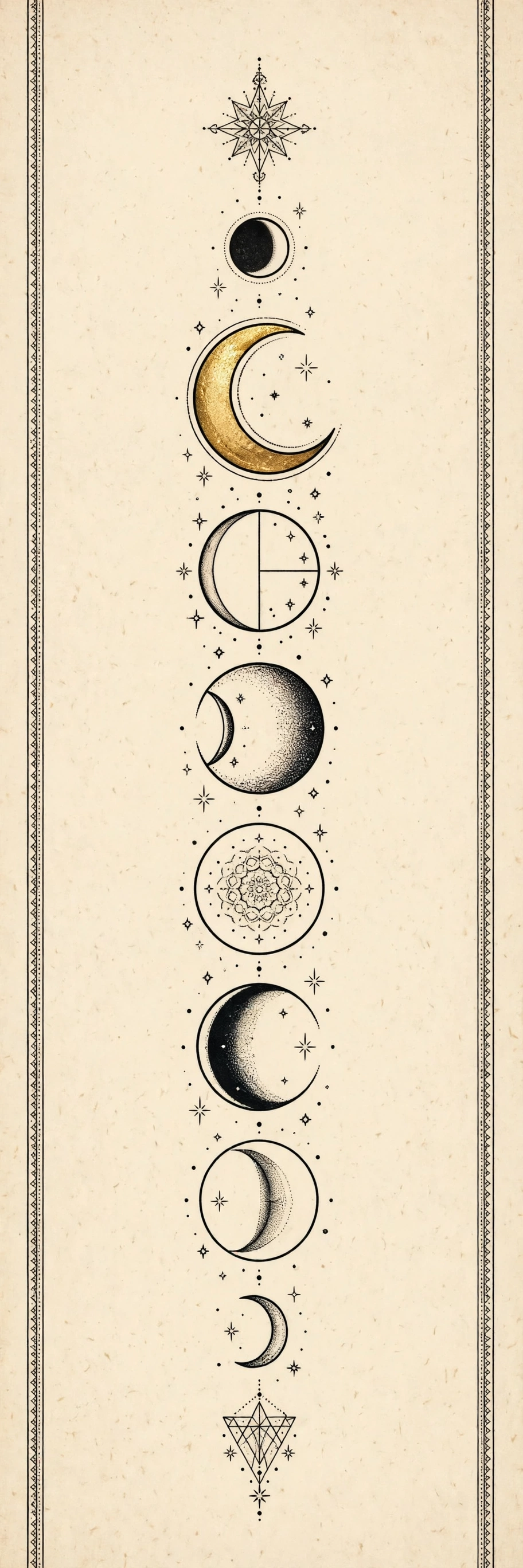
Moon phases stepping down the spine — full moon at the top, fading to new moon at the base — in fine black dots with one gold accent moon.
Your zodiac constellation in fine dots with thin connecting lines, centred on the spine, with the glyph small above it.
A fine-line floral stem with one bloom at the top and leaves trailing down, black ink with a single gold stem line.
A vertical ornamental column: a small mandala at the top, geometric bands stepping down, and a tiny pendant symbol at the base.
Birth-date stars — one small star for each important date — running down the spine like a quiet timeline only you can read.
A snake in fine black line coiling gently down the spine, following the curve of the back instead of fighting it.
A chain of small symbols — sun, moon, star — spaced evenly down the spine, each one simple enough to read on its own.
A single feather in blackwork, quill at the top and fine barbs trailing down, sized to the full length of the upper back.
A geometric spine: thin triangles and dots forming a narrow column, with a gold dot marking the centre of the piece.
Plan the numbers properly: try the Cost Estimator for a size-and-style estimate, and read the Placement Pain Guide before you pick a spot. Only a licensed artist who sees the design and the body part can give you a real quote.
See also: Tattoo Generator · Tattoo Placement Pain Guide · Birth Chart Generator.
The generator reads your birth date, your intention and your style, so the design it makes is yours, not a copy of someone else's.
Size (Tiny to Extra Large) and style in, cost range out. Ranges are estimates — an artist quote wins. A 20% tip is shown separately.
12 placements: Wrist, Forearm, Upper Arm, Chest, Back, Ribs, Thigh, Ankle, Neck, Hand, Foot, Inner Arm. Shows pain range, healing and fading for the chosen spot. Ranges only — sources disagree, no single decimal is a fact.
Two zodiac signs in, compatibility score out. Tested live: Aries + Leo = 88% overall (Love 90%, Friendship 85%, Soul Bond 88%, Fire + Fire).
Date of birth plus optional birth time (default 06:00 AM). Generates Sun / Moon / Rising summary. This is the only tool that asks for birth time; the homepage DOB wizard does not.
See the full list on the Spine Tattoos main page.
Spine tattoos for women: long vertical designs, honest pain guidance, healing times and the sizes that suit a narrow spine. Plan yours with confidence.
How much does a spine tattoo hurt? The consensus range, why bone and vibration make it sting, and how to get through a long session.
Vertical spine script tattoos: choosing words, fonts and sizes that stay readable down your back. Quotes, names, dates and what to avoid.
The best designs are narrow and vertical: script, moon phases, a constellation, or a single floral stem. Anything wide distorts around the curve of the back, so pick a design that follows the centre line of the spine rather than spreading across it.
A small spine piece can take one session of one to two hours. A full-length piece of 15-40 cm usually takes two sessions — lining first, then shading or fill. Long sessions over bone are tiring, so splitting the work gives cleaner lines.
Yes — the consensus range is around 7.5/10, among the more painful placements. The needle works over bone the whole way, and vibration carries along the spine. The upper spine near the neck and the lower spine near the tailbone tend to feel sharpest.
The spine is one of the more stable placements for weight change, because the skin along the centre line moves less than on the stomach or hips. Large, rapid changes can still affect any tattoo, but a narrow vertical design on the spine holds its shape better than a wide piece elsewhere.
Yes, and it suits the placement well. A constellation in fine dots, a glyph with its element symbol, or the Sun, Moon and Rising trio stacked vertically all work. Keep the glyph small and centred and let the constellation carry the length.
Wear loose clothing, avoid bra straps and backpacks over the fresh ink, and sleep on your side or stomach. You cannot easily reach your own back, so a partner or a mirror helps, and your artist may use a second-skin film. Healing takes about 4-6 weeks.
AI designs are for inspiration only. Always consult a licensed tattoo artist. Astrology on this site is for inspiration and self-expression. This page does not provide medical advice. Last reviewed: 24 November 2026.