Tattoo Cost Estimator
Size (Tiny to Extra Large) and style in, cost range out. Ranges are estimates — an artist quote wins. A 20% tip is shown separately.
full sleeve tattoo ideas · Full Sleeve Tattoos
10 full sleeve tattoo ideas planned as one piece — zodiac wheel, forest, ocean, geometric and more. How to pick a theme that flows shoulder to wrist.
A full sleeve works best when you plan it as one piece, not a pile of small tattoos. One theme, one flow, from shoulder to wrist — that is what makes a sleeve read as a design instead of a collection. These ten ideas show how different themes carry a whole arm.
This page sits under Full Sleeve Tattoos.
Key takeaways
| What | What to expect |
|---|---|
| Size | 35 cm+ (XL class) |
| Pain | 3–8/10 by zone (consensus range, sources disagree) |
| Healing | Multi-session; months to complete and settle |
| Fading | Slow on the outer arm, fast at the wrist and hand |
Pain is a consensus range — artists and charts disagree on the exact number, so treat it as a range, not a measurement. Only a licensed artist who sees the design and the body part can give you a real quote.
One theme, one flow, and one focal point make a full sleeve idea work. The theme gives every section a reason to sit next to the others, the flow carries the eye from shoulder to wrist, and the focal point — one big element, usually on the upper arm — anchors the whole piece.
Size is the sleeve's advantage and its trap. You have 35 cm or more of skin, so a design can breathe — but that space also tempts people to cram in everything they like. The sleeves that age best are the ones that leave negative space: bare skin between the elements, so each part stays readable. Bold lines help too. At sleeve scale, thick black outlines and solid shapes hold their edge for years, while fine detail softens and merges. Think of the arm as a canvas with a shape of its own: it tapers toward the wrist, bends at the elbow, and moves all day. A good idea respects that shape instead of fighting it.
Themes with a natural flow suit a full sleeve best: forests, oceans, night skies, winding snakes, zodiac wheels and geometric patterns. They all have elements that travel — a river, a vine, a constellation line, a snake's body — so the design can move down the arm instead of sitting in separate blocks.
Nature themes are the most forgiving. A forest can climb from wrist to shoulder with trees of different sizes, and an ocean can roll from a wave at the wrist to a storm at the shoulder. Celestial themes work the same way: stars, moons and constellations scatter naturally across the arm, and a zodiac wheel gives you a ready-made centrepiece. Geometric blackwork suits people who want structure — repeating patterns wrap the arm evenly and look sharp from every angle. Mythic themes need more planning: a dragon or phoenix needs room for its body to coil, so the artist has to map it around the elbow rather than across it. Whatever theme you pick, ask one question: does it give the artist something that flows, or just a list of pictures?
Start with the anchor pieces, map them on the arm, then connect them. Pick two or three large elements first — the focal point on the upper arm, one strong piece on the forearm — and place them where the arm is flattest. Then use background and gap fillers to join them, leaving open skin so the design can breathe.
The consultation is where a sleeve is made or broken. Bring your theme and your must-have elements, and let the artist draw the flow — they know how a design wraps around muscle and bends at the elbow. A common mistake is tattooing the favourite piece first with no map, then discovering there is no room left for the rest. Ask the artist to sketch the full layout, even roughly, so you can see where each element lands. Leave the wrist and inner arm for later sessions: the skin there is thinner and sorer, and the design choices there — bold and simple — are different from the upper arm. And keep the theme consistent. One style throughout reads as a sleeve; three styles read as three tattoos.
Avoid cramming too many themes into one arm, shrinking detailed designs to fit small gaps, and ignoring how the wrist and hand fade. The three mistakes share one cause: treating the sleeve as a collection instead of a composition. The cause is the same every time.
Tiny detail is the most common regret. A face, a line of script or a detailed animal needs size to survive — squeezed into a gap between larger pieces, it blurs into a smudge as the ink settles. The wrist and hand deserve the same caution: ink there fades fastest, so fine lines and light shading wash out first. Keep those areas bold and simple, or leave them open. Avoid clashing styles as well. Realism next to dotwork next to watercolour can work in the hands of one artist with a plan, but as a pile of separate decisions it looks accidental. Finally, do not rush the plan to save a consultation fee. The planning session is the cheapest part of a sleeve and the one that decides whether the expensive part turns out well.
A zodiac wheel flowing down the arm, with your sign's animal as the centrepiece on the upper arm and constellation lines trailing toward the wrist.
A forest sleeve that climbs from wrist to shoulder, with tall trees on the forearm and a dense canopy wrapping the upper arm.
An ocean sleeve, with waves rolling up from the wrist, a whale or turtle on the forearm, and a storm sky at the shoulder.
Bold geometric blackwork wrapping the whole arm in repeating patterns, with one gold-accented shape as the focal point.
A botanical sleeve of large flowers and winding vines, with open skin between the blooms so each flower stays readable.
A night-sky sleeve scattered with constellations, a crescent moon on the forearm and a full star map across the shoulder.
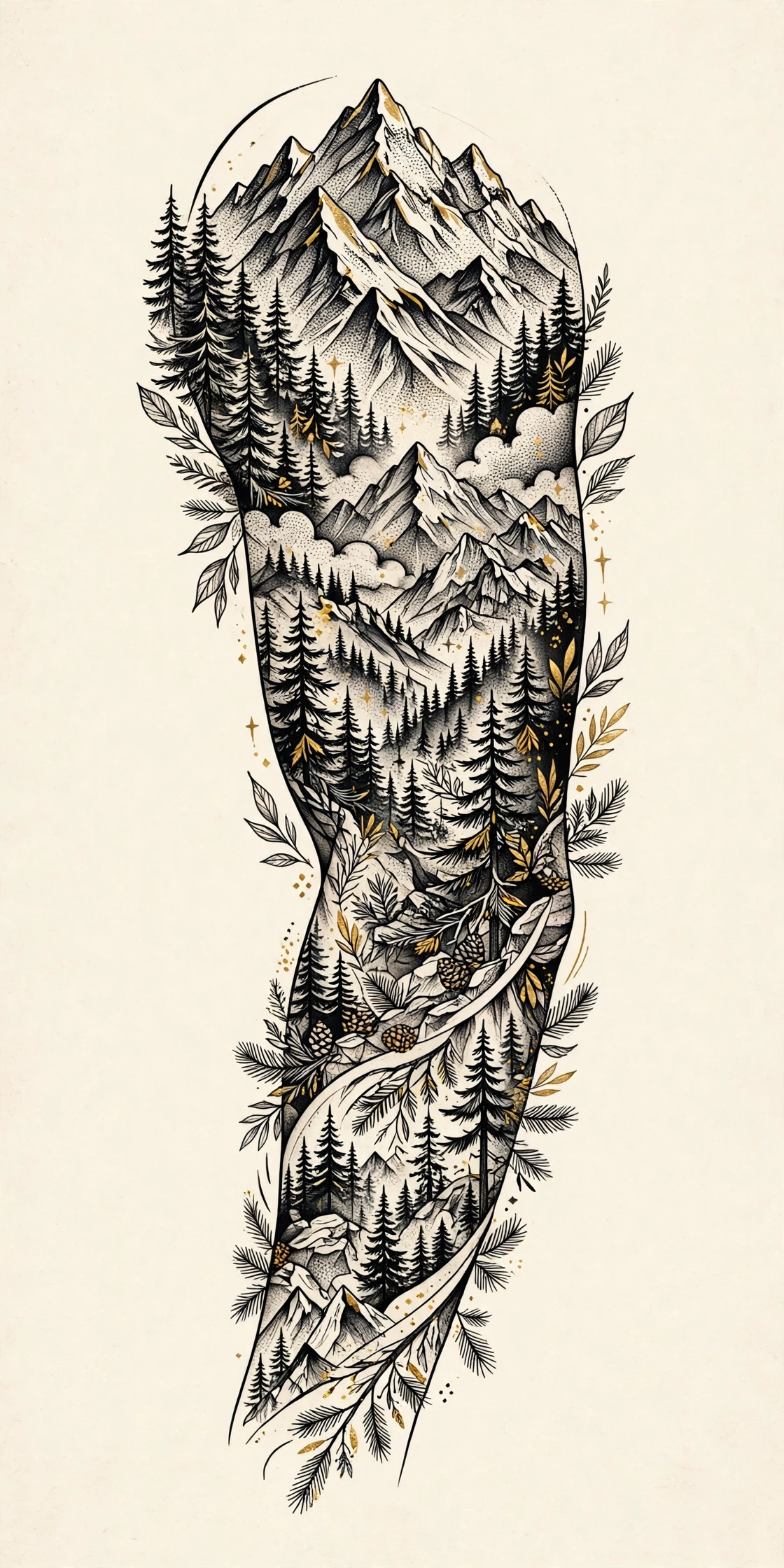
A mountain landscape sleeve, with peaks on the upper arm, a valley on the forearm and a small cabin or pine at the wrist.
A snake winding the full length of the arm, its coils giving the design a natural flow around the elbow.
A mythic sleeve built around one creature — a dragon or phoenix — with its body coiling down the arm and flames or feathers as filler.
A birth-chart wheel on the upper arm, with your Sun, Moon and Rising glyphs trailing down the forearm in a clean band.
Plan the numbers properly: try the Cost Estimator for a size-and-style estimate, and read the Placement Pain Guide before you pick a spot. Only a licensed artist who sees the design and the body part can give you a real quote.
See also: AI Tattoo Generator · Tattoo Placement Pain Guide · Tattoo Cost Estimator.
The generator reads your birth date, your intention and your style, so the design it makes is yours, not a copy of someone else's.
Size (Tiny to Extra Large) and style in, cost range out. Ranges are estimates — an artist quote wins. A 20% tip is shown separately.
All 23 placements from our placement guides — pick a spot, optionally compare a second one, and see its pain range, healing time, fading and size guidance, quoted from the same guide data, with a link to the full placement guide. Ranges only — sources disagree, no single decimal is a fact.
Two sun signs in, an honest reading out — no invented percentages. The tool compares the two signs' elements and ruling planets, tells you where the pairing clicks and where it rubs, and turns it into a matching-tattoo idea with links to both sign guides.
Your Sun, Moon and Rising signs from your birth date and time — all three computed in your browser, with the Moon and Rising honestly labelled approximate. Each sign comes with a short traditional reading and a tattoo angle, plus links to its sign guide and to the wheel and fusion tools.
See the full list on the Full Sleeve Tattoos main page.
A full sleeve tattoo costs $2,000–$12,000 and takes 15–50 hours over 4–8 sessions. What sets the price, and how to budget for it.
Half vs full sleeve tattoo: cost, hours, sessions and pain compared. A full sleeve is $2,000–$12,000; a half sleeve costs less and skips the sorest zones.
A full sleeve takes 15–50 hours across 4–8 sessions over 3–12 months. Where the months go, what slows it down, and how to finish faster.
Sleeve gap fillers join a full sleeve into one flowing piece. Stars, dots, leaves, clouds and more — what works, what to avoid, and when to add them.
A zodiac full sleeve turns your arm into your birth chart — wheel, animal and constellations. How to plan one, what it needs, and what it costs.
The best theme is one with a natural flow — forest, ocean, night sky, zodiac or geometric. It should give the artist elements that travel down the arm, and it should mean something to you, since you will wear it every day for decades.
At least palm size, and larger on the upper arm. The focal piece anchors the sleeve, so give it room: a design squeezed small blurs as it ages, while a bold centrepiece stays readable from a distance.
You can, but one style throughout reads far better as a sleeve. Mixed styles need one artist and one plan to look deliberate; as separate decisions they tend to look accidental. If you love two styles, use one as the main and the other as an accent.
A full sleeve is a big first tattoo — 15–50 hours over months — but it is possible if you are sure of the theme. Most artists suggest starting with the upper arm section first, so you learn how your skin heals before committing to the wrist and elbow.
Slowly on the outer arm, faster at the wrist and hand, where sun and washing wear ink down. Bold blackwork holds up best; fine lines and light colour fade first. Sunscreen once healed is the simplest protection.
Pick one theme and two or three anchor elements, then book a consultation. Ask the artist to sketch the full layout before the first session, so every piece has a place and the sleeve reads as one design.
AI designs are for inspiration only. Always consult a licensed tattoo artist. Astrology on this site is for inspiration and self-expression. This page does not provide medical advice. Last reviewed: 24 November 2026.