Tattoo Cost Estimator
Size (Tiny to Extra Large) and style in, cost range out. Ranges are estimates — an artist quote wins. A 20% tip is shown separately.
Illustrative Tattoos · Tattoo Styles
Illustrative tattoos explained — drawn like a book illustration, with visible sketch lines. How the style ages, the placements that suit it, and design ideas to take to your artist.
Illustrative tattoos look like drawings lifted from a storybook page: clear ink outlines, visible sketch and hatching lines, and soft shading that keeps the hand of the artist in the picture. Any subject can be drawn this way, which makes it the most personal of styles, part picture, part handwriting.
This page sits under Tattoo Styles.
Key takeaways
| What | What to expect |
|---|---|
| Line | Clear defining outlines with visible hatching and sketch-like inner lines |
| Colour | Black and grey or colour with a drawn, hatched quality rather than smooth blends |
| Aging | Solid outlines hold the image; fine hatching and pale shading soften first |
| Best placements | Forearm, upper arm, calf, thigh and back, flat areas that suit a picture |
An illustrative tattoo is defined by looking drawn. It keeps the techniques of pen-and-ink and book illustration on the skin: a clear outline, cross-hatching for shadow, sketch lines left visible, and shading that shows its strokes instead of hiding them. The subject can be anything; the hand-drawn treatment is the style.
Think of the pictures in a classic storybook or a natural history plate. A fox is outlined cleanly, its fur suggested with directional strokes, its shadow built from parallel hatching rather than a smooth grey blend. Some illustrative artists work in an engraving manner, all fine lines and stipple, while others keep loose, energetic sketch lines that make the animal feel mid-movement. Colour versions borrow from watercolour and coloured pencil, with colour laid in visible, textured strokes inside firm outlines.
That firm outline is what separates illustrative work from pure sketch or realism styles. Realism hides its construction to imitate a photograph; illustrative work shows its construction proudly, but still gives the image a strong drawn frame. When choosing an artist, look for that balance: drawings that feel alive and personal, held together by outlines confident enough to survive on skin for decades.
Illustrative tattoos age well when they are built like good tattoos first and drawings second. The main outlines, if laid at a proper weight, hold the subject clearly for years. The delicate inner work, fine hatching, pale sketch lines and light colour strokes, softens first, so the drawing simplifies gracefully rather than collapsing.
Hatching deserves a specific warning. Rows of fine parallel lines are this style's shading engine, and lines placed too close together merge as ink settles, turning careful shading into a flat dark patch. Skilled illustrative artists space their hatching for skin, not for paper, and keep the densest line work in areas where a little merging will still read as shadow rather than damage.
Colour illustrative work follows the usual colour rules: deeper, well-saturated tones outlast pale washes, and all colour benefits from sun protection. Black and grey illustrative pieces are the most forgiving over time. Either way, expect the tattoo to look slightly softer and more settled than its fresh photograph, which most wearers find suits the storybook character. A design whose charm depends on one hair-thin sketch line is fragile; a design with a real outline is not.
Illustrative tattoos suit flat, picture-friendly placements: the forearm, upper arm, calf, thigh and back, where a drawn scene can sit undistorted and be read like a page. Medium and larger sizes flatter the style, because hatching and inner detail need space to stay separate as the tattoo ages.
The forearm and upper arm are the classic frames: visible, relatively flat, and easy for the artist to draw on without distortion. The calf suits vertical subjects, standing animals, tall flowers, lanterns and figures, and moves less than people expect. The thigh and back open the door to genuine scenes: a whole storybook moment with a setting, plants, objects and sky, drawn at a size where every hatch has breathing room.
Curved and high-movement areas need adaptation rather than avoidance. A design wrapping the arm can be drawn to flow with the limb, with the subject turning the corner deliberately. Across joints, ribs or the stomach, expect the drawing to stretch and settle with the skin, so artists often simplify detail there. Very small illustrative tattoos are the one real caution: below a certain size the hatching must go, and the piece becomes simple linework wearing an illustrative costume.
Illustrative sittings feel much like traditional tattooing: steady outlining, then shading passes that grow more tender over hatched and reworked areas. There is no heavy solid fill in most pieces, which many people find easier than blackwork. Bony and thin-skinned placements remain the sharpest, whatever the style.
Use this site's size bands to frame the cost. A Tiny piece in the $50 to $250 band usually takes 30 minutes to 1 hour, a Small piece in the $50 to $500 band takes 1 to 3 hours, a Medium piece in the $200 to $1000 band takes 2 to 5 hours, a Large piece in the $500 to $2000 band takes 4 to 8 hours, and an Extra Large piece in the $500 to $2000 band takes 4 to 8 hours or more. Most shops set a minimum, usually $80 to $150.
Detail density is what moves an illustrative piece within its band. A clean single subject with light hatching sits comfortably in the middle, while a densely hatched scene or a colour piece with many textured layers takes longer and may be split into an outline sitting and a shading sitting. Custom drawing is central to this style, so ask how your artist handles design revisions and whether drawing time is included in the estimate.
Illustrative ideas begin with a subject you would happily see in a book: a fox among ferns, a moth with patterned wings, a teapot with flowers, a lighthouse, a beloved pet drawn from a photograph. Bring the subject and your favourite illustrators' qualities, line, hatching, colour, and let your artist redraw it in their hand.
Animals and plants dominate this style for good reason: fur, feathers, petals and leaves all translate beautifully into directional line and hatching. Storybook objects follow closely: keys, lanterns, teacups, pocket watches and houses carry a nostalgic, personal charge and can be combined into small still-life scenes that feel like a page from your own story. Portraits of pets are a beloved route in, redrawn with character rather than copied photographically.
Give your artist real references: the animal's posture you love, the exact plant, the object as you remember it, plus examples of illustration whose line quality excites you. Then let them redraw rather than trace, because a drawing made for skin, with hatching spaced and outlines weighted correctly, will always outlast a paper illustration transferred unchanged. Check the design at final size and look at the tightest hatching: if you can count the gaps between lines, the skin will keep them.
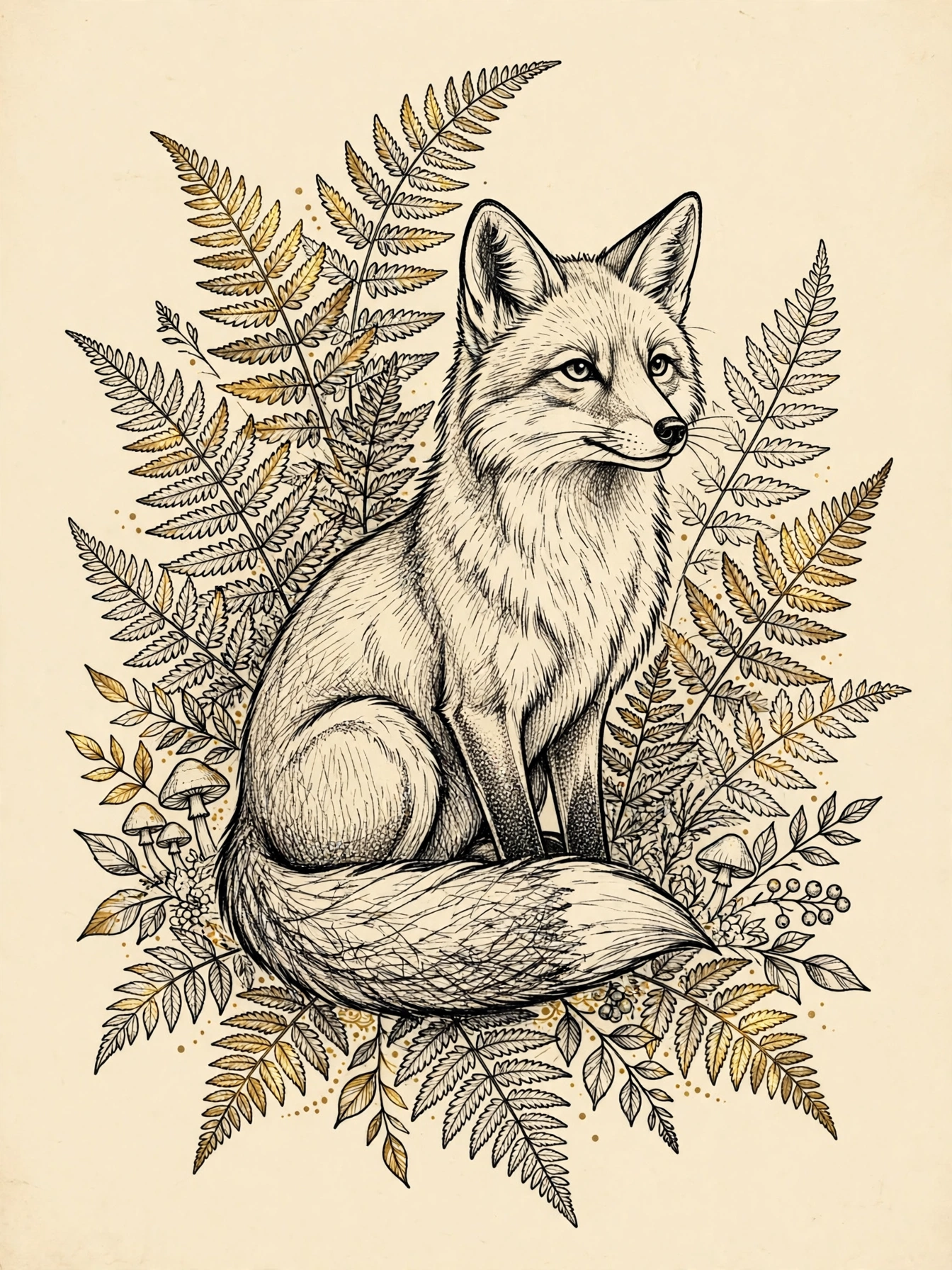
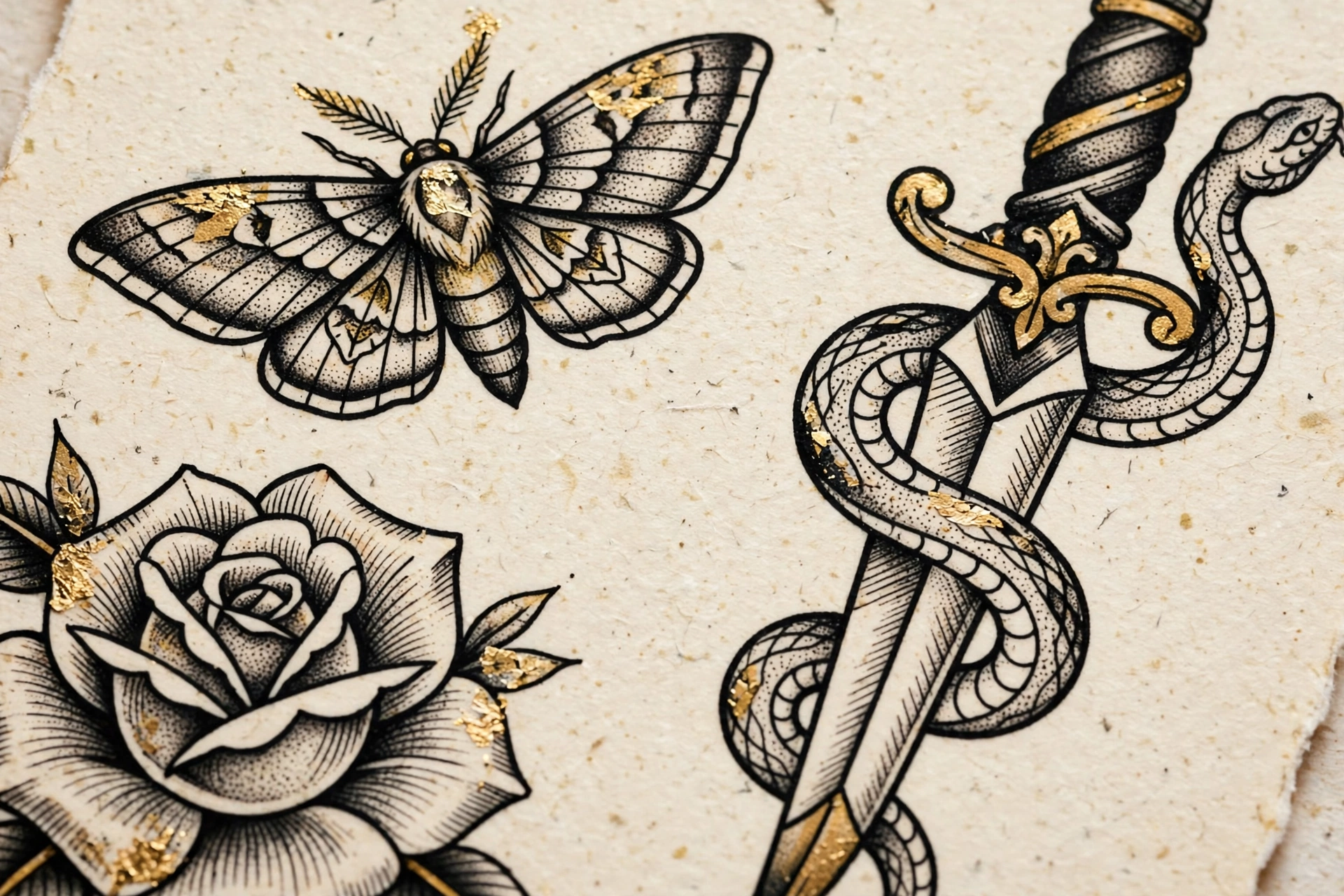
Fox sitting among ferns with hatched fur and a sketch-line tail
Moth with patterned wings built from fine lines and stipple shading
Teapot pouring a stream of small flowers, drawn like a storybook plate
Lighthouse on rocks with cross-hatched waves and a loose sketch sky
Pet portrait redrawn in illustrative style with visible fur strokes
Owl on a branch with engraved-style feather hatching and a round moon
Still life of a pocket watch, key and rose in pen-and-ink style
Bee and lavender sprig with directional hatching, in soft colour strokes
See also: Tattoo Style Finder Quiz · Tattoo Cost Estimator · All Tattoo Styles.
The generator reads your birth date, your intention and your style, so the design it makes is yours, not a copy of someone else's.
Size (Tiny to Extra Large) and style in, cost range out. Ranges are estimates — an artist quote wins. A 20% tip is shown separately.
All 23 placements from our placement guides — pick a spot, optionally compare a second one, and see its pain range, healing time, fading and size guidance, quoted from the same guide data, with a link to the full placement guide. Ranges only — sources disagree, no single decimal is a fact.
Two sun signs in, an honest reading out — no invented percentages. The tool compares the two signs' elements and ruling planets, tells you where the pairing clicks and where it rubs, and turns it into a matching-tattoo idea with links to both sign guides.
Your Sun, Moon and Rising signs from your birth date and time — all three computed in your browser, with the Moon and Rising honestly labelled approximate. Each sign comes with a short traditional reading and a tattoo angle, plus links to its sign guide and to the wheel and fusion tools.
See the full list on the Tattoo Styles main page.
Gothic tattoos explained — cathedral arches, dark ornament and medieval letterforms. How the style ages, the placements that suit it, and design ideas to take to your artist.
Japanese (Irezumi) tattoos explained — dragons, koi, waves and wind bars in the irezumi tradition. How the style ages, the placements that suit it, and design ideas to take to your artist.
Geometric tattoos explained — circles, grids and exact symmetry. How the style ages, the placements that suit it, and design ideas to take to your artist.
Lettering & Script tattoos explained — words as the design — scripts, serif and handstyles. How the style ages, the placements that suit it, and design ideas to take to your artist.
Realism imitates a photograph, hiding its technique in smooth shading. Illustrative work imitates a drawing, showing its technique proudly: visible outlines, hatching and sketch lines. If you want the image to look hand-drawn, like a book plate or storybook picture, you want illustrative.
Almost any subject can be redrawn illustratively, including photographs of pets, places and objects. The artist translates it into outline and hatching made for skin, which usually means simplifying fine detail and strengthening the main shapes. Expect a redraw, not a direct copy, and the tattoo will be better for it.
No. Black and grey is the classic form and ages the most forgivingly. Colour illustrative work uses visible, textured strokes rather than smooth blends, like coloured pencil or watercolour in a book. Both are true to the style; choose by the drawings you love most.
Medium suits most subjects, because the hatching and inner detail need room to stay separate as the ink settles. Simple subjects with bold outlines can go smaller if the fine shading is reduced. Your artist will usually show you the smallest size at which the drawing still works honestly.
The lightest sketch lines soften first, as fine lines do everywhere. A well-built illustrative piece carries its image in its main outlines, so the design simplifies gracefully rather than disappearing. If a favourite detail fades too far over the years, it can usually be refreshed in a short touch-up.
AI designs are for inspiration only. Always consult a licensed tattoo artist. Astrology on this site is for inspiration and self-expression. This page does not provide medical advice. Last reviewed: 25 November 2026.