Tattoo Cost Estimator
Size (Tiny to Extra Large) and style in, cost range out. Ranges are estimates — an artist quote wins. A 20% tip is shown separately.
Gothic Tattoos · Tattoo Styles
Gothic tattoos explained — cathedral arches, dark ornament and medieval letterforms. How the style ages, the placements that suit it, and design ideas to take to your artist.
Gothic tattoos draw on medieval architecture and ornament: pointed cathedral arches, rose windows, tracery, gargoyles and blackletter forms, rendered in black ink with fine detail and deep shadow. The mood is dark and romantic rather than frightening, celebrating craftsmanship, history and beautiful, intricate stone made wearable in ink.
This page sits under Tattoo Styles.
Key takeaways
| What | What to expect |
|---|---|
| Line | Fine tracery lines anchored by bold arch outlines and solid blacks |
| Colour | Overwhelmingly black and grey; occasional deep red or muted jewel accent |
| Aging | Bold arches hold; fine tracery and pale grey shading soften and merge first |
| Best placements | Back, chest, sternum, upper arm and forearm, where detail has room |
Gothic tattoos are defined by the visual language of medieval Gothic architecture and lettering: pointed arches, rose windows, stone tracery, lancet windows, gargoyles and ornate blackletter forms. Rendered mostly in black and grey with strong contrast, the style treats cathedrals, manuscripts and graveyard ornament as a design library of beautiful, intricate shapes.
The architecture does the heavy lifting. A single pointed arch can frame any subject, a saint-like figure, a rose, a moon, a beloved animal, and instantly give it the gothic character, while tracery, the delicate stone patterning inside windows, supplies the fine detail the style is loved for. Rose windows become mandala-like centrepieces, and gargoyles, chandeliers, candelabra, bats, ravens and thorny vines fill out the darker, romantic side of the vocabulary.
Lettering belongs here too. Blackletter, the dense, angular script of medieval manuscripts, is used for single words, initials and short phrases, its thick vertical strokes and diamond details echoing the architecture. Handled respectfully, gothic work borrows the beauty of these historic forms, arches, windows and scripts, as ornament and atmosphere. It is about craft and mood, not about mocking the faith those buildings were raised for, and good artists keep that line comfortably.
Gothic tattoos age in two layers. The bold structure, arch outlines, solid blacks and strong silhouettes, holds up very well over the years. The fine layer, tracery lines, tiny window details and pale grey shading, softens and can merge if it was tattooed too small or too close together, so scale is this style's best protection.
Tracery is the vulnerable element. On a real cathedral it is carved stone; on skin it is a set of fine lines with narrow gaps of bare skin between them, and those gaps narrow as ink settles and spreads. A rose window that was exquisite at palm size may read as a grey medallion years later, while the same window across the upper back keeps its pattern clearly because every line had room.
Pale grey wash shading, often used for stone and shadow effects, lightens faster than solid black, so the deepest shadows should be carried by genuinely dark tones rather than mid greys. If you love the intricate end of this style, commit to the size it needs, keep the finest details for the flattest skin, and let your artist simplify any element that would be smaller than a fingernail. A touch-up can re-darken shading, but merged tracery cannot be un-merged.
Gothic tattoos want placements with presence and room: the back for a full cathedral window, the chest and sternum for a centred arch or chandelier design, and the upper arm and forearm for framed scenes and blackletter words. Symmetry suits the style, so the body's midline placements flatter it most.
The back is the natural home of the big architectural piece: a rose window between the shoulder blades or a tall lancet arch running down the spine uses the body's own symmetry exactly as a cathedral facade does. The sternum carries the popular chandelier and under-breast ornamental designs, where tracery and hanging dot chains follow the body's centre, though this area is tender and the skin moves, so sizing and spacing need an experienced hand.
Forearms suit vertical compositions beautifully: a narrow arch framing a figure, a candle or a rose reads like a window you carry with you, and a blackletter word runs the length of the arm with real presence. Upper arms and thighs give roomier canvases for gargoyles, ravens and thorny scenes. Keep the finest tracery off hands, fingers and feet, where fine lines wear fastest, and reserve those areas, if you use them at all, for bold simple motifs such as a small solid bat or cross-shaped ornament.
Gothic sittings combine fine detail work with areas of solid black and soft shading, so the sensation varies through a piece: outlining is steady, packing black is more intense, and long detail sessions are tiring. Sternum, spine and ribs are the tender placements; the outer arm, back and thigh are kinder for large work.
Frame cost by this site's size bands. A Tiny piece in the $50 to $250 band usually takes 30 minutes to 1 hour, a Small piece in the $50 to $500 band takes 1 to 3 hours, a Medium piece in the $200 to $1000 band takes 2 to 5 hours, a Large piece in the $500 to $2000 band takes 4 to 8 hours, and an Extra Large piece in the $500 to $2000 band takes 4 to 8 hours or more. Most shops set a minimum, usually $80 to $150.
Detail is the multiplier in this style. A tracery-heavy window or a large blackletter piece takes considerably longer than a bold design of the same dimensions, so expect intricate gothic work toward the upper end of its band, and large back or chest pieces to be planned over several sittings. Ask your artist to stage the work, structure first, detail second, so each session heals fully and the fine lines are added to settled skin.
Classic gothic ideas start from the architecture: a pointed arch framing a rose or a moon, a rose window as a centrepiece, a gargoyle in profile, or a single blackletter word with ornamental flourishes. Choose one architectural element as the anchor, then add at most one or two supporting motifs so the piece stays composed, not crowded.
Framed scenes are the most versatile route. Almost any subject gains gothic character inside a lancet arch with simple tracery above it: a raven on a branch, a lit candle, a moth, a sleeping cat, a bunch of dark roses. The frame supplies the style, so the subject inside can stay personal and even gentle. Rose windows work alone as medallions on the back, chest or thigh, and pair naturally with dotwork shading in the stonework.
For lettering, pick a word or short phrase that deserves the weight blackletter gives it, and have the letterforms drawn for you rather than lifted from a font image, because tattooed blackletter needs its counters and gaps opened up for skin. Whatever you choose, view the sketch at final size and check the smallest tracery gap: if you cannot clearly see skin between the fine lines at arm's length, the design needs to grow or simplify before it is tattooed.
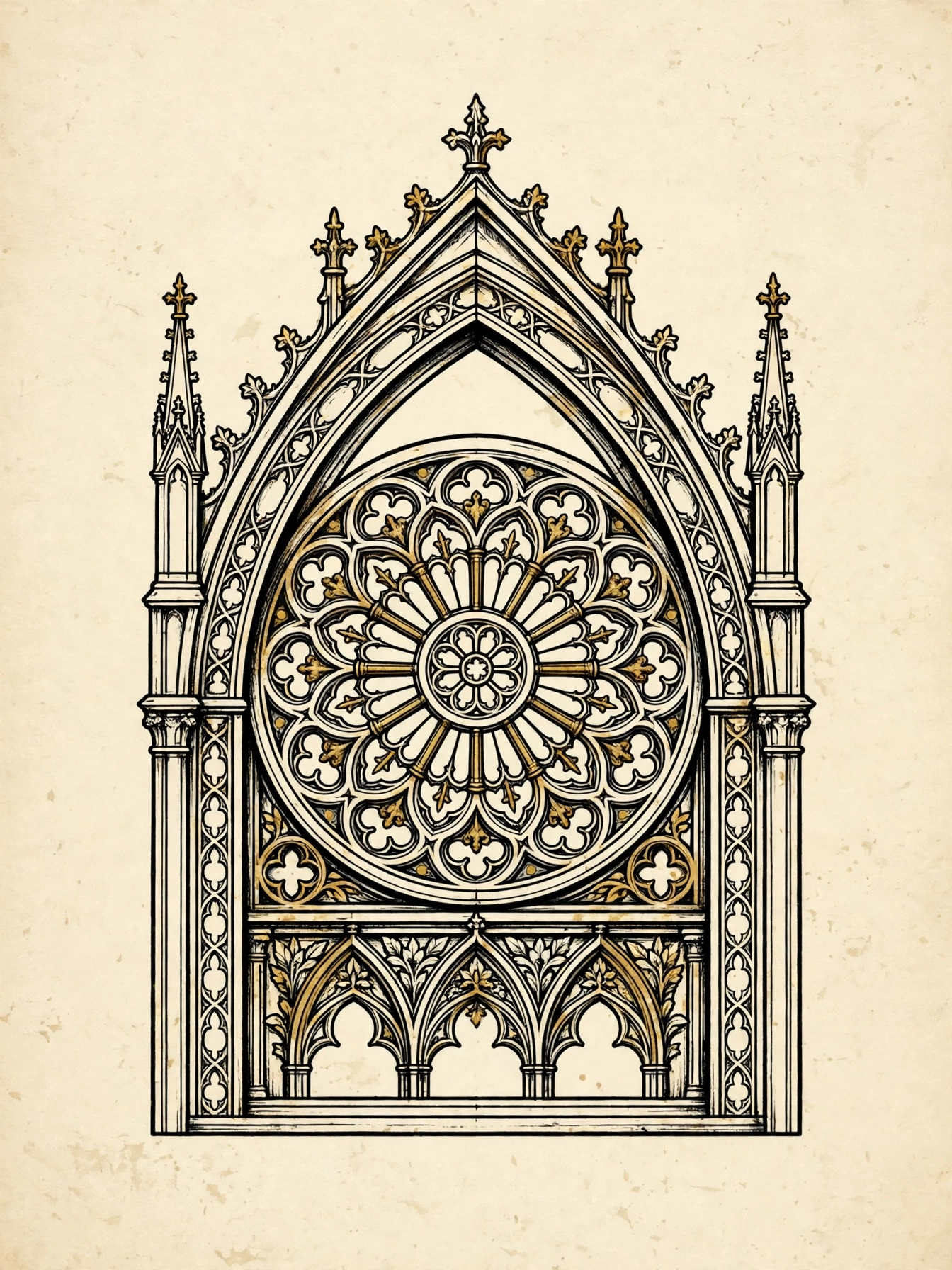
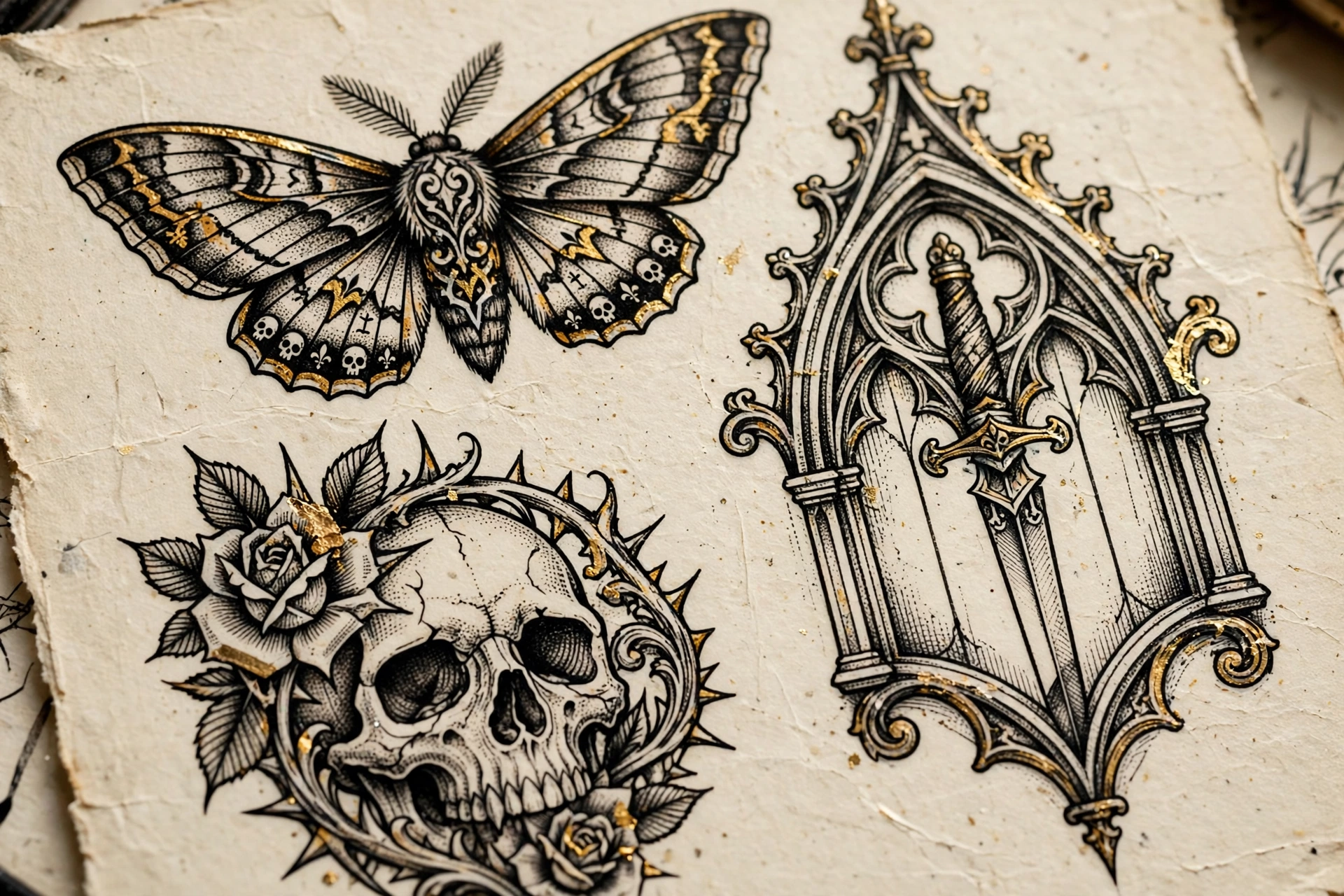
Pointed cathedral arch framing a dark rose and crescent moon
Rose window medallion with dotwork stone shading between the shoulder blades
Gargoyle in profile perched on a tracery ledge, upper arm piece
Single blackletter word with ornamental flourishes down the forearm
Chandelier sternum design with hanging dot chains and a central arch
Raven perched on a thorny branch inside a tall lancet window frame
Pair of lit candelabra with fine tracery panels on either side
Bat with spread wings above a small rose window on the thigh
See also: Tattoo Style Finder Quiz · Tattoo Cost Estimator · All Tattoo Styles.
The generator reads your birth date, your intention and your style, so the design it makes is yours, not a copy of someone else's.
Size (Tiny to Extra Large) and style in, cost range out. Ranges are estimates — an artist quote wins. A 20% tip is shown separately.
All 23 placements from our placement guides — pick a spot, optionally compare a second one, and see its pain range, healing time, fading and size guidance, quoted from the same guide data, with a link to the full placement guide. Ranges only — sources disagree, no single decimal is a fact.
Two sun signs in, an honest reading out — no invented percentages. The tool compares the two signs' elements and ruling planets, tells you where the pairing clicks and where it rubs, and turns it into a matching-tattoo idea with links to both sign guides.
Your Sun, Moon and Rising signs from your birth date and time — all three computed in your browser, with the Moon and Rising honestly labelled approximate. Each sign comes with a short traditional reading and a tattoo angle, plus links to its sign guide and to the wheel and fusion tools.
See the full list on the Tattoo Styles main page.
Geometric tattoos explained — circles, grids and exact symmetry. How the style ages, the placements that suit it, and design ideas to take to your artist.
Illustrative tattoos explained — drawn like a book illustration, with visible sketch lines. How the style ages, the placements that suit it, and design ideas to take to your artist.
Fine Line tattoos explained — single-needle hairlines and delicate detail. How the style ages, the placements that suit it, and design ideas to take to your artist.
Japanese (Irezumi) tattoos explained — dragons, koi, waves and wind bars in the irezumi tradition. How the style ages, the placements that suit it, and design ideas to take to your artist.
Not necessarily. The style borrows the architecture, ornament and letterforms of the medieval period, arches, windows, tracery and blackletter script, as a design language. Some wearers do choose faith-related subjects, and many choose purely decorative or romantic ones. A good artist treats the source material with respect either way.
Bold simple motifs can be small, but anything with tracery, rose window detail or fine lettering needs medium size or larger so the fine lines keep their gaps as the ink settles. If your artist suggests scaling an intricate design up, it is to protect the detail you are paying for.
Short words and initials suit blackletter best, because the letterforms are dense and decorative. Long phrases become hard to read and very wide. Have the lettering custom drawn with opened-up spacing for skin, and check a printed proof at final size before committing.
They are overwhelmingly black and grey, which suits the stone and shadow subject matter and ages best. A restrained accent, a deep red rose or a muted jewel tone in a window, can work beautifully. Bright full colour moves the piece toward a different style altogether.
A single framed motif is a kind first piece: an arch framing a rose, moon or raven on the forearm or upper arm. It gives you the style's character at a manageable size and sitting, and it can be expanded later with tracery or companion pieces if you want more.
AI designs are for inspiration only. Always consult a licensed tattoo artist. Astrology on this site is for inspiration and self-expression. This page does not provide medical advice. Last reviewed: 25 November 2026.