Tattoo Cost Estimator
Size (Tiny to Extra Large) and style in, cost range out. Ranges are estimates — an artist quote wins. A 20% tip is shown separately.
Japanese (Irezumi) Tattoos · Tattoo Styles
Japanese (Irezumi) tattoos explained — dragons, koi, waves and wind bars in the irezumi tradition. How the style ages, the placements that suit it, and design ideas to take to your artist.
Japanese tattooing, known as irezumi, is a centuries-old tradition built on bold outlines, rich colour and motifs that flow across large areas of the body as one connected composition. It is a serious, long-term commitment, best done by an artist trained in the tradition who understands what each motif means.
This page sits under Tattoo Styles.
Key takeaways
| What | What to expect |
|---|---|
| Line | Bold, confident black outlines that hold the whole composition together |
| Colour | Rich, saturated traditional palette — reds, greens, blues and gold over black and grey background |
| Aging | Ages very well thanks to bold line and strong contrast; colour may soften and need refreshing over the years |
| Best placements | Back, full or half sleeve, chest and thigh — large, connected areas of the body |
Irezumi is defined by scale and unity: one main motif, such as a dragon or koi, supported by background elements like waves, wind bars and clouds that tie the whole piece together. Bold outlines, flat areas of strong colour and flowing composition that follows the body's shape are its unmistakable signatures.
Traditional Japanese tattooing treats the body as a single canvas. A back piece or sleeve is planned as one picture, with the main figure placed where the body is widest and background elements filling every gap so no skin sits empty by accident. Waves, wind and cloud patterns are not decoration for its own sake; they create movement and connect separate sessions into one finished work.
The motifs themselves come from folklore, nature and seasonal imagery, and each carries meaning. Koi are linked with perseverance and strength, dragons with wisdom and protection, cherry blossom with the shortness of life, peonies with prosperity and bravery, and tigers with courage. Choosing a motif without knowing its story misses the point of the tradition, so a good artist will talk through meaning before drawing anything.
Japanese tattoos age better than most styles because the work is built on thick outlines, deep contrast and colour laid in solidly rather than washed thin. Over the years the colours soften and lines spread slightly, but the design stays readable from across a room, which is exactly what it was designed to do.
The honest trade-off is maintenance, not survival. Reds and lighter tones can fade faster than the black work, especially on skin that sees a lot of sun, and a large piece may benefit from a colour refresh after many years. Because the outlines are bold, that refresh is straightforward: the structure of the tattoo is still there underneath.
What does not age well is a Japanese-style piece done too small. The background patterns and fine details inside scales, petals and waves need room; squeezed into a small area they blur together and the piece loses the clarity that makes the style work. Scale is not vanity in irezumi, it is what keeps the tattoo legible for decades.
The back is the classic canvas, offering the largest flat area for a full composition, followed by the full sleeve, chest panels and thighs. Irezumi is designed around connected coverage, so placements that let one piece flow into the next, like a sleeve meeting a chest panel, suit the tradition best.
A full back piece lets a dragon, phoenix or pair of koi move across the body with waves and blossom filling the space around them. Sleeves work the same way on a smaller scale: one main motif travelling down the arm, background tying it together from shoulder to wrist. Thighs are a good choice for people who want a substantial piece that stays covered at work.
Small, isolated placements fight against the style. A single tiny koi on an ankle can be a nod to the imagery, but it is not irezumi in the traditional sense, and an honest artist will say so. If your heart is set on the tradition, plan for the coverage it asks for, even if you build it in stages over several years.
Cost follows size and time: Japanese work is usually Large to Extra Large in the site's size bands, at $500–$2000 per band, and most full pieces need several sessions, so the total is the sum of many sittings rather than one payment. Pain varies by area, with ribs and inner arm sharper than back or outer arm.
Budget honestly before you start. A half sleeve might sit across the Large band, while a full back will run through the Extra Large band repeatedly, session after session. Leaving a large piece unfinished for years because the money ran out is the most common regret with this style, so agree the full plan and a realistic payment rhythm with your artist first.
Pain is manageable for most people on the back, shoulders and outer arms, and harder over the ribs, spine and inner arm. Sessions are long, so eat well, rest, and do not book marathon sittings back to back. An experienced artist will pace the work so each area heals properly before the next session builds on it.
The strongest Japanese designs pair one clear main motif with the background that belongs to it: koi with waves, a dragon among clouds, a tiger through bamboo. The ideas below follow that traditional structure, and each one can be scaled from a half sleeve to a full back piece with the same composition.
Start by choosing the creature or flower that means something to you, then let the background do its job. Water suits koi and dragons, wind bars suit fast-moving subjects, and seasonal flowers anchor the piece to a time of year. Your artist will adjust the flow so the design follows your muscles rather than sitting on top of them like a sticker.
Above all, find an artist trained in this tradition, or one whose healed portfolio shows they understand its rules. Irezumi has conventions for a reason, from which motifs belong together to how a dragon should be drawn, and an artist who respects them will give you a piece that honours the source instead of copying its surface.

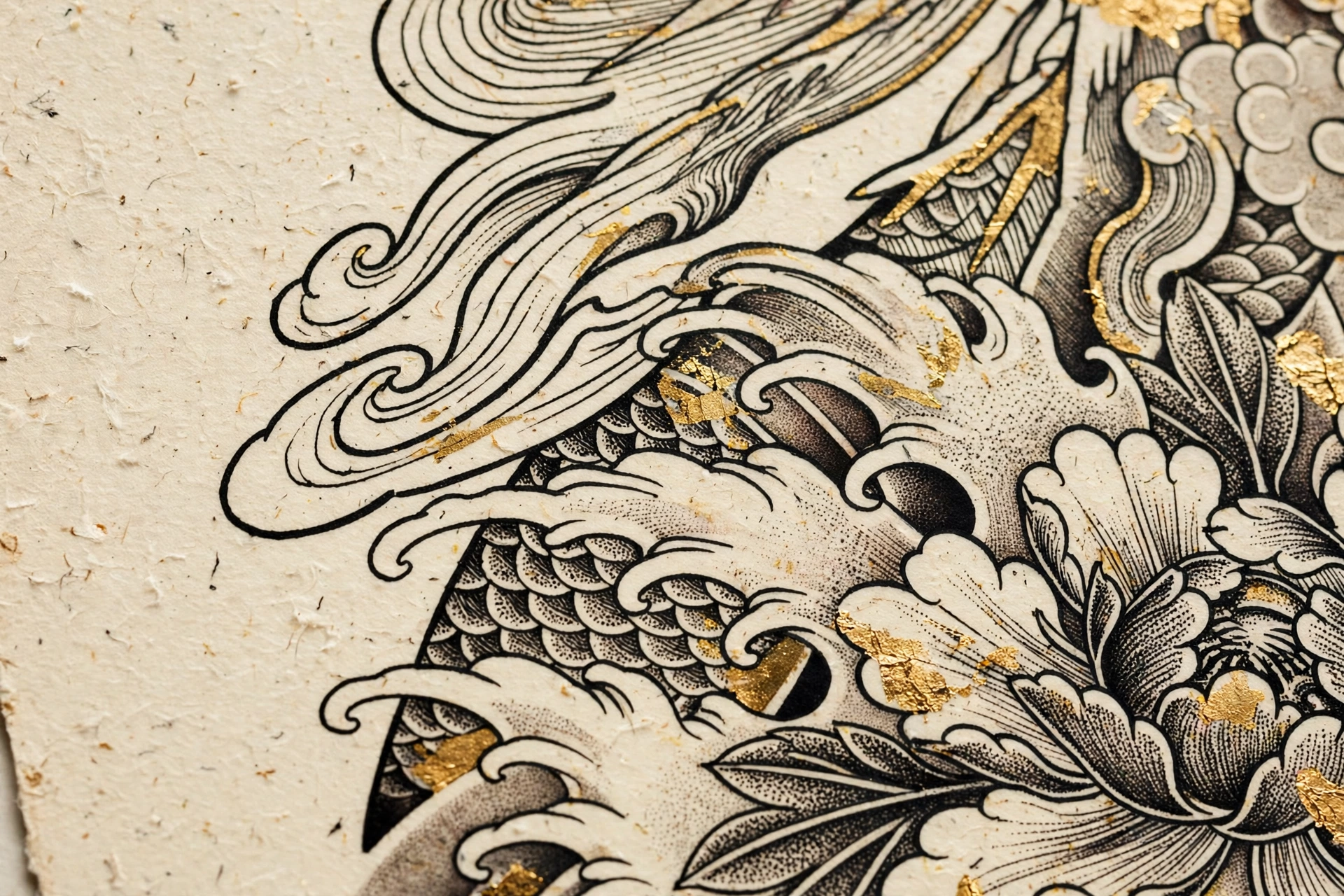
Koi swimming upstream through stylised waves on a forearm or half sleeve, with maple leaves scattered on the water
Dragon coiled among clouds across a full back, claws open, with cherry blossom drifting through the composition
Tiger moving through bamboo on the thigh, bold stripes against deep green stalks and wind bars
Pair of koi, one dark and one bright, circling on the chest as a balance of effort and rest
Phoenix rising across the shoulder and upper arm, tail feathers flowing into waves below
Peony and snake half sleeve, the flower full and open with the snake woven through the petals
Crane in flight over pine branches on the upper back, wings spread wide with cloud bands behind
Hannya mask framed by cherry blossom and waves as a calf or thigh piece with strong red accents
See also: Tattoo Style Finder Quiz · Tattoo Cost Estimator · All Tattoo Styles.
The generator reads your birth date, your intention and your style, so the design it makes is yours, not a copy of someone else's.
Size (Tiny to Extra Large) and style in, cost range out. Ranges are estimates — an artist quote wins. A 20% tip is shown separately.
All 23 placements from our placement guides — pick a spot, optionally compare a second one, and see its pain range, healing time, fading and size guidance, quoted from the same guide data, with a link to the full placement guide. Ranges only — sources disagree, no single decimal is a fact.
Two sun signs in, an honest reading out — no invented percentages. The tool compares the two signs' elements and ruling planets, tells you where the pairing clicks and where it rubs, and turns it into a matching-tattoo idea with links to both sign guides.
Your Sun, Moon and Rising signs from your birth date and time — all three computed in your browser, with the Moon and Rising honestly labelled approximate. Each sign comes with a short traditional reading and a tattoo angle, plus links to its sign guide and to the wheel and fusion tools.
See the full list on the Tattoo Styles main page.
Illustrative tattoos explained — drawn like a book illustration, with visible sketch lines. How the style ages, the placements that suit it, and design ideas to take to your artist.
Lettering & Script tattoos explained — words as the design — scripts, serif and handstyles. How the style ages, the placements that suit it, and design ideas to take to your artist.
Gothic tattoos explained — cathedral arches, dark ornament and medieval letterforms. How the style ages, the placements that suit it, and design ideas to take to your artist.
Linework tattoos explained — the line itself as the whole design, minimal shading. How the style ages, the placements that suit it, and design ideas to take to your artist.
Irezumi is the Japanese word for tattooing and refers to the traditional style of large, connected body work. A genuine irezumi piece is planned as one composition with a main motif and background, rather than a collection of separate small tattoos gathered over time.
You need an artist trained in the tradition, whatever their background. Look for healed work showing correct motif pairings, flowing backgrounds and confident composition. An artist who only copies single images from the internet will usually miss the structure that makes the style hold together.
Koi are traditionally linked with perseverance, strength and determination, especially when shown swimming upstream. Dragons are associated with wisdom, strength and protection. Meanings vary by context and pairing, so discuss the story you want with your artist before committing to a motif.
A full sleeve is several long sessions spread over months: outline first, then background shading, then colour, with healing time between each stage. The exact number depends on detail and how your skin takes the work, and your artist can map it out after the design is drawn.
Yes, if it is planned that way from the start. Tell your artist the final coverage you want, even if you begin with one section, so the composition leaves room to grow. Adding background later around an unplanned small piece is much harder and rarely looks as unified.
Approaching the tradition with respect is what matters: learn what your motif means, avoid religious imagery used as decoration, and choose an artist who works within the tradition rather than treating it as a costume. Done thoughtfully, irezumi is widely shared and appreciated as an art form.
AI designs are for inspiration only. Always consult a licensed tattoo artist. Astrology on this site is for inspiration and self-expression. This page does not provide medical advice. Last reviewed: 25 November 2026.