Tattoo Cost Estimator
Size (Tiny to Extra Large) and style in, cost range out. Ranges are estimates — an artist quote wins. A 20% tip is shown separately.
Minimalist Tattoos · Tattoo Styles
Minimalist tattoos explained — the fewest lines that still say it. How the style ages, the placements that suit it, and design ideas to take to your artist.
A minimalist tattoo says the most with the least: a mountain range in three lines, a face in one curve, a whole memory in a single small symbol. Nothing is there by accident, and nothing can be removed without losing the meaning — that discipline is what makes the style so enduring.
This page sits under Tattoo Styles.
Key takeaways
| What | What to expect |
|---|---|
| Line | Very few, deliberately placed lines — often fine to medium weight, never crowded |
| Colour | Usually black only; a single restrained colour accent appears in some designs |
| Aging | Simple open shapes age gracefully; lines thicken slightly, so tight tiny details are best avoided |
| Best placements | Wrist, inner arm, ankle, collarbone and behind the ear for small pieces; back and ribs for larger quiet designs |
Minimalist tattoos are defined by reduction: the subject is stripped back to the fewest lines that still express it, with no shading, no background and no decoration. The empty skin around the design is part of the artwork, giving each small mark room to breathe and be understood instantly.
The discipline is harder than it looks. When a design has only five lines, each one has to be in exactly the right place, at the right weight, saying exactly the right thing. A minimalist mountain is not a lazy mountain — it is a mountain with everything unnecessary removed, and getting there takes more drawing judgement than adding detail does.
Minimalism is not the same as small, although the two often travel together. A minimalist design can be large: a single sweeping line down a spine, or one bold circle on a back. What defines it is the restraint, not the dimensions, and that restraint is why the style sits comfortably alongside any other tattoos you may add later.
Minimalist tattoos age gracefully when they are kept open and simple, because there is little detail to lose. The honest catch is that every line spreads slightly over the years, so designs drawn extremely fine, or with lines placed very close together, can soften into each other and lose their clean separation.
The safest minimalist work uses a line weight with some substance — not bold, but not a whisper either — and keeps generous space between lines. A tiny symbol with two lines a hair apart may look perfect when fresh and muddy later; the same symbol slightly larger, with open space inside it, will read clearly for decades.
Because there is so little ink, fading shows honestly too. A minimalist piece that has gone grey with sun exposure looks tired faster than a dense tattoo does. The fix is simple: protect it from the sun once healed, and know that a single short touch-up session can restore the original darkness completely, since there is so little line to rework.
Small minimalist pieces suit the wrist, inner arm, ankle, collarbone and the area behind the ear, where a quiet design can sit without competing with anything. Larger minimalist work belongs on the back, ribs or thigh, where one simple shape or line can use a big calm canvas without feeling empty.
Placement and design should be chosen together. A horizontal line of mountains wants a horizontal home like the forearm or collarbone; a vertical sprig wants the spine, the side of the ankle or the inner arm. Following the body's natural lines is what makes a simple design look intentional rather than randomly placed.
Consider visibility honestly. Minimalist tattoos are popular first tattoos partly because they can be discreet, but a design hidden completely away is also one you rarely enjoy. Many people settle on a spot they can see themselves — the inner wrist or forearm — in a size that feels personal rather than performative.
Most minimalist tattoos fall in the Tiny band at $50–250 or Small at $50–500, and the shop minimum, usually $80–$150, is what a very small piece will actually cost. Sessions are short and, on comfortable placements like the arm, among the least painful tattoo experiences going.
A simple minimalist piece can be finished in well under an hour once the stencil is placed — and placing the stencil deserves most of that time. With so few lines, a design sitting two millimetres off-centre is obvious, so a careful artist will position, check in the mirror, and reposition without rushing. That patience is part of what you are paying for.
Larger minimalist work prices by its size band like anything else: a big single-line back piece is a Medium or Large tattoo at $200–1000 or $500–2000, even though the ink coverage is light, because the drawing and placement take real time. Pain stays modest for the style almost everywhere, rising only over bone-thin areas like ribs, spine and ankles.
Great minimalist ideas come from subjects with one unmistakable gesture: the curve of a wave, the ridge of a mountain, the outline of an animal mid-movement. The eight ideas below each reduce a familiar subject to its essential lines, leaving designs that stay clear, personal and easy to live with.
A useful test before you commit: sketch the idea as simply as you can, then try removing one more line. If it still reads, remove another. The version just before it stops making sense is your tattoo. That process is exactly how minimalist artists work, and doing it with them at the consultation leads to a design that feels inevitable.
Personal meaning hides well in this style. A skyline reduced to the three buildings that matter, a pet reduced to the outline of its ears, a shared place reduced to one ridge line — nobody else needs to decode it. Minimalist tattoos are often the most private kind of storytelling on skin.
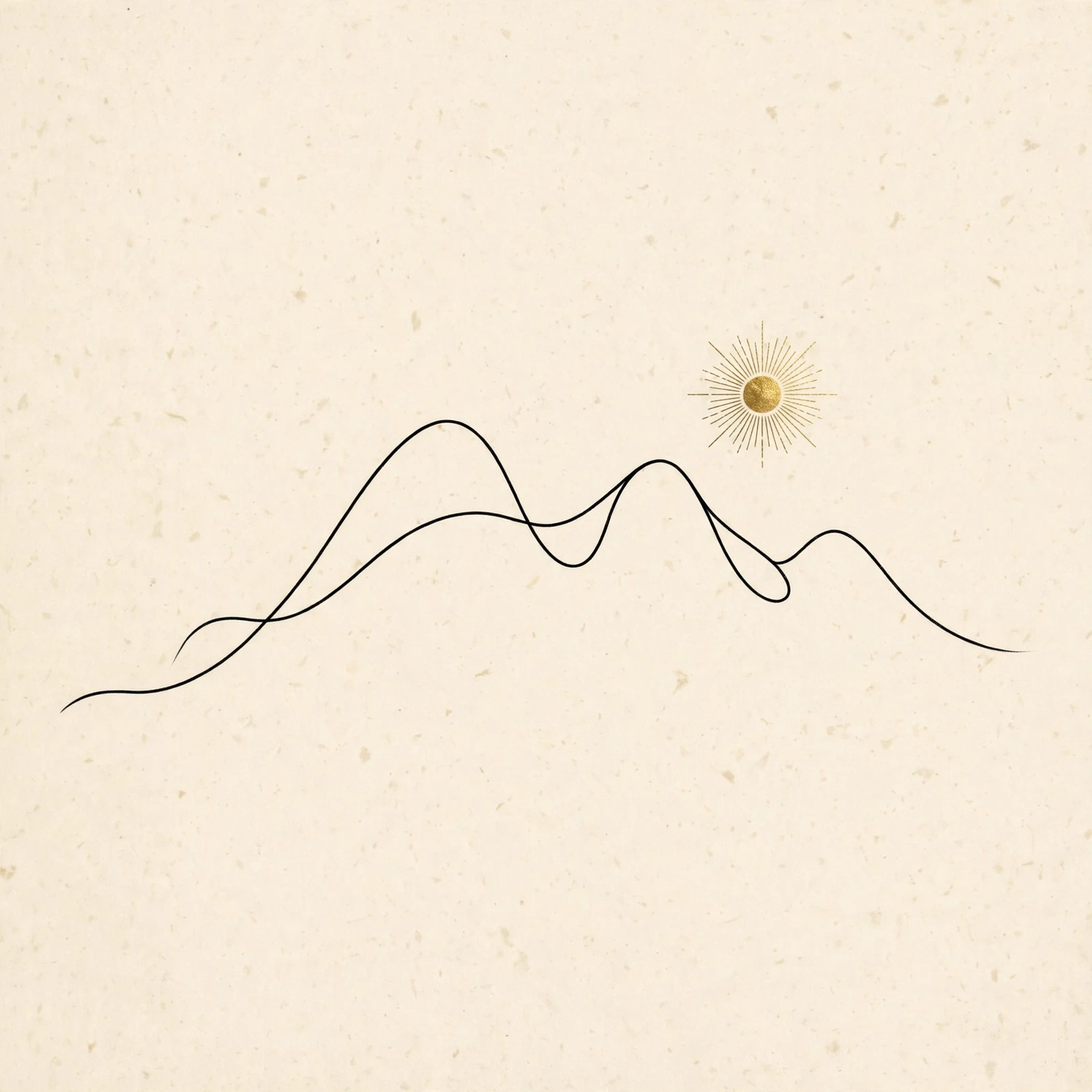
Mountain ridge drawn as one unbroken line with a small circle sun above it, on the inner forearm
Single continuous line forming two faces in profile, placed on the upper arm
Tiny wave made from one clean curve with a short second line beneath, on the ankle
Outline of a sitting cat reduced to a few curves, behind the ear or on the inner wrist
Small sprig with three leaves on one stem following the collarbone
Pair of simple birds in flight, two curved lines each, across the shoulder blade
One bold open circle with a single dot below it as a quiet statement on the upper back
Heartbeat line that rises into a small heart shape at its centre, on the inner arm
See also: Tattoo Style Finder Quiz · Tattoo Cost Estimator · All Tattoo Styles.
The generator reads your birth date, your intention and your style, so the design it makes is yours, not a copy of someone else's.
Size (Tiny to Extra Large) and style in, cost range out. Ranges are estimates — an artist quote wins. A 20% tip is shown separately.
All 23 placements from our placement guides — pick a spot, optionally compare a second one, and see its pain range, healing time, fading and size guidance, quoted from the same guide data, with a link to the full placement guide. Ranges only — sources disagree, no single decimal is a fact.
Two sun signs in, an honest reading out — no invented percentages. The tool compares the two signs' elements and ruling planets, tells you where the pairing clicks and where it rubs, and turns it into a matching-tattoo idea with links to both sign guides.
Your Sun, Moon and Rising signs from your birth date and time — all three computed in your browser, with the Moon and Rising honestly labelled approximate. Each sign comes with a short traditional reading and a tattoo angle, plus links to its sign guide and to the wheel and fusion tools.
See the full list on the Tattoo Styles main page.
Micro tattoos explained — tiny, highly detailed pieces at miniature scale. How the style ages, the placements that suit it, and design ideas to take to your artist.
Neo-Traditional tattoos explained — traditional bones with a wider palette and softer shading. How the style ages, the placements that suit it, and design ideas to take to your artist.
Linework tattoos explained — the line itself as the whole design, minimal shading. How the style ages, the placements that suit it, and design ideas to take to your artist.
Ornamental tattoos explained — jewellery-like symmetry, dot chains and lace patterns. How the style ages, the placements that suit it, and design ideas to take to your artist.
It is one of the most popular first choices for good reason: the session is short, the pain is modest, the cost sits at the lower bands, and the design is easy to live with. Choose a line weight with some substance and a placement you can see, and it is a gentle introduction to being tattooed.
It does not fade faster, but fading is more noticeable because there is so little ink — a soft grey line reads as tired sooner than a soft grey patch in a dense tattoo. Sun protection once healed, and a quick touch-up if it lightens, keep it looking deliberate.
Small is fine as long as the design stays open. The limit is set by spacing: lines need enough skin between them to survive the slight spread all ink does over time. Your artist will show you the smallest size at which your specific design keeps its separation — that may be a little larger than the photo you found.
Both are possible. Because the ink is light and open, a minimalist piece is one of the easier tattoos to cover with a larger design later. It can also grow: many people add a second small element nearby over the years, building a quiet collection that still feels like one idea.
A fine-to-medium line is the sweet spot for most people. Hairline-fine work looks delicate when fresh but softens fastest; a slightly stronger line keeps the design's clean geometry for much longer while still looking minimal. Your artist can show you healed examples at different weights to compare.
They can — a single muted colour, like a small rust-red sun or a soft blue wave, keeps the restraint of the style while adding warmth. Black remains the most durable and the most classic choice, and it pairs with any other tattoos you might get later. If you choose colour, one colour only suits the style best.
AI designs are for inspiration only. Always consult a licensed tattoo artist. Astrology on this site is for inspiration and self-expression. This page does not provide medical advice. Last reviewed: 25 November 2026.