Tattoo Cost Estimator
Size (Tiny to Extra Large) and style in, cost range out. Ranges are estimates — an artist quote wins. A 20% tip is shown separately.
Ornamental Tattoos · Tattoo Styles
Ornamental tattoos explained — jewellery-like symmetry, dot chains and lace patterns. How the style ages, the placements that suit it, and design ideas to take to your artist.
An ornamental tattoo is jewellery drawn in ink: symmetrical patterns, dot chains, lace-like filigree and small gem details arranged to follow the body's own lines. It depicts nothing and decorates everything, turning a sternum, a spine or a hand into something that looks intentionally adorned.
This page sits under Tattoo Styles.
Key takeaways
| What | What to expect |
|---|---|
| Line | Fine to medium lines in mirrored patterns, with dot chains and small repeated motifs |
| Colour | Almost always black and grey; the jewellery effect comes from pattern, not colour |
| Aging | Bold elements hold well; the finest dots and tightest lace details soften first and may need refreshing |
| Best placements | Sternum, spine, collarbones, hands, feet and the centre of the back — anywhere symmetry can be shown off |
Ornamental tattoos are defined by decoration rather than subject: mirrored patterns, dot chains, mandala elements, lace-like filigree and tiny gem or bead details composed to flatter a specific part of the body. The design has no picture to read — its beauty is in the pattern and its placement.
The style draws on jewellery, henna patterns, lace and architectural ornament. A sternum piece might centre on a lotus or crescent, with chains of dots draping outward like a necklace. A spine piece stacks small motifs down the centre line of the back. In every case the artist is designing for your anatomy, measuring the pattern against your body's centre so the symmetry lands exactly where it should.
Technique mixes fine line work with dotwork: dots build the chains and soft shading, lines carry the structure, and small solid elements — a black gem shape, a filled petal — give the pattern its contrast. Because the elements are small and repeated, precision is everything; a dot chain that wanders is visible immediately.
Ornamental tattoos age in layers: the stronger lines and solid details hold their shape for years, while the finest dots and the tightest lace-like sections soften first as ink spreads slightly. Designs that mix bold anchors with delicate detail age best, because the structure survives even as the finest touches relax.
The honest risk in this style is crowding. Lace patterns drawn with lines very close together can merge into a grey patch over time, and dot chains placed too tightly become a dotted smudge rather than separate beads. A skilled ornamental artist spaces elements with ageing in mind, even when a tighter version looks more impressive in a fresh photograph.
Symmetry also deserves a thought: bodies change, and a design centred on the sternum or spine will move with your body rather than against it, which is why centre-line placements age more gracefully than patterns wrapped around joints. If a delicate area does soften, dotwork and fine lines are straightforward to refresh in a short touch-up session.
The sternum is the signature placement, where a symmetrical design drapes like jewellery, followed by the spine, the centre of the upper back, collarbones and the backs of the hands and feet. Ornamental work belongs anywhere the body offers a natural centre line or a curve the pattern can follow.
Under-breast and sternum pieces are designed around the body's shape, flowing outward from a central motif and following the ribcage's curve — they are private, elegant and made to be revealed on your terms. Spine pieces run from the neck downward in a column of motifs and suit people who want a design that appears when hair is up or a back is bare.
Hands and feet make beautiful ornamental canvases, echoing henna traditions, but they come with a warning: skin there wears and renews quickly, so fine detail fades faster and touch-ups are likely. Many people enjoy hand ornament anyway, eyes open. For a first ornamental piece, the sternum, back or collarbone area gives the same effect with far less maintenance.
Ornamental pieces are usually Small at $50–500 or Medium at $200–1000 depending on coverage, with delicate hand or foot pieces sometimes priced from the shop minimum, usually $80–$150, upward. Pain follows the placement: sternum and spine work over bone feels sharp, while back and collarbone areas are more moderate.
The price reflects time and precision rather than ink. Hundreds of individually placed dots and a stencil that must be centred perfectly take longer than the coverage suggests, and large symmetrical back or sternum pieces can run into the Large band at $500–$2000. Ask your artist to quote the complete design, including the careful placement time, so there are no surprises.
For comfort, plan honestly around the tender placements. The centre of the sternum, directly over the spine and the tops of the feet are spicy areas for most people, though the fine needles used for dot chains are often described as gentler than heavy shading. Sessions for smaller pieces are short; a big symmetrical back piece is better split so the stencil work on each section stays exact.
The best ornamental ideas start from the placement and let the pattern grow from it: a central motif, mirrored sides, and chains or lace that follow the body's curve. The eight ideas below cover the style's favourite canvases, each built with bold anchors so the design keeps its structure as the fine detail matures.
Bring your artist reference for pattern language — the kind of lace, the density of dots, whether you like mandala geometry or flowing filigree — but let them compose the piece on your body. Ornamental work is fitted, not transferred: the same design sits differently on every sternum and spine, and the fitting is most of the artistry.
Think about how the piece will live with your wardrobe and your other tattoos. A sternum ornament pairs naturally with a small collarbone piece later; a spine column can grow downward over the years by adding motifs. Because the style is decorative rather than pictorial, it combines with almost any other style without clashing.
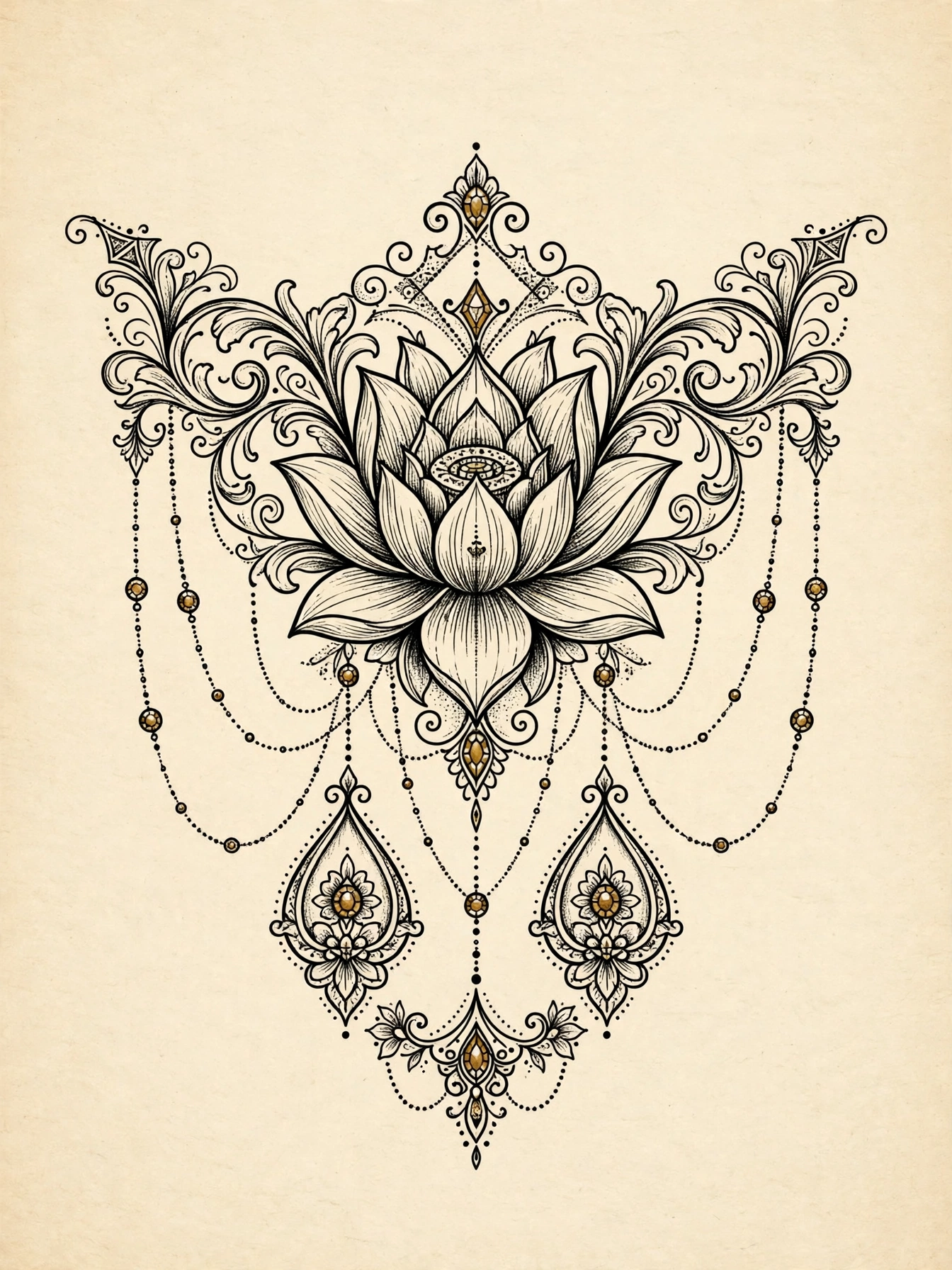
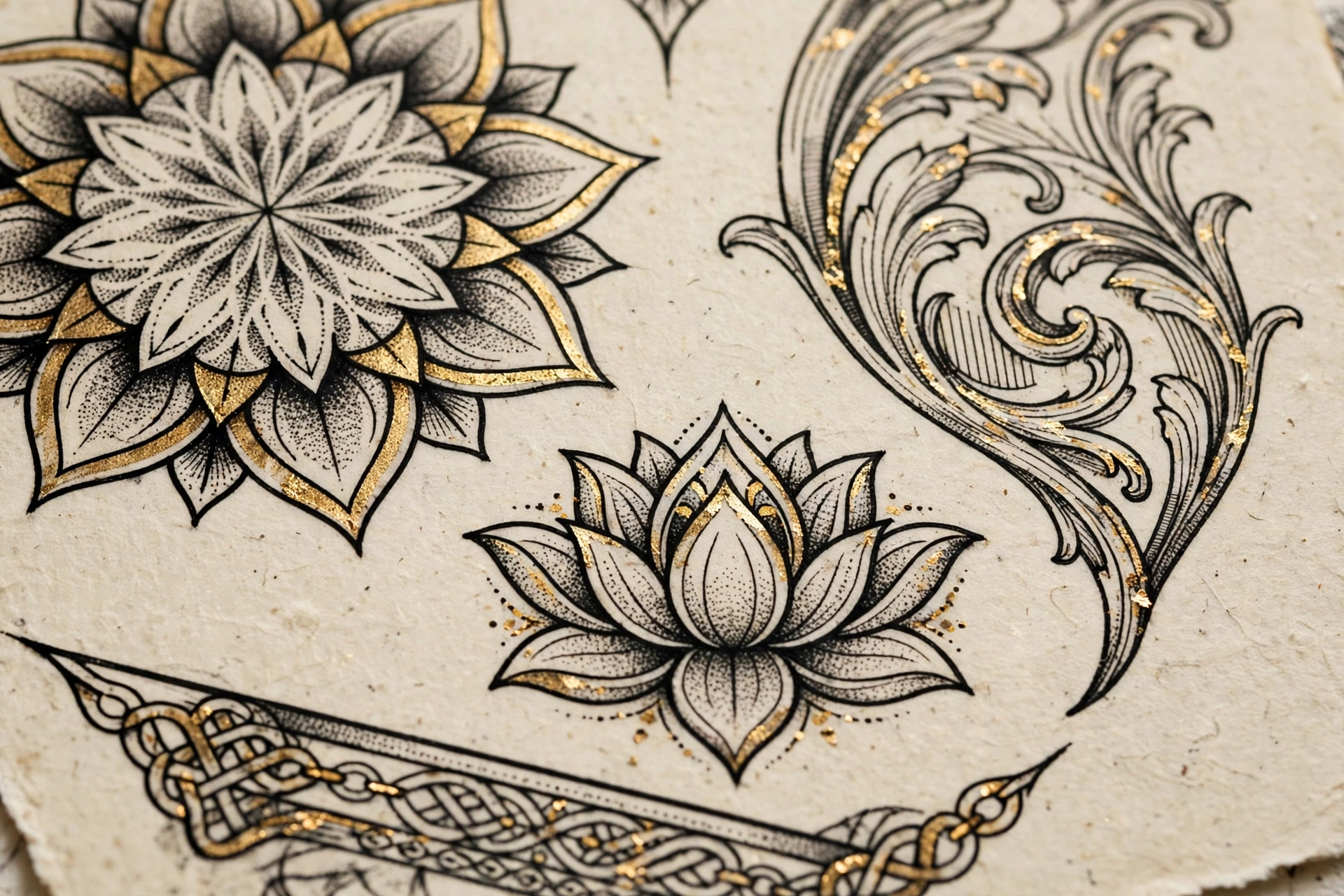
Symmetrical sternum ornament with a central lotus, dot chains draping outward and small gem details at each end
Spine column of stacked motifs — small mandala, crescent and dot drops — running from the neck down the back
Ornamental hand piece with a mandala centre on the back of the hand and fine dot chains trailing toward each finger
Collarbone lace following both bones, meeting at a small central pendant shape in the middle of the chest
Ankle ornament like a permanent anklet: a fine chain of dots and tiny charms circling just above the ankle bone
Central upper-back medallion with radiating filigree and hanging dot drops, designed to sit between the shoulder blades
Ornamental foot piece mirroring a sandal strap, with a small mandala over the centre of the foot
Under-bust filigree arc following the ribcage, centred with a crescent moon and finished with three hanging dot drops
See also: Tattoo Style Finder Quiz · Tattoo Cost Estimator · All Tattoo Styles.
The generator reads your birth date, your intention and your style, so the design it makes is yours, not a copy of someone else's.
Size (Tiny to Extra Large) and style in, cost range out. Ranges are estimates — an artist quote wins. A 20% tip is shown separately.
All 23 placements from our placement guides — pick a spot, optionally compare a second one, and see its pain range, healing time, fading and size guidance, quoted from the same guide data, with a link to the full placement guide. Ranges only — sources disagree, no single decimal is a fact.
Two sun signs in, an honest reading out — no invented percentages. The tool compares the two signs' elements and ruling planets, tells you where the pairing clicks and where it rubs, and turns it into a matching-tattoo idea with links to both sign guides.
Your Sun, Moon and Rising signs from your birth date and time — all three computed in your browser, with the Moon and Rising honestly labelled approximate. Each sign comes with a short traditional reading and a tattoo angle, plus links to its sign guide and to the wheel and fusion tools.
See the full list on the Tattoo Styles main page.
Neo-Traditional tattoos explained — traditional bones with a wider palette and softer shading. How the style ages, the placements that suit it, and design ideas to take to your artist.
Realism tattoos explained — photographic shading, portraits and lifelike texture. How the style ages, the placements that suit it, and design ideas to take to your artist.
Minimalist tattoos explained — the fewest lines that still say it. How the style ages, the placements that suit it, and design ideas to take to your artist.
Sacred Geometry tattoos explained — flower of life, metatron and mathematical pattern. How the style ages, the placements that suit it, and design ideas to take to your artist.
A mandala is one kind of ornamental element — a circular, radiating pattern. Ornamental tattooing is the wider style: it includes mandalas but also dot chains, lace, filigree and jewellery-like draped designs, and it is defined by decorating a body part symmetrically rather than by any single motif.
The structure does, provided it is well spaced. Strong lines and solid details hold for years; the finest dots and tightest lace soften first as ink spreads. Artists who specialise in the style leave ageing room inside the pattern. A short touch-up can refresh softened dot chains later.
The sternum is one of the more sensitive placements because the skin is thin over bone, so expect a sharper sensation, especially at the centre. The fine dotwork sections are usually more comfortable than solid line work. Most sternum pieces are not huge, so the intense part of the session is relatively brief.
Yes — it is one of the style's strengths. Dot chains, lace and framing patterns are often added around an older central piece to refresh it or tie a collection together. Show your artist the existing work and let them design the ornament to fit both the tattoo and your body.
They are the highest-maintenance version of the style. Hand skin takes constant wear and renews quickly, so fine lines and dots fade faster there and touch-ups are likely over the years. Many people still choose them, but a good artist will explain the upkeep plainly before starting.
Look for healed work with true symmetry, evenly spaced dots and clean, consistent chains — and check that their designs sit centred on the body in photos. Ornamental work exposes unevenness immediately, so an artist whose healed patterns stay precise and balanced is the right choice.
AI designs are for inspiration only. Always consult a licensed tattoo artist. Astrology on this site is for inspiration and self-expression. This page does not provide medical advice. Last reviewed: 25 November 2026.