Tattoo Cost Estimator
Size (Tiny to Extra Large) and style in, cost range out. Ranges are estimates — an artist quote wins. A 20% tip is shown separately.
Sacred Geometry Tattoos · Tattoo Styles
Sacred Geometry tattoos explained — flower of life, metatron and mathematical pattern. How the style ages, the placements that suit it, and design ideas to take to your artist.
Sacred geometry tattoos are built from exact, repeating mathematical patterns — overlapping circles, the flower of life, Metatron's cube and precise grids — drawn with fine lines and often finished with dotwork. For many people these shapes carry spiritual associations alongside their beauty. What the style demands above all is precision: symmetry, spacing and a steady, patient artist.
This page sits under Tattoo Styles.
Key takeaways
| What | What to expect |
|---|---|
| Line | Fine, exact lines forming circles, grids and overlapping patterns — precision is the whole point |
| Colour | Usually black, often with dotwork shading; restrained colour appears but line purity leads |
| Aging | Crisp geometry softens slightly over time, so generous spacing and clean line weight help patterns stay legible |
| Best placements | Back, chest, sternum, forearm and calf — broad or symmetrical areas where the pattern can sit flat and centred |
Sacred geometry tattoos are defined by mathematical pattern: overlapping circles, radial symmetry, grids and shapes like the flower of life and Metatron's cube, drawn with fine, exact lines. Many people associate these patterns with balance, creation and the structure of nature, and choose them for that spiritual resonance as much as for how they look.
The flower of life is the pattern most people meet first — a lattice of evenly overlapping circles inside a larger circle, built from one repeated measurement. Metatron's cube starts from a set of circles connected by straight lines, producing a dense, crystalline diagram. Around these sit simpler forms: the seed of life, the Sri yantra's interlocking triangles, spirals and the five Platonic solids, each one a study in proportion.
What unites them in tattooing is discipline. Unlike a freehand floral, a geometric piece cannot hide a wobble — a circle that is slightly off, or spacing that drifts, is visible at a glance. Artists who specialise in this work often build the design digitally, check it from every angle, and spend real time placing the stencil so the pattern sits perfectly centred on the body it belongs to.
Sacred geometry ages according to its spacing. Fine lines soften and thicken slightly over the years, so a pattern drawn with generous gaps stays crisp and readable, while a very small, dense pattern can close up and lose its structure. Choosing a sensible size, steady line weight and uncluttered placement protects the precision that makes the design work.
The risk in this style is not fading so much as merging. When circles sit very close together, the natural slight spread of ink over time can narrow the skin gaps between them until the pattern reads as texture rather than geometry. Dotwork shading ages kindly in comparison, softening into a gentle gradient, but the fine dots can also lose definition if they are packed too tightly.
Your artist's best tools against this are scale and restraint. A flower of life that works beautifully at palm size may need simplifying at coin size, and a good geometric artist will tell you that plainly rather than tattoo a pattern they know will close up. Once healed, protecting the piece from heavy sun exposure helps keep the fine lines as sharp as skin allows.
Sacred geometry sits best where the body offers symmetry and a flat canvas: centred on the upper back, chest or sternum, running down the spine, or wrapping a forearm or calf. These placements let a pattern stay centred and undistorted, which matters more here than in looser styles. Joints and strongly curved areas fight the precision.
A centred back piece is the classic choice because the spine gives the pattern a natural axis — a flower of life or mandala-like composition can mirror perfectly on either side. The sternum works the same way on the front of the body, and a vertical arrangement down the spine turns the body's own line into part of the geometry. Forearms and calves suit elongated patterns and partial wraps, as long as the design is drawn for that curve.
Be cautious with placements that bend and twist constantly, like elbows, knees and the sides of the neck, where a circle becomes an oval every time you move. If you love a pattern but want an awkward spot, ask your artist to adapt it — a simpler, bolder version of the same geometry often survives a difficult placement far better than the full intricate original.
Sacred geometry sessions are slow, careful work, and the pain is mostly the steady sting of fine linework, sometimes with long stretches of dotwork shading. Cost follows size on the usual bands, with intricate, large patterns taking longer and sitting higher in their band. Rushing this style is a false economy — accuracy is what you are paying for.
Using the standard size bands as a guide, a Tiny piece runs $50–250, Small $50–500, Medium $200–1000, Large $500–2000 and Extra Large $500–2000, and most shops work to a minimum of usually $80–$150. A small seed of life sits comfortably in the small band, while a full back flower of life with dotwork shading is a large piece, likely spread across sittings, with a tip normally added on top.
For comfort, placement matters more than pattern. Fine lines on the sternum, spine or ribs will feel sharper and more insistent than the same lines on an outer forearm or calf, and long dotwork passages can feel like a persistent scratching as the session goes on. Eat well, rest, and do not book a huge symmetrical piece for a day when you cannot sit still — your stillness is part of the precision.
Good sacred geometry ideas start from one clear pattern and let it lead: a flower of life, Metatron's cube, seed of life or interlocking triangles, then add only elements that share its logic — dotwork halos, moon phases or a lotus. Keeping the mathematics consistent across the whole piece makes the finished tattoo feel calm and intentional.
Combining patterns works when they genuinely fit together geometrically. Moon phases arc naturally around a circular pattern, a lotus can sit at the centre of a seed of life because both are built on radial symmetry, and dotwork can fill the spaces a pattern leaves without adding a competing structure. What tends to fail is stacking several famous symbols at random sizes and hoping they harmonise.
Bring your artist the pattern you love most and the placement you have in mind, and let them scale and simplify it for that exact spot. Many people also grow these pieces over time — starting with a central pattern and adding rings, arcs or a matching second panel later — which suits the style well, because the underlying geometry gives future additions a clear structure to follow.
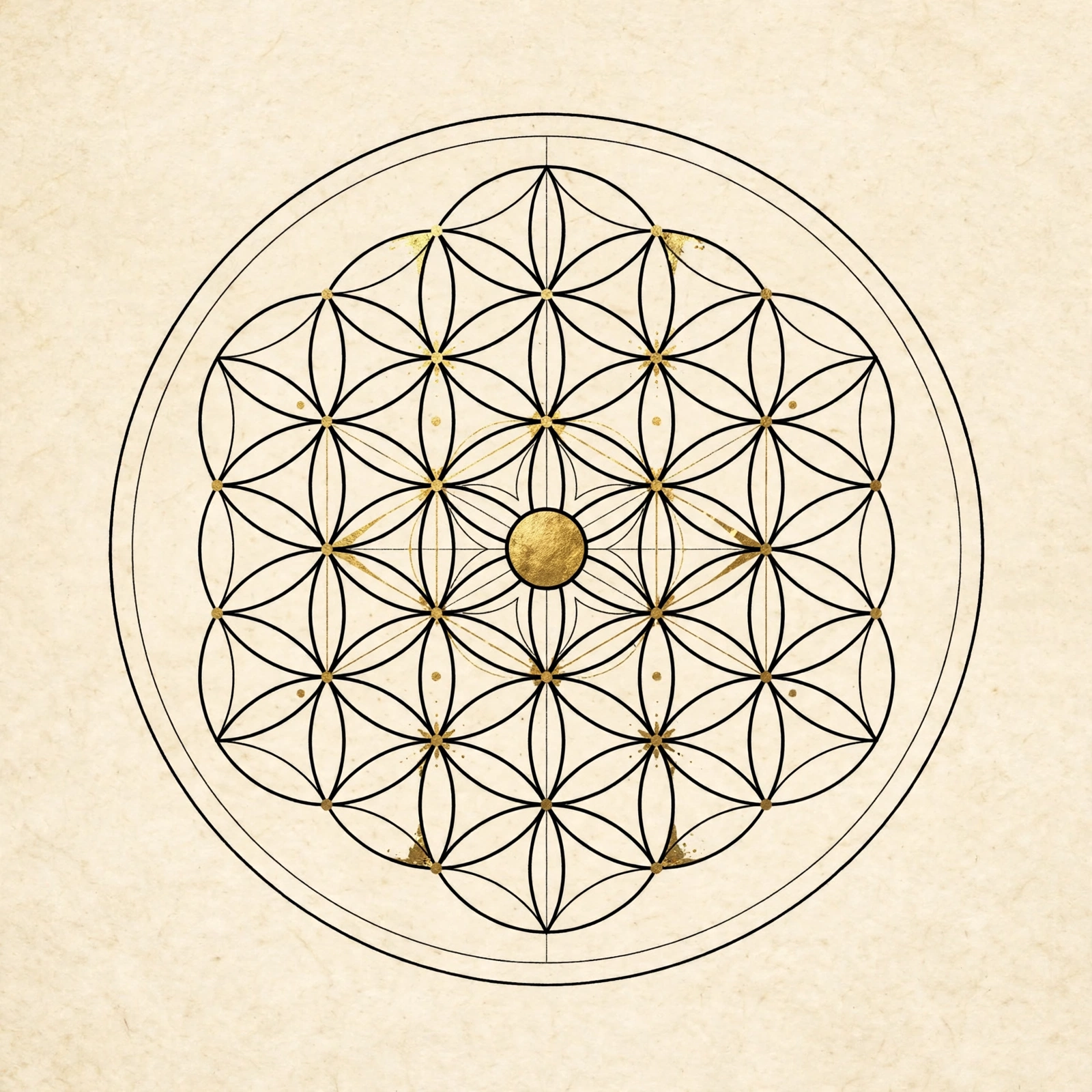
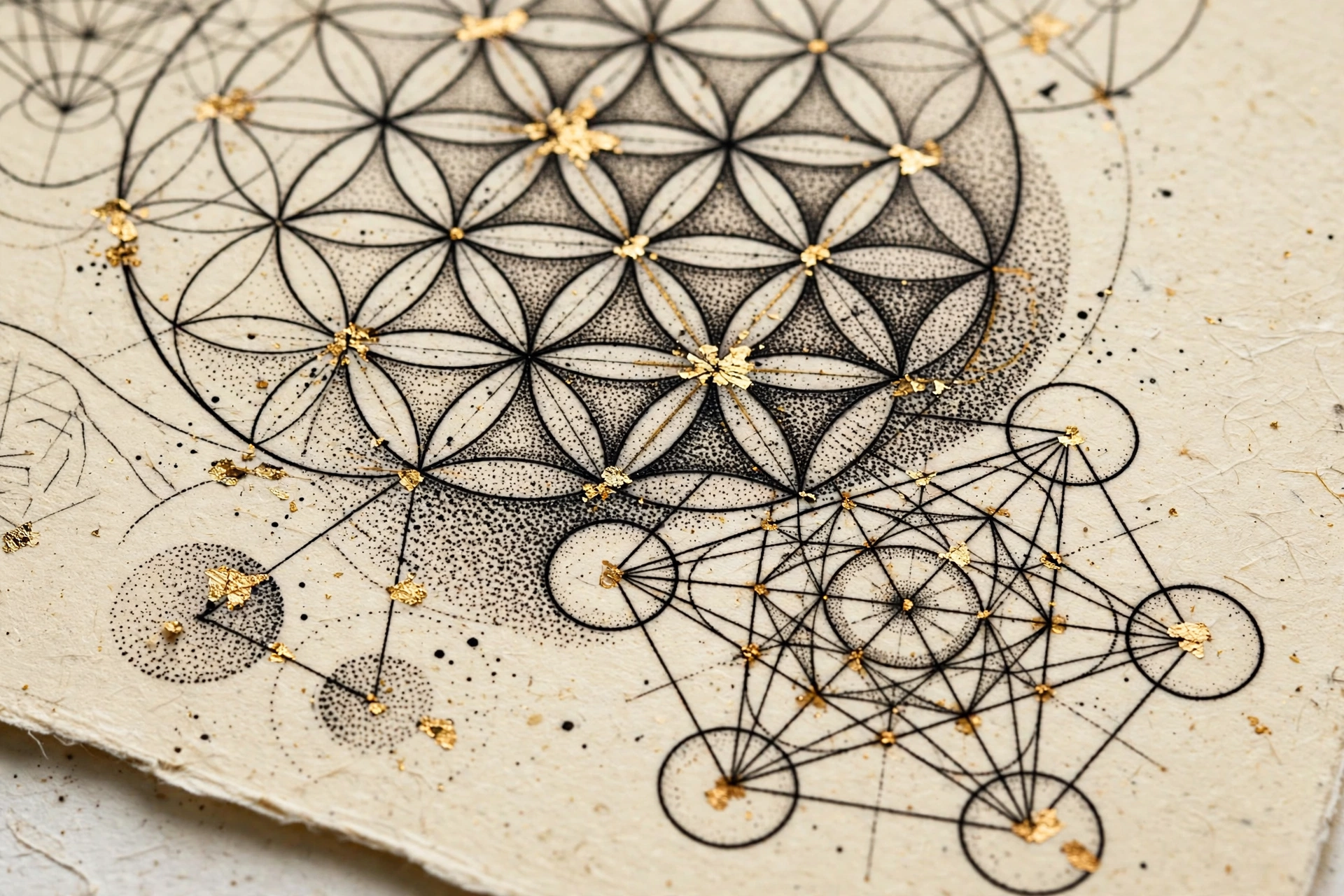
Flower of life centred between the shoulder blades, fine line with a soft dotwork halo
Metatron's cube on the forearm, its circles and connecting lines kept clean and open
Seed of life at the sternum with a small lotus worked into the centre
Geometric sleeve built from repeating triangles and circles, dotwork shading between the shapes
Sri yantra style interlocking triangles on the upper back, symmetrical and uncluttered
Moon phases following the curve of a flower of life arc along the spine
Platonic solids — cube, tetrahedron and sphere forms — arranged down the calf
Unalome-inspired spiral and dots paired with a small geometric lotus on the inner arm
See also: Tattoo Style Finder Quiz · Tattoo Cost Estimator · All Tattoo Styles.
The generator reads your birth date, your intention and your style, so the design it makes is yours, not a copy of someone else's.
Size (Tiny to Extra Large) and style in, cost range out. Ranges are estimates — an artist quote wins. A 20% tip is shown separately.
All 23 placements from our placement guides — pick a spot, optionally compare a second one, and see its pain range, healing time, fading and size guidance, quoted from the same guide data, with a link to the full placement guide. Ranges only — sources disagree, no single decimal is a fact.
Two sun signs in, an honest reading out — no invented percentages. The tool compares the two signs' elements and ruling planets, tells you where the pairing clicks and where it rubs, and turns it into a matching-tattoo idea with links to both sign guides.
Your Sun, Moon and Rising signs from your birth date and time — all three computed in your browser, with the Moon and Rising honestly labelled approximate. Each sign comes with a short traditional reading and a tattoo angle, plus links to its sign guide and to the wheel and fusion tools.
See the full list on the Tattoo Styles main page.
Realism tattoos explained — photographic shading, portraits and lifelike texture. How the style ages, the placements that suit it, and design ideas to take to your artist.
Sketch tattoos explained — raw pencil-energy lines, cross-hatching and unfinished edges. How the style ages, the placements that suit it, and design ideas to take to your artist.
Ornamental tattoos explained — jewellery-like symmetry, dot chains and lace patterns. How the style ages, the placements that suit it, and design ideas to take to your artist.
Traditional (Old School) tattoos explained — bold outlines, limited palette and timeless motifs. How the style ages, the placements that suit it, and design ideas to take to your artist.
No. Many people choose these patterns simply because they find the geometry beautiful, calming or satisfying to look at. Others do attach personal or spiritual meaning to them. Either reason is a good one — what matters is choosing a pattern honestly, for what it means to you.
Both refer to arrangements of overlapping circles. The seed of life is a smaller cluster of circles, and the flower of life is that pattern expanded into more rings inside a containing circle. Your artist can show you both at your chosen size so you can see which reads better.
Yes, that combination is popular and works well when it is planned as one composition, with the mandala echoing the geometry rather than competing with it. Let one pattern lead, keep line weights consistent, and give the whole piece enough size that the two do not crowd each other.
Only in the sense that closely spaced lines can blur toward each other over years, which is why spacing matters so much in this style. A well-spaced piece at a sensible size on a flat placement should stay clearly readable, and your artist can simplify a pattern if your chosen size is tight.
By size, as usual: a Small geometric piece falls in the $50–500 band, Medium in $200–1000 and Large in $500–2000, with a shop minimum usually $80–$150. Very intricate dotwork shading adds sitting time, so an exact quote needs your final pattern and size.
AI designs are for inspiration only. Always consult a licensed tattoo artist. Astrology on this site is for inspiration and self-expression. This page does not provide medical advice. Last reviewed: 25 November 2026.