Tattoo Cost Estimator
Size (Tiny to Extra Large) and style in, cost range out. Ranges are estimates — an artist quote wins. A 20% tip is shown separately.
Phoenix Tattoo Meanings · Tattoo Meanings
Phoenix Tattoo Meanings explored honestly — what the phoenix has meant across cultures, design variations that change the message, placement notes and ideas.
A phoenix tattoo is for the life that ended and the one that replaced it. In Greek tradition the phoenix burns and rises from its own ashes, and that single story has made it the defining symbol of rebirth after total loss. This guide separates the phoenix from the Chinese fenghuang, and explains how people wear it now.
This page sits under Tattoo Meanings.
Key takeaways
| What | What to expect |
|---|---|
| Core meanings | Rebirth, rising after total loss, resilience, renewal of identity, and beauty built from ashes |
| Watch out | The Greek phoenix and the Chinese fenghuang are different creatures from different traditions; blending them into one generic bird confuses both |
| Pairs well with | Flames and embers, ashes and feathers, suns, lotus flowers, dates of a turning point, and names being honoured |
In Greek tradition, the phoenix is a singular, long-lived bird that, at the end of its life, is consumed by fire and rises renewed from the ashes. It became an emblem of resurrection and renewal. The Chinese fenghuang is a different creature entirely, associated with virtue and harmony, and it does not burn.
The phoenix's power as a symbol comes from the completeness of its cycle. It does not escape death or avoid the fire; it goes through it, and what rises is genuinely new while still being the phoenix. Early writers described a magnificent bird from the east associated with the sun, and the story was retold through Roman and later European tradition, where the phoenix became a standard emblem of resurrection, renewal and things that return stronger after destruction.
The fenghuang deserves its own respect. In Chinese tradition it is a composite bird — drawing features from several creatures — associated with virtue, grace, the union of opposites and harmonious rule, and it appears as a sign of peace and prosperity. It has no fire and no rebirth cycle. Japanese tradition adapted it as the hoo-ou, with similar associations of virtue and good governance. When a tattoo blends a Greek fire-bird with fenghuang features, it is mixing two traditions; many wearers do not mind, but it is worth knowing the difference before you choose.
Today the phoenix almost always marks a rebuilt life: recovery from addiction or illness, surviving a disaster, escaping a damaging past, or deliberately becoming a new person. The ashes stay in the story — the tattoo says the worst happened, and it was not the end.
Of all the symbols in this series, the phoenix is the one wearers most consistently attach to a specific before and after. The scale of the bird matches the scale of the claim: people rarely choose a phoenix for a minor setback. It appears after the house fire, the diagnosis survived, the addiction left behind, the life dismantled and rebuilt — and its placement is often somewhere with room to do the story justice, like the back or the ribs.
There is also a quieter phoenix: the person who simply refuses to stay down, who has rebuilt more than once and expects to again.
Flames, wings and tail decide how a phoenix reads. A bird mid-burn, wreathed in fire, emphasises the ending; a bird rising with wings fully spread emphasises the return. Long flowing tail streamers give it elegance and a fenghuang-adjacent grace, while sharp, angular wings feel defiant. Ash, embers and falling feathers at the base keep the cost of the rebirth visible.
Composition is storytelling here. A phoenix drawn low, head down among flames, is about the burning; the same bird drawn high with wings at full stretch is about the rising. Most wearers want the rising moment, with the fire present but below — a design decision worth stating clearly to your artist, because it changes the entire posture of the bird. Curved, layered tail feathers that flow with the body's lines give the piece movement; geometric or tribal phoenixes trade that flow for boldness and symmetry.
Style and colour carry the temperature. Traditional and neo-traditional phoenixes in red, gold and orange are the classic fire statement. Black and grey versions feel like monuments — more grief, less blaze — and suit memorial readings. A phoenix combined with a lotus, a sun or a date banner gains a second sentence: what the new life is for. Without that anchor, a phoenix can read as generic fantasy art; with it, the design becomes a record.
The phoenix is a large-subject tattoo: it belongs on the back, ribs, chest, thigh or a full upper arm, where wings and tail streamers can move with the body. The spine suits its vertical rise beautifully. Small phoenixes only work as simplified flame-bird silhouettes.
Give the bird the canvas it needs. A full back lets the wings spread symmetrically and the tail flow down the spine — the most dramatic and most chosen phoenix placement. The ribs offer a tall, curved canvas where a rising phoenix can follow the body's lines, though it is one of the more sensitive areas to tattoo and the design will move as you breathe. Thigh and upper arm suit single-wing or three-quarter compositions at a more manageable scale.
Honest scaling matters more with a phoenix than with almost any other symbol, because feathers, flames and streamers are all fine detail competing in one design. A phoenix squeezed onto a forearm at small size will lose its feathers first and its story second. If your budget or pain tolerance says small, choose the silhouette version proudly — a clean flame-bird shape reads instantly as a phoenix and ages far better than a miniature detailed one.
Make a phoenix yours by naming what the fire was and what rose from it: a date in the embers, a lotus for the calm that followed, a name honoured in a falling feather,. The bird supplies the drama — your details supply the truth, and a phoenix without them is only half the story.
The ideas below assume the phoenix is a considered piece, not an impulse tattoo, and most will take more than one session. When you brief your artist, bring the posture decision — burning, rising or fully risen — and any element you want at the base of the design, since the ashes, embers or flowers at the bottom are where the personal record usually lives.
Choose an artist whose large-scale healed work you have seen. A phoenix is drawn for a specific back, ribcage or thigh, not transferred from a print, and the best versions are designed on the body with the stencil adjusted to your movement.
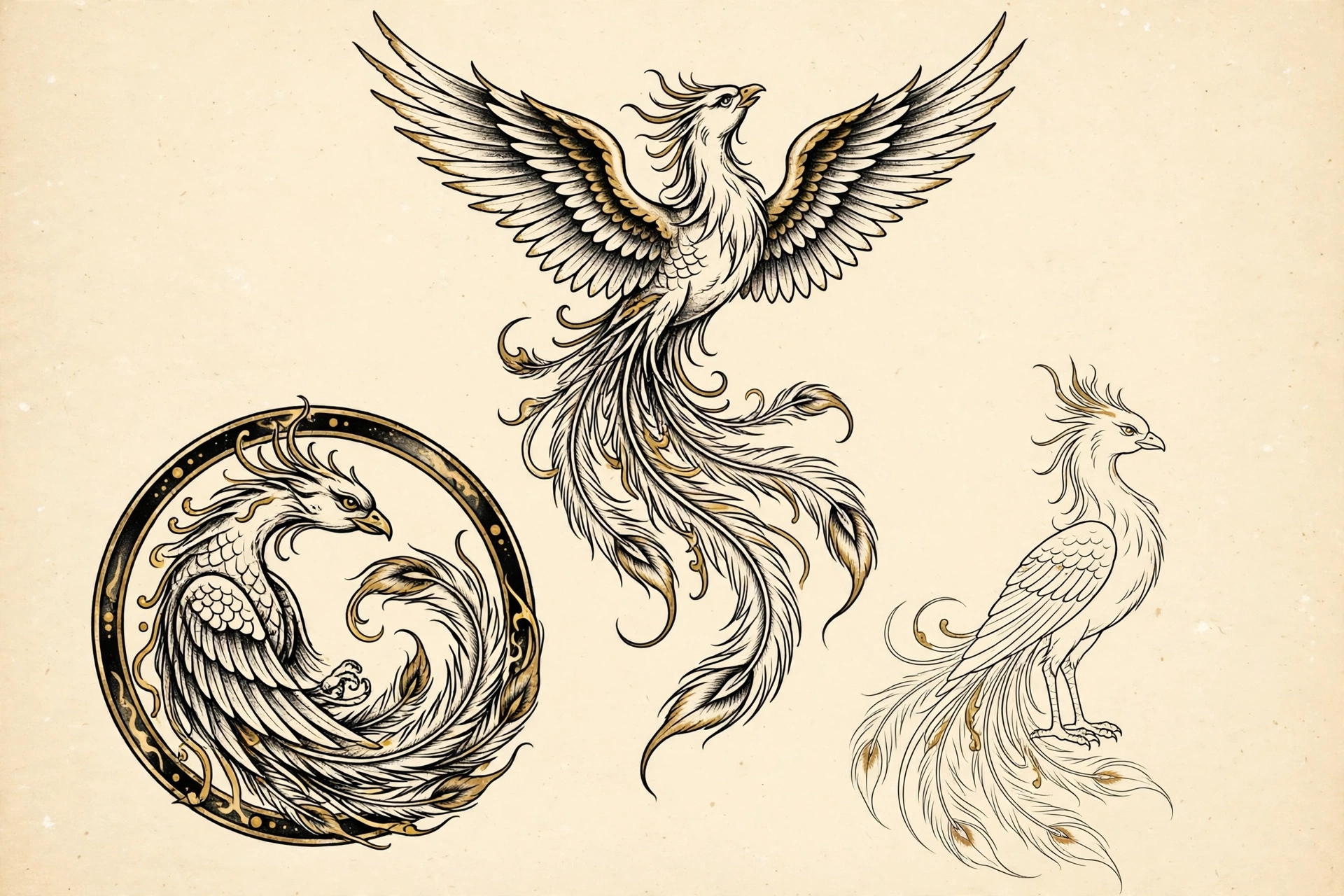
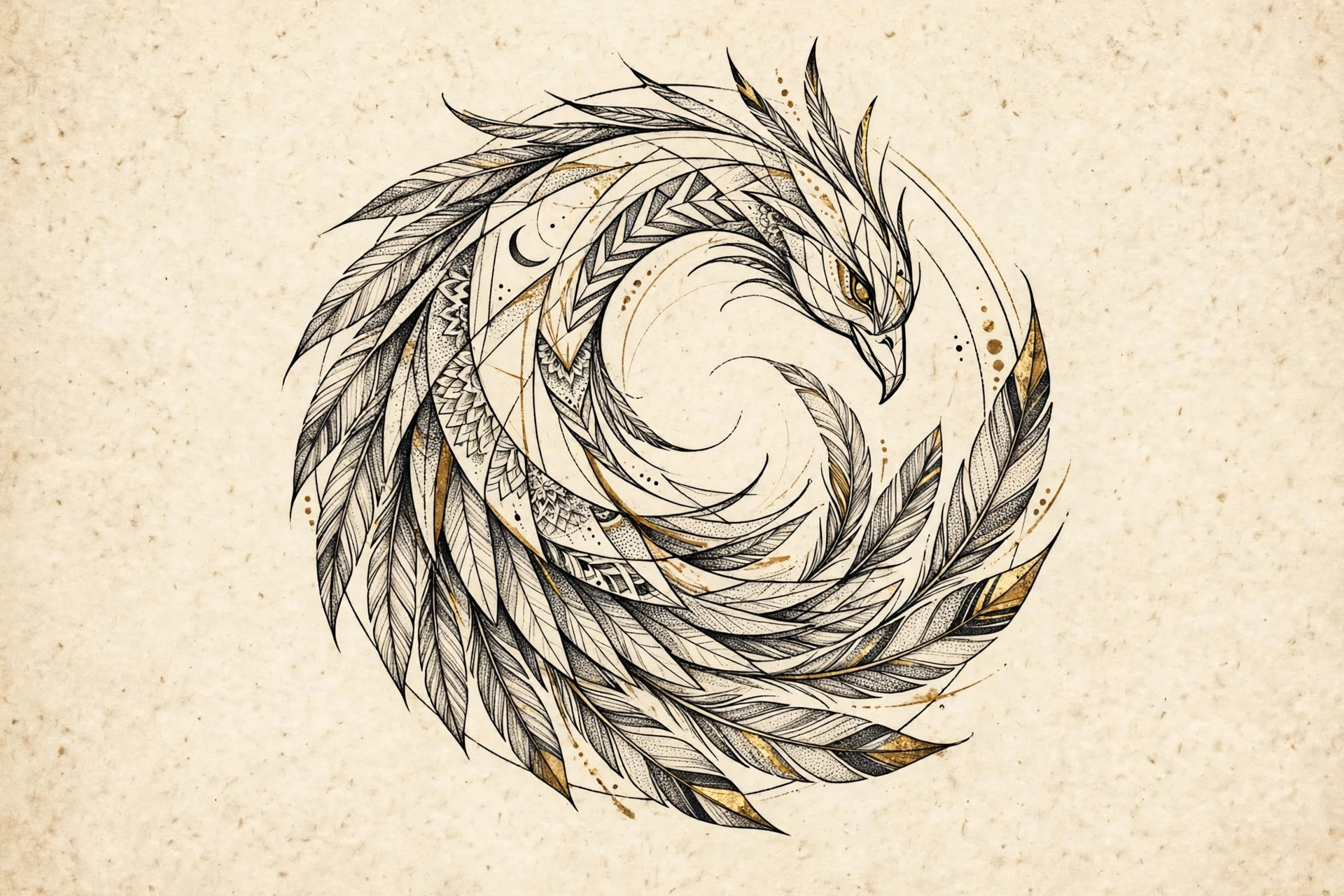
Full-back phoenix with wings spread and tail streamers flowing down the spine
Neo-traditional phoenix in red, orange and gold rising along the ribs
Black and grey phoenix on the thigh with embers and falling feathers
Small flame-bird silhouette on the shoulder blade for a simplified rising mark
Phoenix wrapping the upper arm with flames curling toward the elbow
Phoenix and lotus combined on the chest, bird above and flower below
Watercolour phoenix on the forearm with colour washing out of the wings
Phoenix rising from a dated banner on the calf marking a turning-point year
See also: All Tattoo Meanings · Manifestation Sigil Maker · Spirit Animal Finder.
The generator reads your birth date, your intention and your style, so the design it makes is yours, not a copy of someone else's.
Size (Tiny to Extra Large) and style in, cost range out. Ranges are estimates — an artist quote wins. A 20% tip is shown separately.
All 23 placements from our placement guides — pick a spot, optionally compare a second one, and see its pain range, healing time, fading and size guidance, quoted from the same guide data, with a link to the full placement guide. Ranges only — sources disagree, no single decimal is a fact.
Two sun signs in, an honest reading out — no invented percentages. The tool compares the two signs' elements and ruling planets, tells you where the pairing clicks and where it rubs, and turns it into a matching-tattoo idea with links to both sign guides.
Your Sun, Moon and Rising signs from your birth date and time — all three computed in your browser, with the Moon and Rising honestly labelled approximate. Each sign comes with a short traditional reading and a tattoo angle, plus links to its sign guide and to the wheel and fusion tools.
See the full list on the Tattoo Meanings main page.
Butterfly Tattoo Meanings explored honestly — what the butterfly has meant across cultures, design variations that change the message, placement notes and ideas.
Dragon Tattoo Meanings explored honestly — what the dragon has meant across cultures, design variations that change the message, placement notes and ideas.
Rose Tattoo Meanings explored honestly — what the rose has meant across cultures, design variations that change the message, placement notes and ideas.
Snake Tattoo Meanings explored honestly — what the snake has meant across cultures, design variations that change the message, placement notes and ideas.
The phoenix comes from Greek tradition — a unique bird that burns at the end of its life and rises renewed from its ashes, a story retold by writers including Herodotus and Ovid. The fenghuang comes from Chinese tradition, is a composite creature associated with virtue, grace and harmony, and does not burn or resurrect. They are separate traditions that are often confused in modern tattooing.
That is its most common modern meaning, yes — a total ending followed by a rebuilt life: recovery from addiction or illness, surviving a fire or a collapse, leaving an old identity behind. The ashes are part of the symbol's honesty; the phoenix does not pretend the burning did not happen.
Usually, yes. The phoenix's drama lives in its wings, tail streamers and flames, and shrinking it loses the story. Small phoenixes can work as simplified flame-bird silhouettes, but detailed versions belong on the back, ribs, thigh or a full arm, where the feathers and fire have room to stay readable.
Fire colours — red, orange, gold — state the burning-and-renewal story directly and suit traditional and neo-traditional styles. Black and grey phoenixes feel more solemn and sculptural, emphasising form over flame. Blue and teal versions exist and look striking, but they step away from the fire symbolism, so choose them for the look rather than the legend.
Very well, and it is a classic pairing: the phoenix for the life rebuilt, the lotus for the purity and calm it was rebuilt toward. Both are rising symbols — one from ashes, one from muddy water — so the combination reads as a complete recovery story. Keep one as the clear main subject so the design does not crowd.
AI designs are for inspiration only. Always consult a licensed tattoo artist. Astrology on this site is for inspiration and self-expression. This page does not provide medical advice. Last reviewed: 25 November 2026.