Tattoo Cost Estimator
Size (Tiny to Extra Large) and style in, cost range out. Ranges are estimates — an artist quote wins. A 20% tip is shown separately.
Rose Tattoo Meanings · Tattoo Meanings
Rose Tattoo Meanings explored honestly — what the rose has meant across cultures, design variations that change the message, placement notes and ideas.
A rose tattoo says two things at once: this was beautiful, and it was not painless. That honesty is why the rose has outlasted every tattoo fashion — it stands for love, devotion and remembrance, thorns included. Colour, thorns and companions all change its message, and this guide walks through each variation.
This page sits under Tattoo Meanings.
Key takeaways
| What | What to expect |
|---|---|
| Core meanings | Love, devotion, remembrance, beauty with honesty about pain, and balance between softness and defence |
| Watch out | Colour meanings come largely from later flower-language traditions, not ancient codes; gang and prison associations exist for some rose placements and styles, so context matters |
| Pairs well with | Daggers, snakes, skulls, clocks, names and dates, birth flowers, swallows, and thorned stems used as framing |
The rose has been associated with love and beauty since classical antiquity, when Greek and Roman traditions linked it with Aphrodite and Venus, goddesses of love. It later became a symbol of secrecy, of devotion in Christian imagery, and of remembrance.
In Greek tradition, the rose was associated with Aphrodite, and in Roman tradition with Venus, which fixed its link with love and desire early. Roman custom also gave the rose a second meaning: a rose hung over a table signified that what was said there stayed secret — the origin of the phrase sub rosa, under the rose. Few flowers carry two meanings as different as desire and confidentiality, and both still echo in how roses are used today.
In Christian symbolism, the rose became associated with devotion and with the Virgin Mary, and red roses in particular with sacrifice and martyrdom. Much later, the language of flowers popularised in nineteenth-century Europe assigned specific meanings to rose colours, and those conventions — red for romantic love, yellow for friendship, white for purity — are the ones most people still half-know today. They are later traditions rather than ancient codes, but they are genuinely how many wearers choose their colours.
Today the rose most often stands for a specific love rather than love in general: a partner, a mother, a child, or someone who has died. It is also chosen for self-love and survival — beauty that defended itself. Everyone reads a rose instantly, which suits a tribute that needs no explanation.
Names, dates and handwriting turn a general rose into a particular one. A rose with a mother's name in the stem, a partner's initials among the leaves, or a child's birth date on a banner is a memorial or devotion piece, and roses are probably the most common flower chosen for exactly that job. The design can stay classic while the meaning stays private.
The self-directed reading is just as common now. Many people choose a rose after leaving a damaging relationship, recovering from illness or simply deciding to value themselves — the thorns doing as much work as the petals in that story.
Thorns, colour and companions decide a rose's tone. A thornless rose leans innocent; a heavily thorned stem leans honest and defended. A dagger through the rose suggests love and conflict or betrayal survived, a skull turns it toward remembrance and mortality, and a clock toward love inside time. Traditional bold roses feel timeless; fine-line roses feel intimate and modern.
Start with the stem, because that is where the honesty lives. A long, thorny stem drawn as carefully as the flower says the love cost something. Removing the thorns softens the whole design toward romance and purity. The bloom's openness matters too: a tight bud is a beginning or a secret, a full open rose is love declared, and a wilting rose — rarer, braver — is about loss and endings.
Companions reframe the flower completely. Rose and snake suggests temptation, transformation or a dangerous love; rose and swallow, a classic pairing in traditional tattooing, suggests love and safe return; rose and dagger is one of the oldest combinations in Western tattooing, read as the closeness of love and pain. Colour follows the flower-language conventions for most wearers, though blackwork roses step outside that system entirely — there, the drama is in the ink, not the petal colour.
A rose's natural shape — a round bloom on a vertical stem — suits the forearm, upper arm, calf and thigh, and it centres well on the chest, sternum and back. Small simplified roses work on the wrist, ankle and hand, though hands fade faster and need bolder lines.
The forearm is the rose's classic home in traditional tattooing, giving the bloom width and the stem length, and keeping the design visible to the wearer. The upper arm and shoulder let a rose wrap slightly, which suits larger, shaded pieces. On the chest and sternum a single rose centres naturally, while two roses mirror well across the collarbones or the tops of the shoulders.
Long-stem designs are unusually flexible: they can run down a spine, along a rib, behind an arm or down the side of a calf, with the bloom placed wherever the line ends. Hand and finger roses are popular but sit on the fastest-wearing skin on the body, so expect stronger lines, simpler petals and eventual touch-ups. Whatever the placement, a rose needs enough size for its petal layers to stay distinct — a rose shrunk past its detail heals into a cabbage, as artists like to warn.
Make a rose yours by attaching it to the actual love it represents: a name in the stem, or the handwriting of someone you have lost. The rose is universal — the specific, true detail is what makes it a portrait rather than a symbol.
The ideas below cover the main rose families, from a traditional forearm piece to a fine-line collarbone stem. When you brief your artist, be clear about the thorns: how many, how sharp, and whether they are part of your story, because artists vary widely in how much stem they draw by default. Decide the bloom's openness for the same reason — bud, opening or full bloom are three different sentences.
If the rose is a memorial, bring the name, date or handwriting with you rather than choosing a font from a screen; a traced signature or a few words in the person's own hand is the detail families value most later. And check healed examples of the style you want — traditional, blackwork, fine line and realism roses age very differently, and the right choice depends on the size and placement you have in mind.
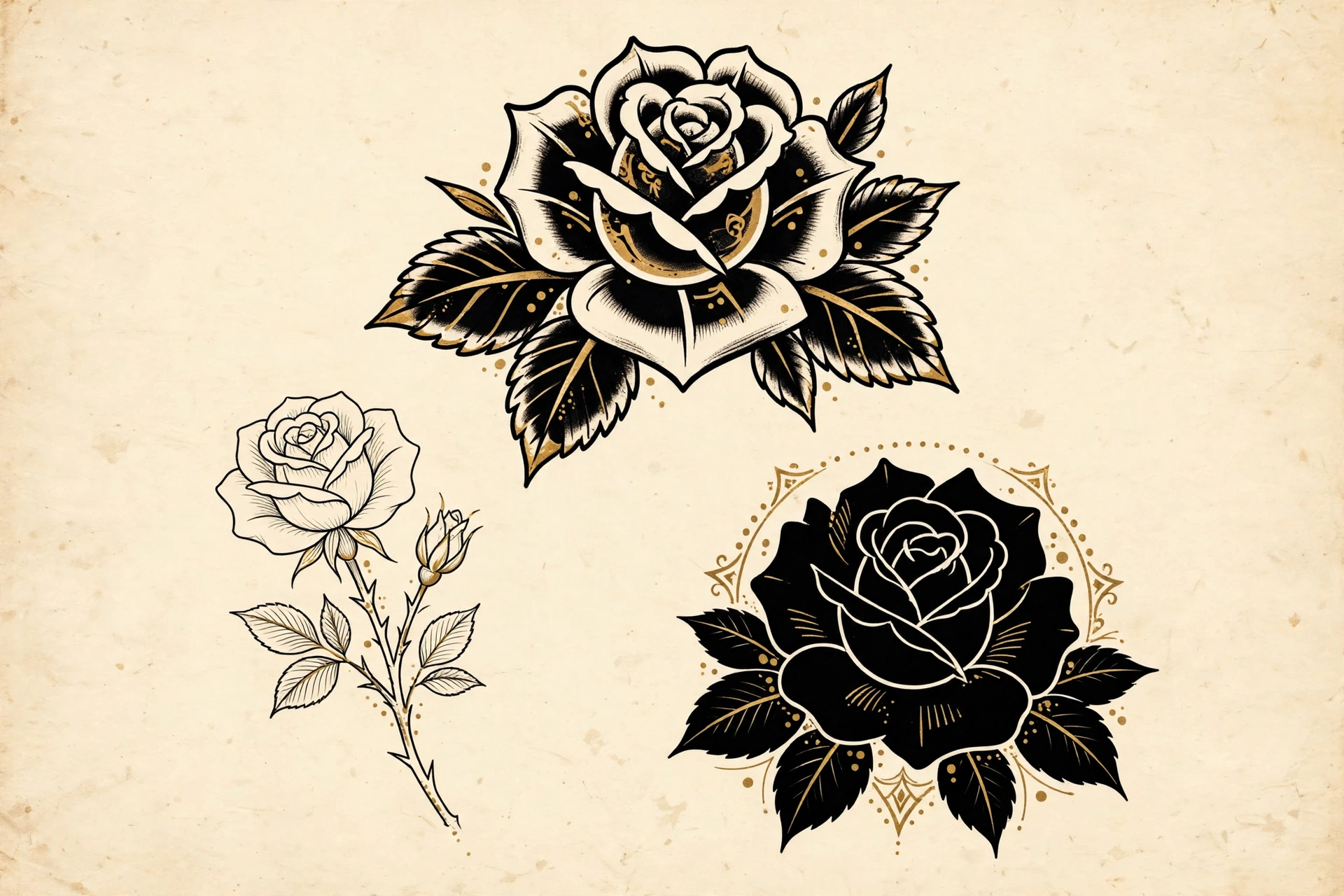

Traditional red rose with a name banner across the stem on the forearm
Fine-line single rose stem along the collarbone, thorns kept small and honest
Blackwork rose on the back of the hand with bold, simple petals
Rose and dagger vertical design on the calf for love that survived conflict
Two small roses on each collarbone, one bud and one open bloom
Rose entwined with a fine-line snake on the upper arm
White and grey realism rose on the shoulder as a memorial piece
Rose with a clock face at its centre on the thigh, marking time and love
See also: All Tattoo Meanings · Manifestation Sigil Maker · Spirit Animal Finder.
The generator reads your birth date, your intention and your style, so the design it makes is yours, not a copy of someone else's.
Size (Tiny to Extra Large) and style in, cost range out. Ranges are estimates — an artist quote wins. A 20% tip is shown separately.
All 23 placements from our placement guides — pick a spot, optionally compare a second one, and see its pain range, healing time, fading and size guidance, quoted from the same guide data, with a link to the full placement guide. Ranges only — sources disagree, no single decimal is a fact.
Two sun signs in, an honest reading out — no invented percentages. The tool compares the two signs' elements and ruling planets, tells you where the pairing clicks and where it rubs, and turns it into a matching-tattoo idea with links to both sign guides.
Your Sun, Moon and Rising signs from your birth date and time — all three computed in your browser, with the Moon and Rising honestly labelled approximate. Each sign comes with a short traditional reading and a tattoo angle, plus links to its sign guide and to the wheel and fusion tools.
See the full list on the Tattoo Meanings main page.
Lotus Tattoo Meanings explored honestly — what the lotus has meant across cultures, design variations that change the message, placement notes and ideas.
Butterfly Tattoo Meanings explored honestly — what the butterfly has meant across cultures, design variations that change the message, placement notes and ideas.
Star Tattoo Meanings explored honestly — what the star has meant across cultures, design variations that change the message, placement notes and ideas.
Phoenix Tattoo Meanings explored honestly — what the phoenix has meant across cultures, design variations that change the message, placement notes and ideas.
In the flower-language traditions that became popular in Europe, red is associated with romantic love, pink with admiration and gratitude, yellow with friendship, white with purity and remembrance, and black with mourning or the end of a chapter. These are conventions, not fixed codes, and many people simply choose the colour they love.
Most often, balance: beauty and pain held together, love that was not simple, or softness that can defend itself. Some people choose thorns deliberately to honour the difficult part of a love or a loss, rather than presenting only the beautiful part. A rose drawn without thorns leans the meaning toward innocence and uncomplicated affection.
Frequently, yes. Roses are one of the most common memorial flowers in everyday life, and the tattoo follows that custom — a rose for a mother, partner or friend who has died, often with a name, date or handwriting worked into the stem or banner. It is a tribute people understand at a glance.
A simplified rose — a spiral centre with two or three petal shapes and a leaf — works at a few centimetres on a wrist, ankle or collarbone. Detailed traditional and realism roses need more room for their layered petals. At small sizes, bold lines and limited shading keep the flower readable as it ages.
Black roses are usually read as mourning, remembrance, or the closing of a chapter, and they are also chosen simply for their striking, gothic look. In blackwork the colour is about ink rather than flower colour, so many black-ink roses carry no mourning meaning at all — the style, not the shade, is the statement.
AI designs are for inspiration only. Always consult a licensed tattoo artist. Astrology on this site is for inspiration and self-expression. This page does not provide medical advice. Last reviewed: 25 November 2026.