Tattoo Cost Estimator
Size (Tiny to Extra Large) and style in, cost range out. Ranges are estimates — an artist quote wins. A 20% tip is shown separately.
Lotus Tattoo Meanings · Tattoo Meanings
Lotus Tattoo Meanings explored honestly — what the lotus has meant across cultures, design variations that change the message, placement notes and ideas.
A lotus tattoo carries one of the clearest stories in all of tattooing: a flower that roots in mud, rises through dark water and opens clean in the light. In Hindu and Buddhist traditions it is associated with purity and awakening, and today it most often marks calm strength and a hard-won fresh start.
This page sits under Tattoo Meanings.
Key takeaways
| What | What to expect |
|---|---|
| Core meanings | Purity, rebirth, calm strength, spiritual growth, and beauty that comes through difficult conditions |
| Watch out | The lotus is a sacred symbol in Hindu and Buddhist practice; the unalome and specific petal counts carry meanings worth respecting, not just copying |
| Pairs well with | Moons, unalome lines, water and waves, koi, dragonflies, birth months, and names in fine script |
In Hindu tradition, the lotus is associated with purity, beauty and divine birth, and is linked with deities including Lakshmi and Brahma. In Buddhist tradition, it is associated with awakening — the flower that rises unstained from muddy water became a natural image for a mind opening toward enlightenment. Both traditions treat it as sacred, not merely decorative.
The lotus earns its symbolism from how it actually grows. Its roots sit in mud at the bottom of ponds, its stem rises through murky water, and the flower opens on the surface clean and dry. For traditions built around the idea that a person can rise from difficult conditions without being defined by them, no plant makes the point more directly.
In Hindu tradition, the lotus is associated with creation, purity and prosperity, and appears with several deities — Lakshmi, goddess of prosperity, is often shown standing or seated on a lotus, and Brahma is associated with a lotus rising from Vishnu. In Buddhist tradition, the lotus is associated with the unfolding of awakening, and different coloured lotuses carry different associations in traditional symbolism.
Most people choose a lotus today for recovery and calm: rising from a hard period without bitterness, staying centred, or growing into a new version of themselves. It is a popular choice after illness, divorce or loss, and for people whose yoga or meditation practice matters to them. The message is quiet strength rather than triumph — blooming, not winning.
The recovery reading dominates modern lotus tattoos, and it maps honestly onto the traditional one. The flower does not deny the mud; it includes it. People often place a lotus where they can see it during the day as a steadying reminder, or mark it at the end of treatment, after a difficult year, or at the start of a deliberately calmer life.
A closed bud and a fully open flower say different things, and many wearers choose consciously between them: the bud for potential and a beginning, the open bloom for something realised. In astrology-adjacent personal framing, some people pair the lotus with their sign or birth flower to make the growth story specifically theirs. Read as personal interpretation, the lotus also suits people who simply want a daily emblem of patience — growth on nature's schedule, not on demand.
Petal count, openness and additions all steer the message. An open bloom reads as awakening or arrival; a bud reads as potential. A lotus joined to an unalome line underneath turns the design into a life-path statement, while water, roots or mud beneath the flower emphasise the rising-from-difficulty story. Colour adds traditional associations — or simply warmth.
Traditional symbolism links the eight-petalled lotus with balance and harmony, which is why eight petals is a common and safe choice for a symmetrical design. More petals create a fuller, more mandala-like flower that reads as meditative and ornamental; fewer, bolder petals read as modern and graphic.
The base of the design is where the story lives. Most lotus tattoos show only the flower, which keeps the reading on purity and calm. Adding a stem descending into waves, or roots in shaded water, tells the fuller story of where the flower came from. Pairing with a moon adds cycles and intuition; pairing with a koi, a classic combination in Asian-influenced tattooing, adds perseverance. Dotwork shading softens the whole piece toward the contemplative, while solid blackwork makes it bolder and more emblematic.
The lotus is a symmetrical flower, so it loves centred placements: between the shoulder blades, on the sternum, the centre of the lower back, the chest and the back of the neck. It also works along the spine with an unalome, and at small sizes on the wrist, ankle and behind the ear.
Centred placements flatter the lotus because the design itself is built on a vertical axis. The sternum piece — a lotus centred under the chest, sometimes with dot chains or small moons at either side — has become a classic precisely because the body's symmetry and the flower's symmetry agree. Between the shoulder blades and the centre of the upper back offer the same effect with more room for petal detail.
For smaller lotuses, the inner wrist, ankle and behind the ear all work if the design is simplified to clean petal shapes. Spine lotuses, often with the stem extending into an unalome's wandering line, use the body's centre line elegantly but sit on a placement many people find sensitive — worth knowing before you commit to a long vertical piece. On the forearm and thigh, a lotus can open wider and carry more shading, which suits dotwork and colour versions.
Personalise a lotus by deciding which part of its story is yours: show the roots if the hard years matter, or choose a bud if you are at a beginning. Adding one honest detail turns the world's most popular flower tattoo into a specific record of your own rising.
The ideas below span the main lotus families — sacred and symmetrical, fine-line and minimal, bud and full bloom. If the traditional meanings matter to you, say so to your artist early, because petal count, colour and the inclusion of an unalome are decisions made at the drawing stage, not the tattooing stage. If your meaning is personal recovery, consider including the water line: it is a small addition that changes the whole story.
Execution matters most in the symmetry. A lotus is unforgiving of uneven petals, so choose an artist whose healed work shows clean, balanced linework, and check the stencil carefully on your body from a distance before the needle starts. Slight asymmetry that is invisible on paper becomes obvious on a centred back or sternum piece, and this is a design worth getting exactly right.
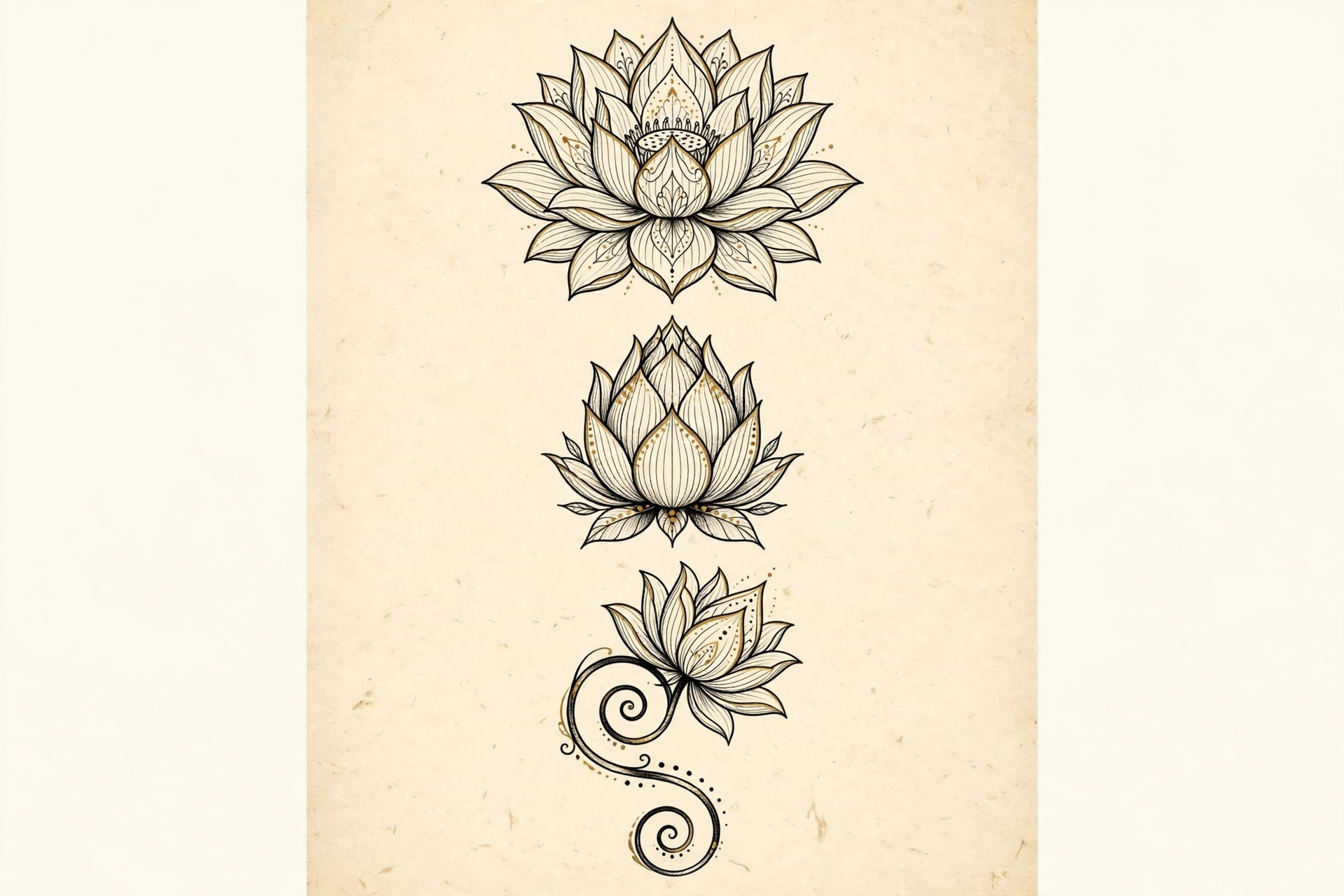
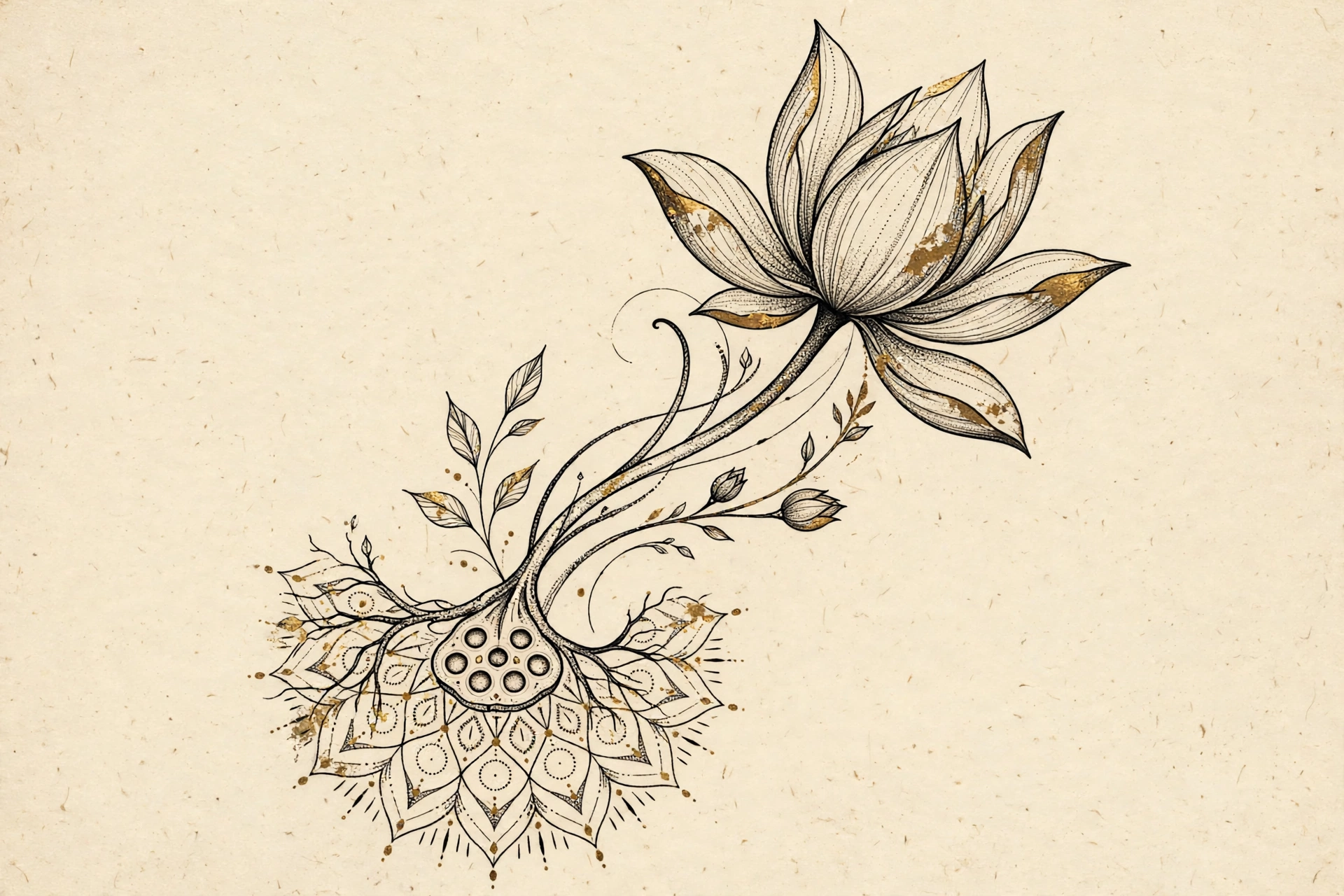
Eight-petalled lotus in dotwork between the shoulder blades
Fine-line lotus and unalome combined down the centre of the spine
Small three-petal lotus on the inner wrist in plain black line
Lotus over gentle wave lines on the forearm, roots visible below the water
Pink and gold lotus on the sternum with small dot chains
Lotus with a crescent moon above it on the upper arm
Closed lotus bud on the ankle for a beginning still unfolding
Open lotus framing a tiny zodiac glyph at its centre on the chest
See also: All Tattoo Meanings · Manifestation Sigil Maker · Spirit Animal Finder.
The generator reads your birth date, your intention and your style, so the design it makes is yours, not a copy of someone else's.
Size (Tiny to Extra Large) and style in, cost range out. Ranges are estimates — an artist quote wins. A 20% tip is shown separately.
All 23 placements from our placement guides — pick a spot, optionally compare a second one, and see its pain range, healing time, fading and size guidance, quoted from the same guide data, with a link to the full placement guide. Ranges only — sources disagree, no single decimal is a fact.
Two sun signs in, an honest reading out — no invented percentages. The tool compares the two signs' elements and ruling planets, tells you where the pairing clicks and where it rubs, and turns it into a matching-tattoo idea with links to both sign guides.
Your Sun, Moon and Rising signs from your birth date and time — all three computed in your browser, with the Moon and Rising honestly labelled approximate. Each sign comes with a short traditional reading and a tattoo angle, plus links to its sign guide and to the wheel and fusion tools.
See the full list on the Tattoo Meanings main page.
Star Tattoo Meanings explored honestly — what the star has meant across cultures, design variations that change the message, placement notes and ideas.
Rose Tattoo Meanings explored honestly — what the rose has meant across cultures, design variations that change the message, placement notes and ideas.
Moon Tattoo Meanings explored honestly — what the moon has meant across cultures, design variations that change the message, placement notes and ideas.
Butterfly Tattoo Meanings explored honestly — what the butterfly has meant across cultures, design variations that change the message, placement notes and ideas.
In Hindu and Buddhist traditions the lotus is associated with purity and unfolding — it grows from muddy water and opens clean above the surface. Petal counts appear in traditional symbolism, with the eight-petalled lotus commonly linked to balance and cosmic harmony, but many modern tattoos choose petal numbers simply for how the design looks.
Traditions attach meanings to lotus colours — white with purity, pink with devotion and the divine, blue with wisdom, among others. In modern tattooing, colour is often chosen for look and skin tone rather than symbolism. If the traditional colour meanings matter to you, tell your artist, because they will shape the palette.
It can. Many people frame it as respect for a symbol whose story they genuinely connect with, keeping the design recognisable and understanding its roots in Hindu and Buddhist practice. Using it as an empty exotic decoration is what draws criticism. Learning the meaning first — as you are doing — is the respectful starting point.
Yes, a simple lotus of three clean petal shapes works at a few centimetres on a wrist, ankle or behind the ear. The risk is over-detailing: inner petal lines and dotwork shading need more room. A small lotus should be drawn bolder and simpler than a large one, not just shrunk.
A lotus is a single flower with layered petals, drawn front-on or in profile, and its meaning centres on purity and unfolding. A mandala is a geometric pattern, often circular and highly detailed, used as a meditation aid and symbol of wholeness. The two are often combined, with a lotus at a mandala's centre.
AI designs are for inspiration only. Always consult a licensed tattoo artist. Astrology on this site is for inspiration and self-expression. This page does not provide medical advice. Last reviewed: 25 November 2026.