Tattoo Cost Estimator
Size (Tiny to Extra Large) and style in, cost range out. Ranges are estimates — an artist quote wins. A 20% tip is shown separately.
Butterfly Tattoo Meanings · Tattoo Meanings
Butterfly Tattoo Meanings explored honestly — what the butterfly has meant across cultures, design variations that change the message, placement notes and ideas.
A butterfly tattoo is the most literal transformation symbol there is: the same creature, completely remade. People choose it after recovery, loss, growth or a deliberate new beginning, and its meaning shifts with wing colour, symmetry and what it rests on. This guide covers the butterfly's story across cultures and how people wear it today.
This page sits under Tattoo Meanings.
Key takeaways
| What | What to expect |
|---|---|
| Core meanings | Transformation, rebirth, freedom, lightness after heaviness, and honouring a life that changed form |
| Watch out | In some contexts, particularly a butterfly on the lower back, dated stereotypes linger; placement and design maturity easily outweigh them |
| Pairs well with | Flowers and birth flowers, moons, skulls in a memento-mori pairing, names, dates, and semicolon-inspired personal marks |
In Greek tradition, the word psyche meant both soul and butterfly, tying the insect to the human spirit. In Japanese tradition, butterflies are associated with youth, joy and the souls of the living and the dead. In Mexican tradition, monarchs arriving around the Day of the Dead are widely associated with the returning spirits of ancestors.
The butterfly's symbolism starts from metamorphosis, the most dramatic transformation in everyday nature: a crawling creature dissolves and rebuilds itself into something that flies. Cultures noticed, and built meaning on it. In Greek, psyche covered both the soul and the butterfly, and Psyche in myth is sometimes depicted with butterfly wings — an early, durable link between the insect and the idea that something of us survives change.
In Japanese tradition, a single butterfly is associated with youth and joy, and a pair with marital happiness, while butterflies more broadly are linked with the souls of the dead visiting the living. In Mexico, the monarch migration arrives in autumn around the Day of the Dead, and the butterflies are widely associated in local tradition with ancestors returning — which is why monarch tattoos often carry memorial weight. The readings differ, but all turn on the same fact: the creature that emerges is not the creature that entered the cocoon, and yet it is.
Today the butterfly is the recovery symbol above all others: sobriety, surviving illness or abuse, eating-disorder recovery, grief, or a chosen reinvention. It also stands for freedom and lightness after a heavy period,. Many wearers say the point is that the caterpillar stage counts — the tattoo honours the whole process.
Ask butterfly wearers what theirs means and transformation is the answer you will hear most, usually attached to a specific chapter. The design often marks a date quietly — the day of a decision, the end of treatment, the year of a new start — without printing the date itself. Its optimism is earned rather than cheerful, which is why it suits serious stories despite its pretty reputation.
The freedom reading runs alongside: wings as the ability to leave, move and choose. Some people choose a butterfly for a loved one who has died, drawing on the soul associations found in several traditions, and place it somewhere private. In personal, astrology-adjacent framing, butterflies are sometimes paired with a sign or a birth flower to tie the change to a particular person's story. However it is framed, the modern butterfly is rarely just decorative — it is one of the most meaning-loaded small tattoos there is.
Symmetry is the butterfly's signature, and breaking it changes the message: one wing floral, one wing plain, or one dark and one bright wing all suggest a life in two parts. Colour leans the design toward joy, nature or a specific species' story.
A classic symmetrical butterfly, wings open and matched, states wholeness — the transformation complete. Asymmetrical designs have become the most personal modern variation: half butterfly and half flowers, half butterfly and half skull, or wings that dissolve into birds, stars or script. Each split design says the same thing in a different dialect — two states in one body, the before and the after sharing a spine.
Species carry their own notes. The monarch brings migration, endurance and, for many, the ancestor association of Mexican tradition. Blue morpho-style butterflies read as rare and striking; swallowtails feel elegant and garden-like. Style steers tone just as strongly: traditional bold butterflies are cheerful and graphic, fine-line butterflies are delicate, and blackwork butterflies with heavy wing patterns can feel almost gothic. A flight path — a dotted, looping trail behind a small butterfly — adds movement and a sense of a journey still in progress.
Butterflies are built for centred placements: between the shoulder blades, on the sternum, the centre of the lower back, the chest and the back of the neck all flatter their symmetry. They also sit naturally on a shoulder, forearm or ankle at small sizes.
Symmetry is the placement rule. A butterfly placed on the body's centre line — spine, sternum, nape — reads as balanced and deliberate, while the same design placed off-centre reads as caught in passing, which can be exactly the lightness some people want. Shoulder blades are a natural home for larger winged pieces because the back offers a wide, flat canvas that moves like wings when you do.
Be honest about detail and size. Wing patterns, eye-spots and fine antennae need room; a butterfly under about four centimetres should be a clean outline or a bold silhouette. The lower back carries an unfair dated stereotype for butterfly tattoos from a particular era — a well-drawn, mature design at any placement outweighs it, but it is worth knowing the association exists so you choose the spot deliberately. Hands and feet fade fast, so small butterflies there need the simplest possible drawing.
Personalise a butterfly by choosing what it is made of: wings built from your birth flower, your children's initials hidden in the wing pattern, a flight path that spells a journey, or the exact species tied to your family's story. The transformation is universal — the materials you build the wings from are what make the tattoo yours alone.
The ideas below range from a two-centimetre ankle outline to a full back centrepiece, including split-wing designs for people whose story has two halves. If your butterfly marks recovery, consider including a small private marker — a date in the flight path, a word in the body line — that only you need to understand. If it is a memorial, the species and the placement usually matter more than added text.
Symmetry is where butterfly tattoos succeed or fail, so check the stencil from a distance and in a mirror, and choose an artist whose healed work shows clean, even linework.
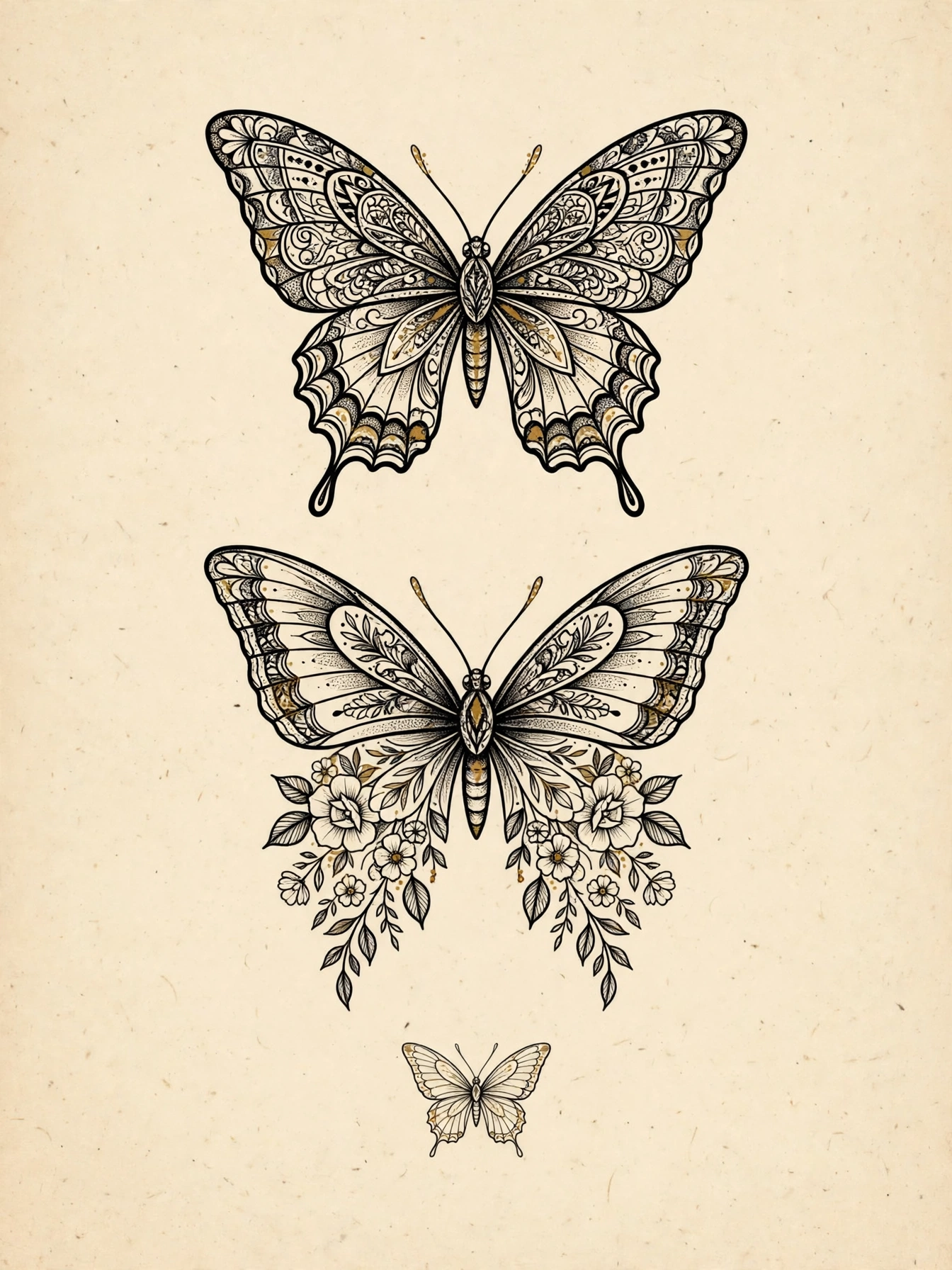
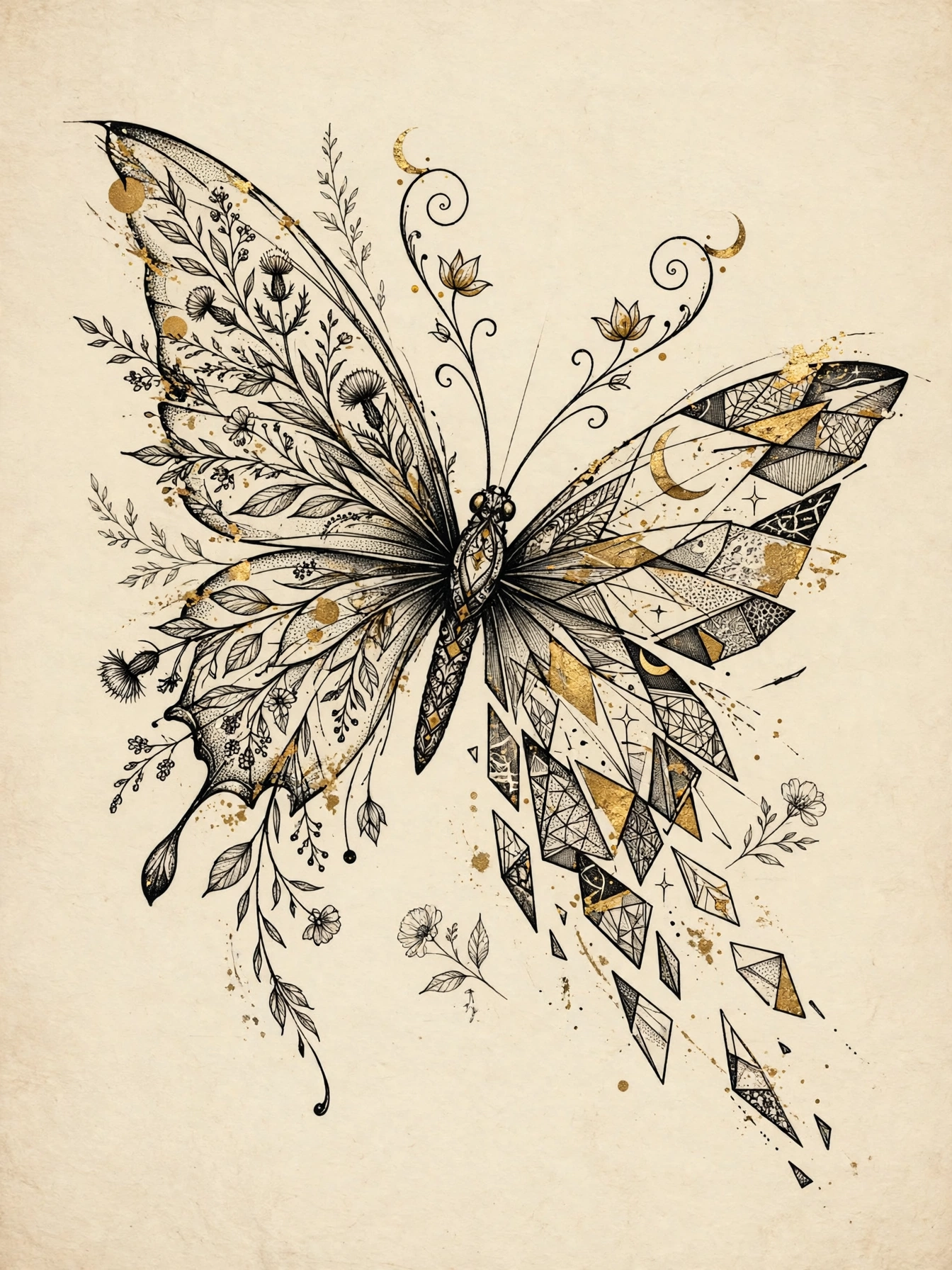
Symmetrical blue morpho-style butterfly centred between the shoulder blades
Fine-line butterfly with birth flowers forming one wing on the forearm
Small monarch outline on the inner ankle with a dotted flight path
Butterfly and crescent moon pairing on the sternum
Blackwork butterfly with bold wing patterns on the upper arm
Two butterflies, one bud-sized and one open, for a parent and child on the collarbone
Watercolour butterfly over a healed scar area, designed with the artist's guidance
Half butterfly, half floral wing design along the side of the ribs
See also: All Tattoo Meanings · Manifestation Sigil Maker · Spirit Animal Finder.
The generator reads your birth date, your intention and your style, so the design it makes is yours, not a copy of someone else's.
Size (Tiny to Extra Large) and style in, cost range out. Ranges are estimates — an artist quote wins. A 20% tip is shown separately.
All 23 placements from our placement guides — pick a spot, optionally compare a second one, and see its pain range, healing time, fading and size guidance, quoted from the same guide data, with a link to the full placement guide. Ranges only — sources disagree, no single decimal is a fact.
Two sun signs in, an honest reading out — no invented percentages. The tool compares the two signs' elements and ruling planets, tells you where the pairing clicks and where it rubs, and turns it into a matching-tattoo idea with links to both sign guides.
Your Sun, Moon and Rising signs from your birth date and time — all three computed in your browser, with the Moon and Rising honestly labelled approximate. Each sign comes with a short traditional reading and a tattoo angle, plus links to its sign guide and to the wheel and fusion tools.
See the full list on the Tattoo Meanings main page.
Rose Tattoo Meanings explored honestly — what the rose has meant across cultures, design variations that change the message, placement notes and ideas.
Phoenix Tattoo Meanings explored honestly — what the phoenix has meant across cultures, design variations that change the message, placement notes and ideas.
Lotus Tattoo Meanings explored honestly — what the lotus has meant across cultures, design variations that change the message, placement notes and ideas.
Dragon Tattoo Meanings explored honestly — what the dragon has meant across cultures, design variations that change the message, placement notes and ideas.
The best-known is the journey from caterpillar to winged insect, which people use to mark recovery, sobriety, surviving illness, leaving a damaging situation or simply growing into a different person. Because the change is total but the creature is the same, it is a hopeful symbol that does not deny the earlier stage.
In some readings, yes — a butterfly with a skull or with one dark wing and one bright wing is used to hold life and death, or grief and hope, in one image. More commonly the pairing is gentler: butterflies with flowers for a person who loved gardens, or a butterfly resting on a name as a sign of a spirit still present.
Only in the sense that any tattoo does. Butterflies are chosen by people of all genders, in styles from soft fine line to heavy blackwork moths and death-head designs. Wing shape, colour and companions decide the tone far more than the insect itself — a bold traditional butterfly reads nothing like a pastel watercolour one.
Yes, if the wing pattern stays simple. A small butterfly needs a clear body and two or four clean wing shapes; detailed eye-spots, scales and colour gradients need a larger canvas. At tiny sizes, a silhouette or simple outline butterfly ages far better than a miniature realistic one.
They use the same transformation story differently. A moth is drawn to light and works at night, so moth tattoos lean toward intuition, shadow and being drawn to what others avoid. Butterflies are daytime creatures and lean toward openness and visible change. Luna and death-head moths have their own specific associations in popular culture.
AI designs are for inspiration only. Always consult a licensed tattoo artist. Astrology on this site is for inspiration and self-expression. This page does not provide medical advice. Last reviewed: 25 November 2026.