Tattoo Cost Estimator
Size (Tiny to Extra Large) and style in, cost range out. Ranges are estimates — an artist quote wins. A 20% tip is shown separately.
Dragon Tattoo Meanings · Tattoo Meanings
Dragon Tattoo Meanings explored honestly — what the dragon has meant across cultures, design variations that change the message, placement notes and ideas.
A dragon tattoo means opposite things on opposite sides of the world — and that is exactly what makes it worth choosing carefully. In East Asian traditions the dragon is a wise, water-bringing protector; in Western tradition it is the fire-breathing adversary. This guide explains both, so the dragon you wear says what you intend.
This page sits under Tattoo Meanings.
Key takeaways
| What | What to expect |
|---|---|
| Core meanings | Power, wisdom, protection and good fortune in East Asian traditions; danger, chaos and a worthy adversary in many Western traditions |
| Watch out | East Asian and Western dragons are visually distinct — claws, whiskers, wings and body shape signal which tradition you are quoting, and mixing them carelessly muddles the reference |
| Pairs well with | Waves, clouds, pearls, tigers, cherry blossom, koi, swords and knights in Western designs, and zodiac animals |
In Chinese tradition, the dragon is associated with imperial power, wisdom, strength and good fortune, and with control of water and rain. In Japanese tradition, dragons are similarly linked with water, wisdom and protection. In much of Western tradition, by contrast, the dragon is a dangerous, fire-breathing hoarder — the chaos a hero must defeat. Same creature, opposite reputations.
The Eastern dragon is a benefactor. In Chinese tradition, dragons are associated with rain, rivers and seas, with the Dragon Kings ruling the waters, and the dragon became the emblem of the emperor — power that is cosmic and ordering rather than merely violent. A dragon appearing was an omen of fortune, not fear. In Japanese tradition, dragons inherited much of this character: wise, water-linked beings, sometimes shape-shifting, generally protective of those who respect them.
The Western dragon grew from different soil. In Greek myth, dragons guarded treasures and sacred places; in Norse tradition, Fafnir is a dwarf transformed by greed into a hoarding dragon; in medieval European stories, dragons like the one fought by Saint George embody chaos, danger and evil to be overcome. Fire, wings and a cave of gold belong to this tradition. Neither reading is wrong — they are two civilisations answering different questions with the same imaginary animal.
Today, people choose Eastern dragons for wisdom, protection, strength under control and good fortune, and Western dragons for raw power, defiance and a love of fantasy. The tradition you draw from decides what your tattoo claims — so decide it first.
The Eastern dragon's modern wearers usually want power with discipline: strength that protects, success earned through wisdom, or a guardian carried on the skin. It is one of the most chosen large designs in Japanese-style tattooing, where a dragon can anchor an entire back or sleeve, and it is frequently chosen by people marking their zodiac year or honouring family heritage — contexts where the benevolent reading is the whole point.
Western dragon wearers tend to want the edge: untamed power, independence, a guardian that is dangerous to everyone else. Fantasy literature and games have softened the Western dragon into something people identify with rather than fear, so a modern Western dragon often means fierce self-possession rather than evil. Both readings are legitimate. What does not work is drifting between them accidentally — whiskers and waves promise one story, bat wings and fire tell another.
Anatomy announces the tradition. Eastern dragons are long, serpentine and wingless, with whiskers, horns and clawed feet, moving through waves and clouds, often chasing a flaming pearl of wisdom. Western dragons have bat-like wings, heavier bodies and a more lizard-like menace, posed with castles, swords or hoards. Colour, companions and posture complete the statement each design makes.
Look at the head first: an Eastern dragon's whiskered, antlered head reads as an ancient water sage; a Western dragon's horned, fanged head reads as a predator. Eastern dragons fly without wings, carried by their own power, and are drawn in motion — coiling, diving, rising — because water and wind are their element. The pearl they chase or guard is associated with wisdom and enlightenment, and including it tilts the design firmly toward the Eastern meaning.
Companions settle any doubt. Waves, wind bars, cherry blossom, koi and tigers place a dragon in the Japanese and Chinese visual world; a tiger pairing specifically suggests balanced opposing forces. Swords, shields, castles and flames place it in the European one.
Dragons are movement tattoos and need room to move: the back, chest, ribs and full arm are their classic homes, where a long body can coil with the wearer's own lines. Small dragons must be simplified to silhouettes — detailed whiskers, scales and claws cannot survive shrinking.
The best dragon placements use the body's length. A back piece lets an Eastern dragon dive from shoulder to hip through clouds and water; a sleeve lets it wind around the arm so the head lands on the chest or hand; ribs give a tall, curved field for a rising dragon. Western dragons, being winged and frontal, suit the chest and upper back, where spread wings can mirror the shoulders symmetrically.
Plan for sessions, not a sitting. A detailed dragon is among the most time-intensive subjects in tattooing, and large traditional pieces are built in stages — outline, then shading, then colour — sometimes over months. That staging is an advantage: you can confirm the flow of the body on your own frame before detail locks it in. Avoid high-stretch placements for the head and face, since distortion hits the most expressive part of the design first.
Make a dragon yours by committing to its tradition and its story: choose the Eastern guardian or the Western power, give it your zodiac year, a pearl inscribed with a private detail,. A dragon is a declaration — the wearers who love theirs longest are the ones who knew which dragon they were getting.
The ideas below split deliberately between the two traditions, and each can be scaled from a forearm piece to a full back. When you brief your artist, lead with the tradition, because it determines the anatomy, the background elements and the mood before a single line is drawn. Bring reference images from that tradition only — a mixed reference folder produces a mixed dragon.
For traditional Eastern work especially, choose an artist who specialises in it. The flow of a dragon's body around yours, the balance of water and cloud background, and details like claws and colour are a learned visual language, and the difference between a fluent piece and an imitation is visible across a room.
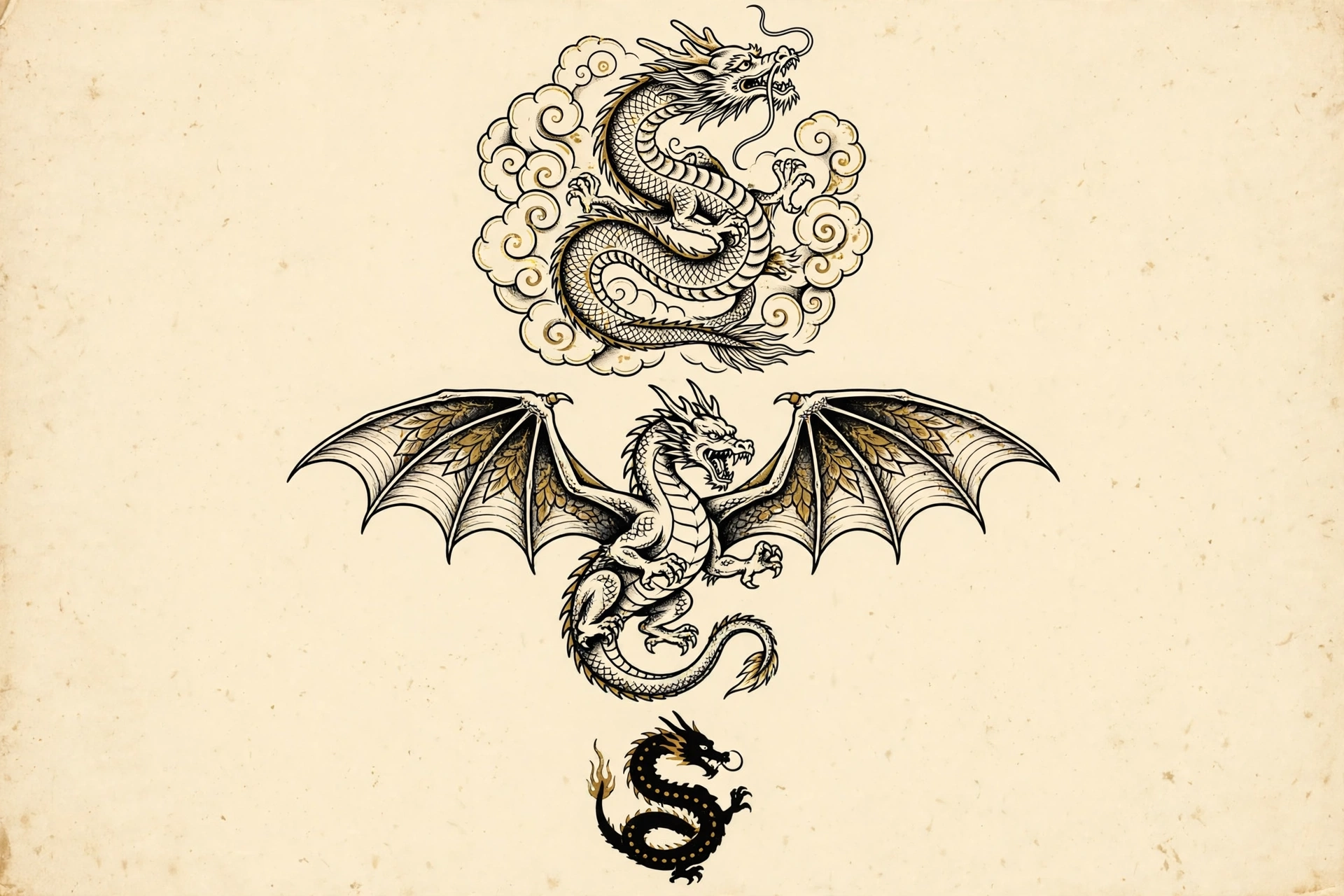
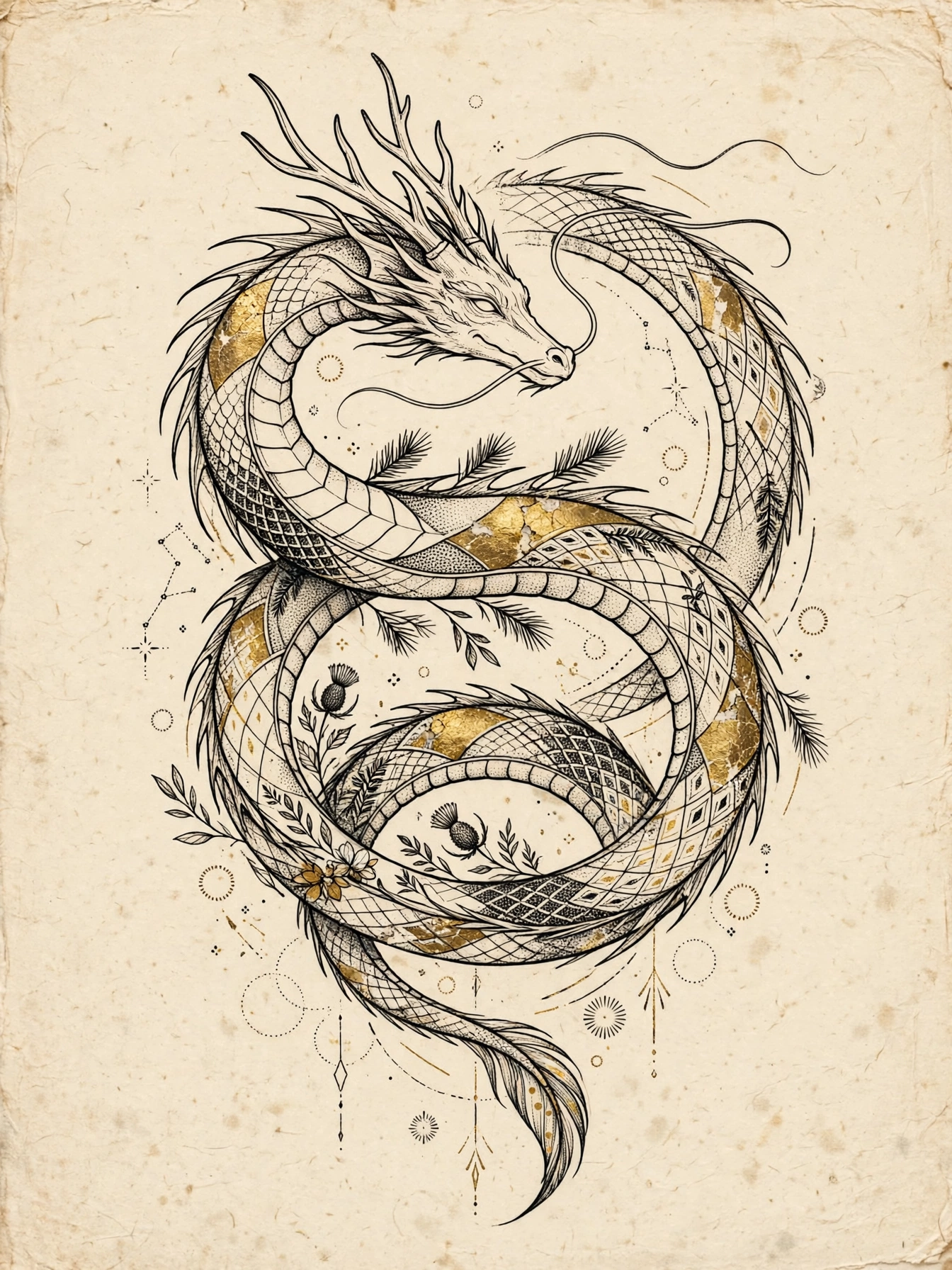
Japanese-style dragon winding down the upper arm through waves and blossom
Full-back Eastern dragon chasing a pearl through clouds
Western dragon with spread wings across the chest in black and grey
Small coiled dragon silhouette on the shoulder blade
Dragon and tiger balanced pair across the two sides of the back
Fine-line Eastern dragon along the ribs with whiskered head and flowing body
Traditional green dragon on the calf among wind bars and water
Dragon wrapped around a sword on the forearm in a Western design
See also: All Tattoo Meanings · Manifestation Sigil Maker · Spirit Animal Finder.
The generator reads your birth date, your intention and your style, so the design it makes is yours, not a copy of someone else's.
Size (Tiny to Extra Large) and style in, cost range out. Ranges are estimates — an artist quote wins. A 20% tip is shown separately.
All 23 placements from our placement guides — pick a spot, optionally compare a second one, and see its pain range, healing time, fading and size guidance, quoted from the same guide data, with a link to the full placement guide. Ranges only — sources disagree, no single decimal is a fact.
Two sun signs in, an honest reading out — no invented percentages. The tool compares the two signs' elements and ruling planets, tells you where the pairing clicks and where it rubs, and turns it into a matching-tattoo idea with links to both sign guides.
Your Sun, Moon and Rising signs from your birth date and time — all three computed in your browser, with the Moon and Rising honestly labelled approximate. Each sign comes with a short traditional reading and a tattoo angle, plus links to its sign guide and to the wheel and fusion tools.
See the full list on the Tattoo Meanings main page.
Phoenix Tattoo Meanings explored honestly — what the phoenix has meant across cultures, design variations that change the message, placement notes and ideas.
Snake Tattoo Meanings explored honestly — what the snake has meant across cultures, design variations that change the message, placement notes and ideas.
Butterfly Tattoo Meanings explored honestly — what the butterfly has meant across cultures, design variations that change the message, placement notes and ideas.
Rose Tattoo Meanings explored honestly — what the rose has meant across cultures, design variations that change the message, placement notes and ideas.
In East Asian traditions, dragons are associated with water, rain, wisdom, strength and good fortune, and are generally benevolent protectors. In many Western traditions, dragons are fire-breathing hoarders and adversaries that heroes must defeat. The same word names near-opposite creatures, which is why a dragon tattoo should be clear about which tradition it belongs to.
In Japanese tattoo tradition, dragon colour carries associations — green with nature, black with wisdom and experience, gold with value and prosperity, among others — though readings vary and are not a fixed code. In modern Western tattooing, colour is usually chosen for look and contrast. If traditional colour meaning matters to you, discuss it with an artist experienced in Japanese work.
Japanese dragon designs traditionally show three claws, Chinese designs often five, and Korean designs four, in popular accounts of the traditions — claw count is one of the details specialists notice. Most wearers do not need to be exact, but if you are commissioning an authentic traditional piece, it is a detail worth raising with your artist.
It is harder than most subjects, because the dragon's scales, whiskers and flowing body lose definition when shrunk. Small dragons work as simplified silhouettes or single-line coils, but a detailed traditional dragon needs a forearm at minimum, and preferably a back, chest or full arm. A good artist will tell you honestly if your size is too small.
In East Asian tradition the dragon and tiger are a classic pairing representing balanced opposing forces — the dragon linked with heaven, water and wisdom, the tiger with earth and raw power. Together they state equilibrium rather than conflict. The pairing is a foundation of many large Japanese-style pieces.
AI designs are for inspiration only. Always consult a licensed tattoo artist. Astrology on this site is for inspiration and self-expression. This page does not provide medical advice. Last reviewed: 25 November 2026.