Tattoo Cost Estimator
Size (Tiny to Extra Large) and style in, cost range out. Ranges are estimates — an artist quote wins. A 20% tip is shown separately.
Snake Tattoo Meanings · Tattoo Meanings
Snake Tattoo Meanings explored honestly — what the snake has meant across cultures, design variations that change the message, placement notes and ideas.
A snake tattoo holds two reputations at once: healer and tempter, rebirth and danger. The snake sheds its skin and emerges renewed, which is why cultures have linked it with healing and eternal cycles — and why others cast it as the creature to beware. This guide explains both sides, and how design choices pick one.
This page sits under Tattoo Meanings.
Key takeaways
| What | What to expect |
|---|---|
| Core meanings | Rebirth and renewal through shedding skin, transformation, healing, protection, temptation and dangerous knowledge |
| Watch out | A snake's reading flips with context — coiled with an apple it suggests temptation, wrapped on a staff it suggests healing; species and companions decide the story |
| Pairs well with | Roses, daggers, skulls, moons, lotus and peonies, apples, swords, and a Rod of Asclepius for a healing meaning |
Snakes carry opposite meanings because they do opposite things: they heal and they kill. In Greek tradition, the snake-entwined Rod of Asclepius became an emblem of medicine and healing. The ouroboros, a snake eating its own tail, appears in Egyptian and Greek traditions as a symbol of eternity and cycles.
The healing snake is older than most people expect. In Greek tradition, Asclepius, associated with medicine, carried a staff with a single snake wrapped around it, and that image — the Rod of Asclepius — is still used as a medical emblem today. The connection likely grew from watching snakes shed their skins and emerge renewed: an animal that visibly restores itself became a natural sign for recovery and renewal.
The dangerous snake is just as rooted. In the Genesis story, the serpent is the tempter in Eden, which fixed the snake's association with forbidden knowledge and the fall in Western imagination. In Norse tradition, the world serpent Jormungandr encircles the earth — an ouroboros-like image of a cycle too large to escape. In Hindu tradition, nagas are powerful serpent beings associated with water, fertility and protection, revered rather than feared. A snake tattoo inherits all of this, which is why its companions and posture matter so much.
Today most snake tattoos are about transformation and self-possession: shedding an old life, surviving and emerging different, or carrying a quiet, watchful power. Medical workers sometimes choose the Asclepius snake for healing. Others want the edge — a creature that is beautiful, unbothered and not to be handled carelessly. The snake suits people whose story involves becoming someone new.
The shedding reading dominates modern snake tattoos, and it is easy to see why: the snake does not change gradually, it leaves its old skin behind in one piece and moves on. People mark recoveries, reinventions and escapes with it — the old life quite literally sloughed off. Unlike the butterfly, the snake's transformation keeps its danger; the new self is not softer than the old one, just freer.
There is also an identity reading that has grown with the symbol's popularity: the snake as calm, self-contained and uninterested in approval, striking only when provoked.
Posture and companions decide which snake you are wearing. A snake coiled around a staff or a lotus reads as healing and renewal; a snake with an apple, a dagger or a skull reads as temptation, danger or mortality. An ouroboros states cycles and eternity.
The head carries the attitude. A cobra with its hood spread is a warning display — protection through threat. A snake with its head resting calmly along its coils is a creature at rest in its own skin. Fangs and a forked tongue push toward danger; a closed mouth and smooth curves push toward elegance and renewal. Species identification matters too: a recognisable cobra, rattlesnake or python imports that animal's real reputation into your design.
What the snake wraps around is its sentence's second half. Around a dagger: conflict, betrayal or survival. Through a skull: mortality faced directly. Around a rose or peony: beauty and danger in balance, a classic pairing in both Western and Japanese tattooing. Eating its own tail: the ouroboros, the purest statement of cycles. Left entirely alone on a long placement, a snake reads as pure form and movement — which is why spine and arm snakes are often left unaccompanied.
The snake is the most placeable large subject in tattooing because it is a line that moves: it coils around arms and legs, runs down spines, wraps ribs, ankles and wrists, and settles into circles on shoulders, hips and the chest. Small single-line snakes suit fingers and behind the ear.
No other symbol follows the body this naturally. A snake can be designed to climb a forearm, spiral a calf, descend a spine or circle a wrist like a living bracelet, and a good artist will draw it for your specific limb, adjusting the coils to your muscles so the snake appears to move when you do. That made-to-measure quality is the difference between a snake tattoo that looks alive and one that looks pasted on.
Scale decisions are about pattern. Realistic scales, belly plates and species markings are fine detail that needs room and a specialist's patience; at small sizes, commit to the elegant alternative — one continuous line, a defined head, no scales — which ages gracefully almost anywhere. Hand and finger snakes are striking but sit on fast-wearing skin, so keep them bold and simple and expect maintenance.
Make a snake yours by choosing its moment and its partner: caught mid-shed for a life in transition, wrapped around the flower of your birth month, forming an ouroboros with a date inside the circle, or drawn as the species tied to your home country. The snake supplies the power — your choices decide whether it heals, warns or transforms.
The ideas below cover the snake's main families — healing, temptation, cycles and pure form — at scales from a finger line to a full arm wrap. When you brief your artist, state the reading first: healer, danger, rebirth or elegance. That one word sets the posture, the companions and the amount of menace in the head, and it prevents the common disappointment of a beautiful snake that says the wrong thing.
Because snakes are drawn to fit, bring your artist the placement early and let them design on your body rather than approving a flat drawing. A snake done well is one of the most striking tattoos there is; it is worth the planning.
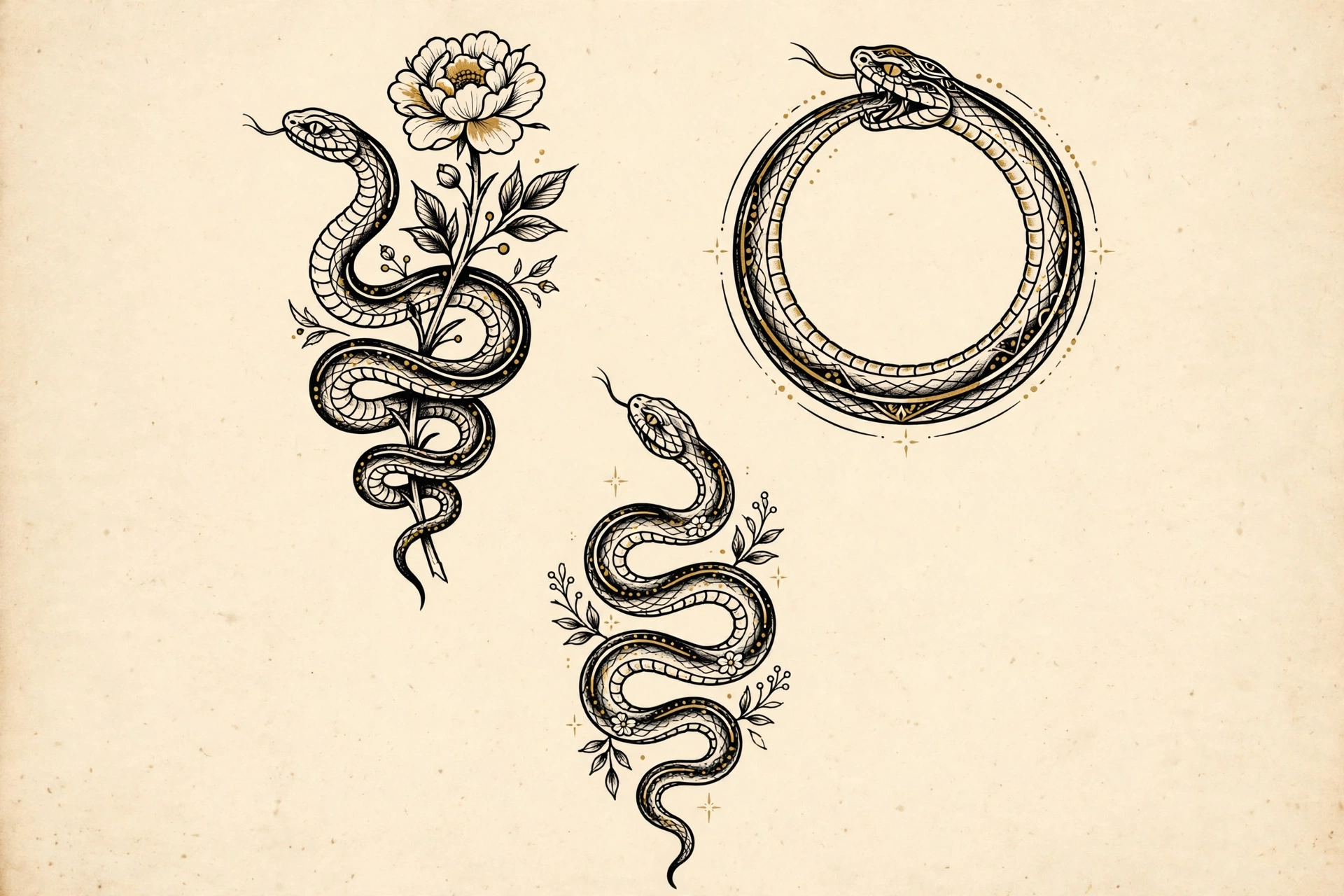
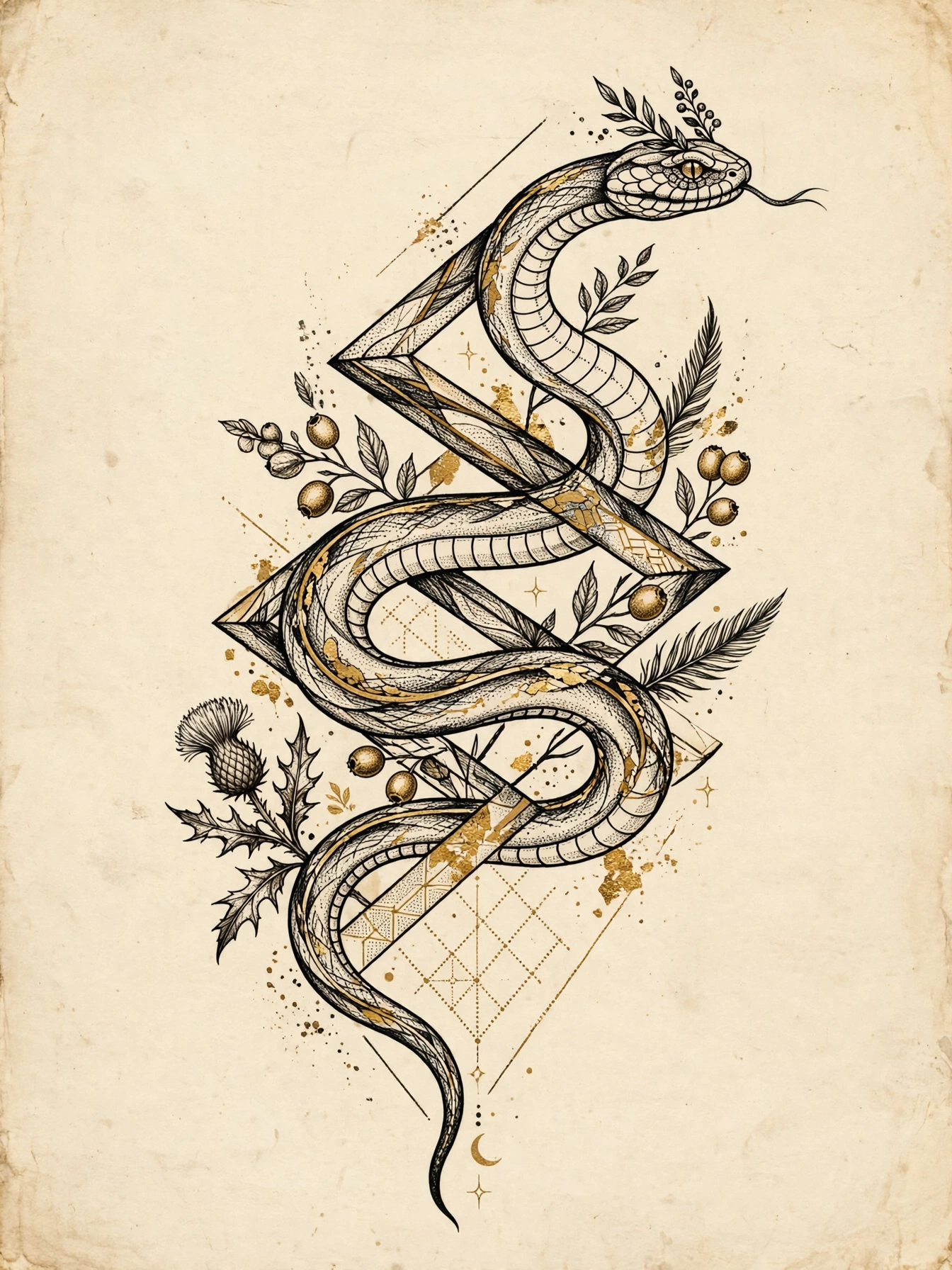
Fine-line snake coiling down the spine with a small moon at its head
Ouroboros circle on the upper arm in plain black line
Snake entwined with a rose stem on the forearm, thorns and scales together
Japanese-style snake with peonies wrapping the upper arm
Blackwork coiled snake on the back of the hand, head resting at the knuckles
Snake and dagger vertical design on the calf
Tiny single-line snake behind the ear or along a finger
Snake wrapped around a lotus stem on the sternum, rising and blooming together
See also: All Tattoo Meanings · Manifestation Sigil Maker · Spirit Animal Finder.
The generator reads your birth date, your intention and your style, so the design it makes is yours, not a copy of someone else's.
Size (Tiny to Extra Large) and style in, cost range out. Ranges are estimates — an artist quote wins. A 20% tip is shown separately.
All 23 placements from our placement guides — pick a spot, optionally compare a second one, and see its pain range, healing time, fading and size guidance, quoted from the same guide data, with a link to the full placement guide. Ranges only — sources disagree, no single decimal is a fact.
Two sun signs in, an honest reading out — no invented percentages. The tool compares the two signs' elements and ruling planets, tells you where the pairing clicks and where it rubs, and turns it into a matching-tattoo idea with links to both sign guides.
Your Sun, Moon and Rising signs from your birth date and time — all three computed in your browser, with the Moon and Rising honestly labelled approximate. Each sign comes with a short traditional reading and a tattoo angle, plus links to its sign guide and to the wheel and fusion tools.
See the full list on the Tattoo Meanings main page.
Dragon Tattoo Meanings explored honestly — what the dragon has meant across cultures, design variations that change the message, placement notes and ideas.
Phoenix Tattoo Meanings explored honestly — what the phoenix has meant across cultures, design variations that change the message, placement notes and ideas.
Butterfly Tattoo Meanings explored honestly — what the butterfly has meant across cultures, design variations that change the message, placement notes and ideas.
Rose Tattoo Meanings explored honestly — what the rose has meant across cultures, design variations that change the message, placement notes and ideas.
The ouroboros — a snake eating its own tail, forming a circle — is an ancient symbol found in Egyptian and Greek traditions and later used in alchemy, associated with eternity, cycles and self-renewal: the end feeding the beginning. As a tattoo it usually means a life understood as cycles, or a self that continually remakes itself.
It can mean either, and context decides. Snakes are associated with healing in Greek tradition — the snake-entwined Rod of Asclepius remains a medical emblem — and with rebirth wherever shedding skin is the focus. They are associated with danger and temptation through the serpent in the Garden of Eden story and through their real venom. Your design's companions tell viewers which snake you mean.
Traditionally, in Japanese tattooing, a snake paired with peonies is a recognised combination, the flowers softening and balancing the snake's dangerous edge. Roses do similar work in Western designs — beauty with a bite. If you want a gentler snake, flowers are the classic way to say so without removing the snake's character.
A simplified snake — one clean coiling line with a defined head — works at small sizes on a finger, wrist or ankle, and fine-line snakes are popular exactly because the form is a single flowing shape. Detailed scales, patterns and forked-tongue realism need more room, and scale patterns are usually the first detail to blur.
Mostly placement and taste. A snake tattoo is a design; a real snake's danger, shedding and behaviour are where its symbolism comes from. People who keep snakes often get portraits of their own animals, which are personal rather than symbolic. Either way, a recognisable species in the design — cobra, python, viper — carries that species' reputation with it.
AI designs are for inspiration only. Always consult a licensed tattoo artist. Astrology on this site is for inspiration and self-expression. This page does not provide medical advice. Last reviewed: 25 November 2026.