AI Tattoo Generator
Generate a design for this placement — your sign, your intention, your style. Free, no sign-up.
full sleeve tattoos
Full sleeve tattoos: cost $2,000-$12,000, 15-50 hours over 4-8 sessions, ideas, and how to plan one piece instead of scattered tattoos.
Generate a design for this placement →
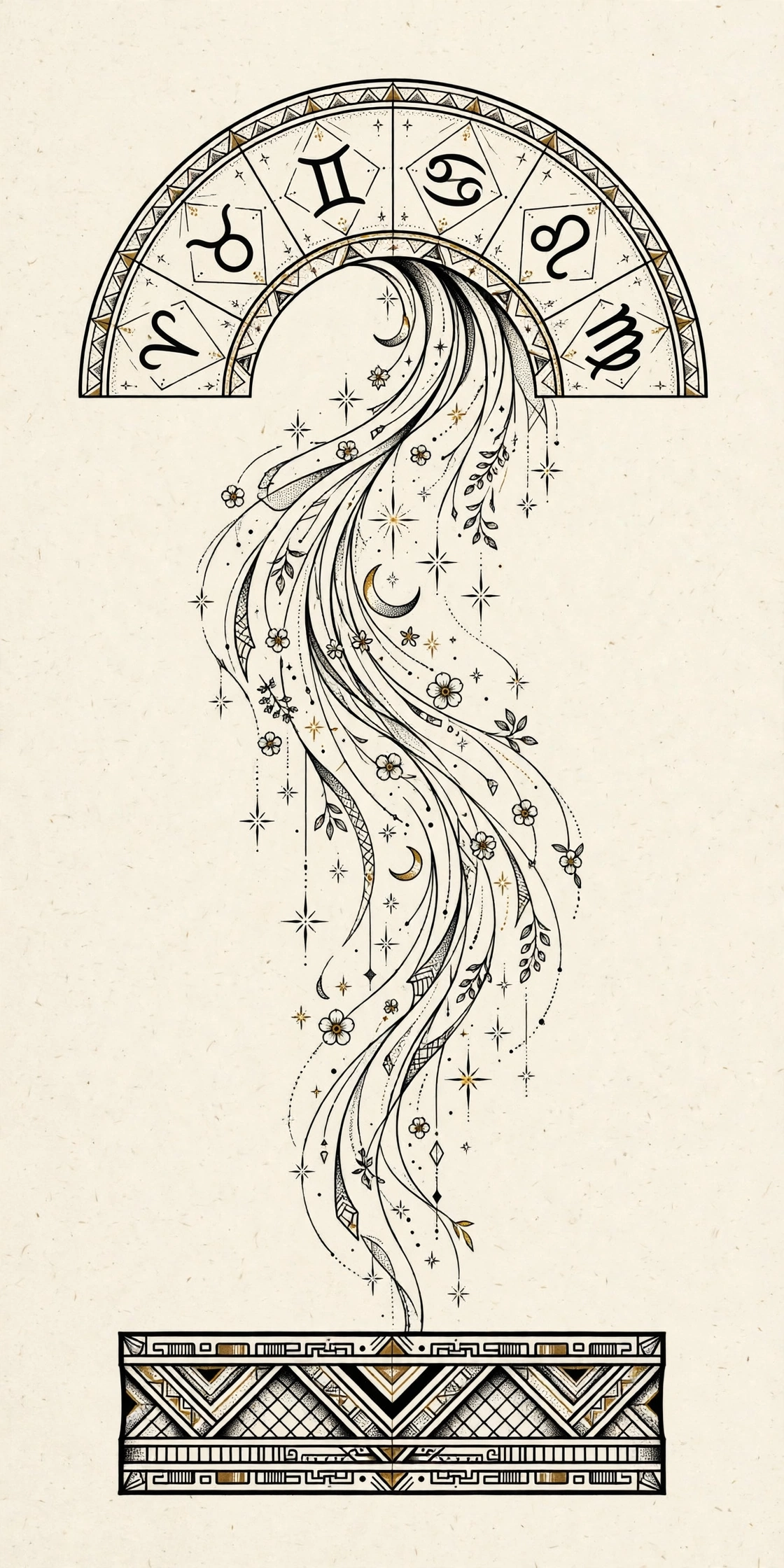
A full sleeve tattoo covers the whole arm from shoulder to wrist, usually 35 cm or more. It suits someone ready for a major, multi-session commitment — a single themed piece, planned as one design rather than a collection of separate tattoos, that takes months to complete.
Key takeaways
| What | What to expect |
|---|---|
| Size | 35 cm+ (XL class) |
| Pain | 3-8/10 by zone |
| Healing | Multi-session, months |
| Fading | Slow on outer arm, fast at wrist/hand |
Pain is a consensus range — artists and charts disagree on the exact number, so treat it as a range, not a measurement. Only a licensed artist who sees the design and the body part can give you a real quote.
A full sleeve works best when it is planned as one piece from the start, with a single theme, a consistent style and a clear flow down the arm. A sleeve built from unrelated tattoos added one at a time rarely looks as coherent as a sleeve designed as a whole.
Start with the theme, not the individual images. A sleeve needs an idea big enough to fill an arm — a journey, a story, a landscape, a set of symbols that belong together — and every element should earn its place in that story. A zodiac wheel flowing down the arm, a forest scene, an ocean journey or a myth told in panels are all themes that can fill a sleeve naturally.
The flow matters as much as the theme. A sleeve is seen from many angles and in motion, so the design needs to work when the arm bends, turns and moves. Background elements — clouds, waves, smoke, foliage — connect the main images and stop the sleeve looking like separate pictures pasted onto an arm.
Choose your artist with the same care as your theme. A full sleeve means many hours together over months, so look at healed sleeves the artist has finished, not just fresh photos, and make sure you like their work in the style you want. A sleeve is a collaboration, and the artist's judgement about flow, spacing and background will shape the result as much as your ideas.
A full sleeve is a long project: the record for this placement describes 15–50 hours of tattooing, typically spread over 4–8 sessions across 3–12 months. Healing happens between sessions, so the sleeve grows gradually rather than appearing all at once.
Most sleeves are built in stages. An artist will often outline the whole sleeve first, or complete one section at a time — the upper arm, then the forearm, then the joins between them — so that each session has a clear goal and the design stays coherent as it grows.
Time between sessions matters. Skin needs to heal fully before the next session, and your artist will advise on the gap based on how your skin recovers. Rushing sessions can slow healing and affect how the ink settles, so a sleeve that takes a year is not a sleeve that went wrong — it is a sleeve that was given time.
Expect the experience to vary by zone. The outer arm is generally the most comfortable part of a sleeve, while the elbow, wrist and inner arm are the most sensitive. Knowing that in advance helps you plan: many people schedule the tougher zones for sessions when they are well rested, and save the easier zones for days when they have less energy.
A full sleeve is a significant investment that varies widely with the artist, the style, the amount of detail and the number of sessions. The honest answer is that no fixed price fits every sleeve, and an artist's quote for your design, after a consultation, is worth far more than any general estimate.
Several things move the cost. A highly detailed realism sleeve takes more hours than a bold blackwork sleeve of the same size, a well-known artist usually charges more than a newer one, and colour work can add time compared with black and grey. The number of sessions, and the length of each one, is the biggest single factor — more hours means a higher total, however the artist charges.
Ask how the artist charges before you commit: by the hour, by the session, or a set price for the whole sleeve. Each approach has its own advantages, and understanding it in advance avoids surprises halfway through. A deposit is normal, and it is worth asking what happens if you need to reschedule a session.
The cheapest sleeve is rarely the best value. A sleeve covers your whole arm and will be with you for decades, so the artist's skill, the quality of the planning and the way the design ages matter far more than saving money on the first session. Take time to find the right artist rather than the cheapest one.
Pain varies by zone across a sleeve, reported in the 3–8/10 range depending on where the needle is working. The outer arm is generally lower pain, the elbow, wrist and inner arm are the most sensitive, and fading is slow on the outer arm but faster at the wrist and hand.
The elbow deserves special respect. The skin is thin over bone, the joint moves constantly, and the inner elbow creases with every bend, so ink there fades faster and touch-ups are more likely. Many artists plan the elbow as a background or a bold shape rather than a detailed focal point, because detail there is hard to keep crisp.
The wrist and hand are the other end of the sleeve, and they fade fastest. Sun, washing and friction wear at the ink, so a sleeve that ends at the wrist will need more attention at that end than at the shoulder. Some people choose to end the sleeve above the wrist for exactly this reason.
The shoulder and outer arm are the most forgiving zones. They have more flesh, they are usually covered, and they hold detail well, which is why many sleeves place their strongest images there. Healing for a sleeve is multi-session and takes months overall, with each session healing in its own time — follow your artist's aftercare guidance after every session, not just the first.
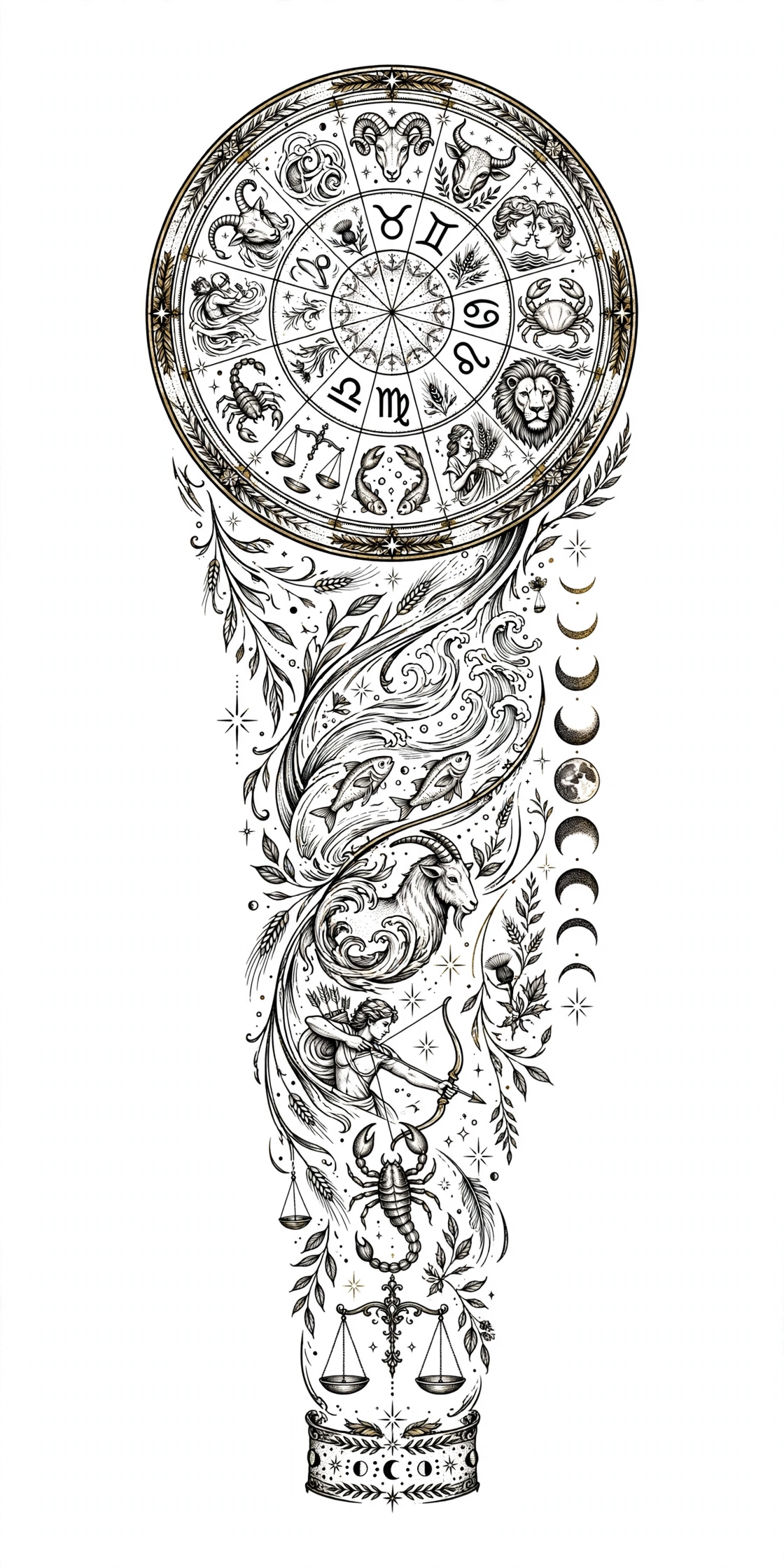
A zodiac wheel flowing down the arm, with the twelve signs arranged around the upper arm and the constellations trailing down the forearm in fine line.
A forest sleeve, with tall trees on the upper arm, a deer or a wolf in the middle, and ferns and mushrooms filling the forearm down to the wrist.
An ocean journey from shoulder to wrist, with waves at the top, a whale or a ship in the middle, and coral and small fish near the wrist.
A Japanese-style sleeve with a koi fish swimming up the arm, cherry blossom falling across the shoulder, and waves filling the background.
A mythological sleeve telling one story in panels, such as a hero's journey, with each scene flowing into the next through clouds or foliage.
A blackwork sleeve of bold geometric patterns and dotwork shading, with a large mandala on the shoulder and the pattern flowing down the arm.
A celestial sleeve with the sun and moon on the upper arm, stars and constellations across the forearm, and a small planet near the wrist.
A nature sleeve of mountains, forests and animals, with a mountain range on the shoulder, a bear or an eagle in the middle, and a river running to the wrist.
A floral sleeve of large blooms — roses, peonies and leaves — covering the arm in a continuous garden, with buds and petals filling every gap.
A portrait sleeve built around one person or one animal, with the main portrait on the upper arm and supporting symbols and scenery filling the forearm.
A full sleeve is the one placement where a zodiac idea can become a complete story rather than a single symbol. The most natural approach is a wheel of the twelve signs flowing down the arm, with the signs arranged around the upper arm and their constellations trailing down the forearm, so the whole sleeve reads as one connected chart. Another approach is a birth-chart theme: your sun, moon and rising signs as the main images, In astrology, a birth chart is read as an interpretation of personality and timing based on the positions of the sun, moon and planets at birth, not as a fixed prediction,
Generate a design for this placement — your sign, your intention, your style. Free, no sign-up.
Size (Tiny to Extra Large) and style in, cost range out. Ranges are estimates — an artist quote wins.
12 placements: Wrist, Forearm, Upper Arm, Chest, Back, Ribs, Thigh, Ankle, Neck, Hand, Foot, Inner Arm. Shows pain range, healing and fading for the chosen spot. Ranges only — sources disagree, no single decimal is a fact.
Upload a photo and preview the same design with fading, blur and line-spread for 1, 10, 30 or 50 years, plus a longevity score with reasons. A visual estimate — not a prediction.
Half sleeve tattoos: cost $800-$3,750, 8-15 hours, 2-4 sittings. Upper vs lower half sleeve, ideas, and how to extend to full later.
Estimates range $2,000-$12,000 depending on artist, style and detail. An artist quote wins over any calculator.
15-50 hours, typically 4-8 sessions over 3-12 months.
Most painful at elbow, wrist and inner arm; outer arm is lower pain.
Choose a theme big enough to fill an arm and personal enough to live with for decades — a story, a journey, a landscape or a set of symbols that belong together. Bring your ideas to a consultation and let your artist shape them into a design that flows down the arm, with background elements connecting the main images.
No — a full sleeve takes 15–50 hours, typically 4–8 sessions over 3–12 months. Skin needs to heal between sessions, and a single session that long would be unsafe and exhausting. A sleeve built gradually, with healing time between sessions, settles better and lasts longer.
Follow your artist's aftercare guidance after every session, not just the first. Keep each healed section clean and moisturised, protect it from sun, and wait until the skin has fully recovered before the next session. Your artist will advise on the gap based on how your skin heals.
AI designs are for inspiration only. Always consult a licensed tattoo artist. This page does not provide medical advice. Last reviewed: 24 November 2026.