Tattoo Cost Estimator
Size (Tiny to Extra Large) and style in, cost range out. Ranges are estimates — an artist quote wins. A 20% tip is shown separately.
Protection Symbol Tattoos · Tattoo Meanings
Protection Symbol Tattoos explored honestly — what the protection symbols has meant across cultures, design variations that change the message, placement notes and ideas.
A protection symbol tattoo is one of the oldest reasons people have ever marked their skin: a small, deliberate sign carried on the body to stand for safety, watchfulness and safe return. This guide explains what the best-known protective symbols have meant across cultures, and how to choose one honestly.
This page sits under Tattoo Meanings.
Key takeaways
| What | What to expect |
|---|---|
| Core meanings | Safety, watchfulness, safe journeys, warding off harm or ill intent, and a reminder to stay alert and grounded |
| Watch out | These symbols belong to living cultures and faiths; copying a sacred design as pure decoration can read as careless |
| Pairs well with | Moons, stars, snakes, olive branches, initials, dates, and small geometric frames that give the symbol a clear centre |
Across cultures, protective symbols share one job: they turn a wish for safety into something visible and carried. In Mediterranean and Middle Eastern cultures the evil eye is associated with deflecting envy and ill intent, while the hamsa hand is linked with protection and blessing. Other traditions developed their own signs for the same human hope.
The evil eye is a familiar motif around the Mediterranean and Middle East, where a stylised eye is associated with watching for harm and turning aside envy or bad luck. The hamsa, an open hand often holding an eye at its centre, appears in both Middle Eastern and North African traditions and is associated with protection, strength and blessing. The two are related in spirit but are not the same symbol, and neither is simply a generic good-luck charm.
In Buddhist tradition, the unalome is associated with the path to enlightenment, its spirals and dots representing the turns of a life moving toward clarity — protection here is guidance rather than a shield. In Celtic-associated design, interlaced knots and the triquetra are often read as symbols of unity and continuity, though many modern readings are later interpretations rather than documented ancient meanings. Norse-associated bind runes are similarly popular today, but specific protective claims for individual combinations are often modern rather than historical.
Today most people choose a protection symbol as a personal marker rather than a literal shield: a reminder after illness, loss, travel or a frightening year, or a quiet sign carried for a child or partner. The meaning is usually private — steadiness, vigilance and the intention to look after yourself and the people you love.
For many wearers the symbol marks a before and after. Someone who has come through surgery, a difficult birth, a long journey or a period of anxiety may choose a small protective sign as a way of saying that chapter is carried, not forgotten. Parents sometimes match a symbol to a child's birth or a family story, keeping the connection close without spelling it out in words.
Others choose one simply because they like the feeling of a watchful sign on the skin — an eye on the wrist they see while working, a small hand behind the ear, a knot over the heart. Read as personal interpretation, that is a perfectly honest meaning. What matters is knowing the difference between a symbol's cultural history and the private meaning you add to it, and being able to hold both without confusing them.
Small design choices shift what a protection tattoo says. An open eye reads as watchfulness, a closed or resting hand as calm blessing, and a symbol woven into a circle as continuity. Adding names, dates or birth flowers makes it specific to one person; keeping it plain and geometric makes it a general statement of intent.
An evil eye drawn with bold concentric circles in traditional blue reads as a direct nod to its Mediterranean roots, while the same eye reduced to fine lines and a single dot feels more like a private emblem. A hamsa filled with floral or celestial detail softens the message toward blessing and growth; a stark blackwork hamsa feels more like a guard sign. Neither is more correct — they simply speak differently.
The unalome changes meaning with direction and finish: the spiral, the wandering line and the ending dots are the point of the design, so simplifying it into a generic swirl loses the message. Knotwork designs gain weight when the line is genuinely unbroken. If a symbol's structure carries its meaning, ask your artist to preserve that structure even in a minimal version, rather than treating it as a decorative outline to be redrawn freely.
Protection symbols are often placed where the wearer can see them — wrist, hand, forearm or ankle — or over places that feel vulnerable, such as the chest, the back of the neck or between the shoulder blades. Small versions suit behind the ear or on a finger; detailed hamsa and knot designs need more room to stay readable.
Visible placements suit the watchful logic of these symbols. An eye or small hand on the inner wrist or forearm is a design you will actually look at during the day, which is part of the point for many people. Chest and sternum placements keep the symbol close and mostly private, while the upper back and the space between the shoulder blades are classic spots for a larger guardian-style piece.
Be practical about scale. An unalome's fine wandering line, a hamsa's inner detail and tight knotwork all blur if shrunk too far, and finger and hand tattoos fade faster than almost anywhere else. If you want a tiny version, simplify boldly — a plain eye, a small triquetra, a single spiral — and let a larger, detailed version live somewhere with room to breathe.
Start from the symbol whose history you genuinely connect with, then make one change that ties it to your life: your child's initial inside a hamsa, a birth flower beside an eye, or your own star sign worked into knotwork. That single personal layer is what turns a well-known protective sign into your tattoo.
Think of the ideas below as starting points for a conversation with your artist, not flash to copy line for line. A protection tattoo works best when the symbol stays recognisable — its recognisability is where the meaning lives — and the personal detail sits around it: a date in fine numerals, a constellation, a sprig of a meaningful plant, or a colour drawn from your own story.
If you are combining symbols from different traditions, pause and consider whether the combination makes sense or simply stacks imagery. One symbol chosen with understanding usually says more than three chosen from a search page. Your artist can also help you adapt a design respectfully — adjusting layout and ornament while keeping the core sign intact.
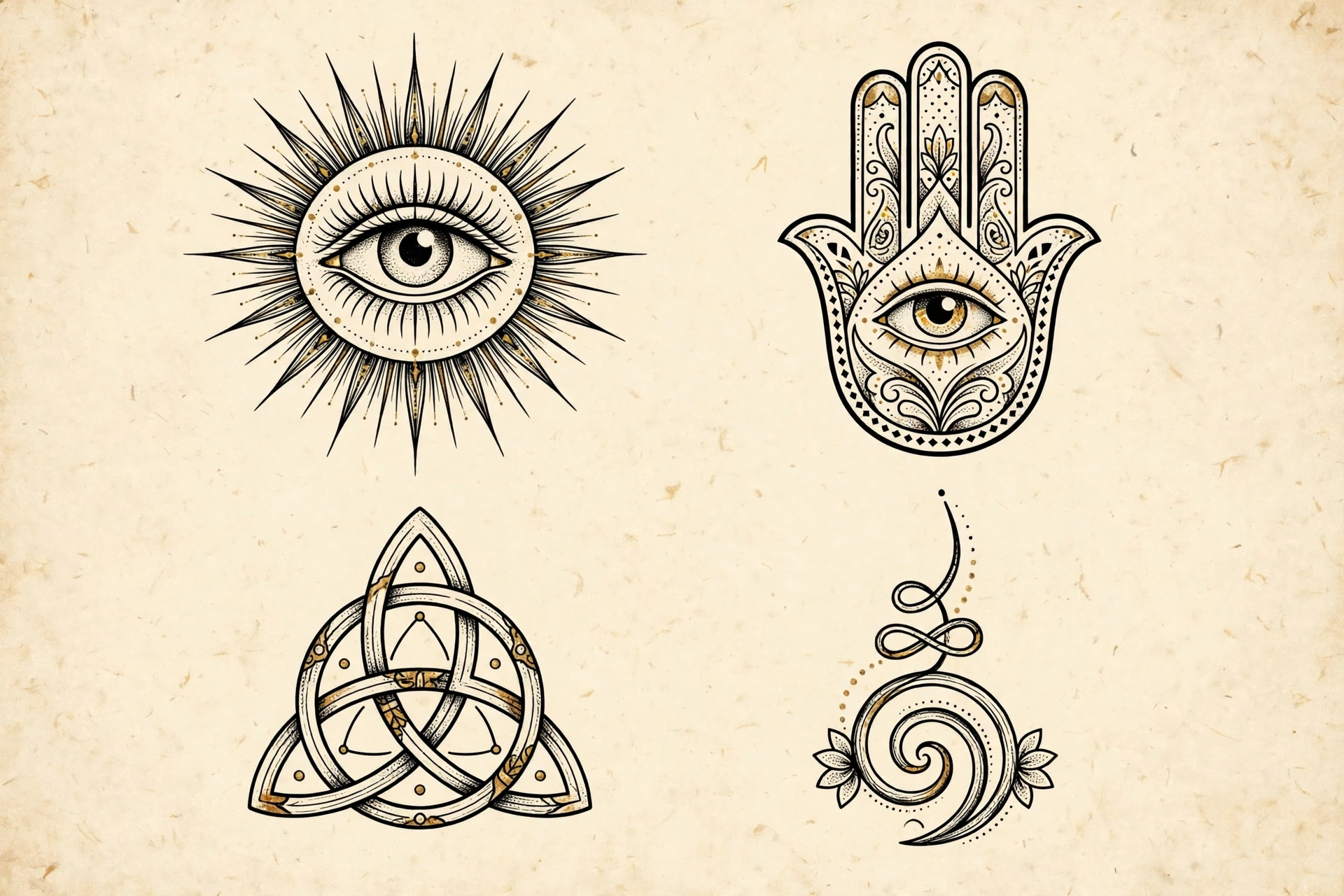
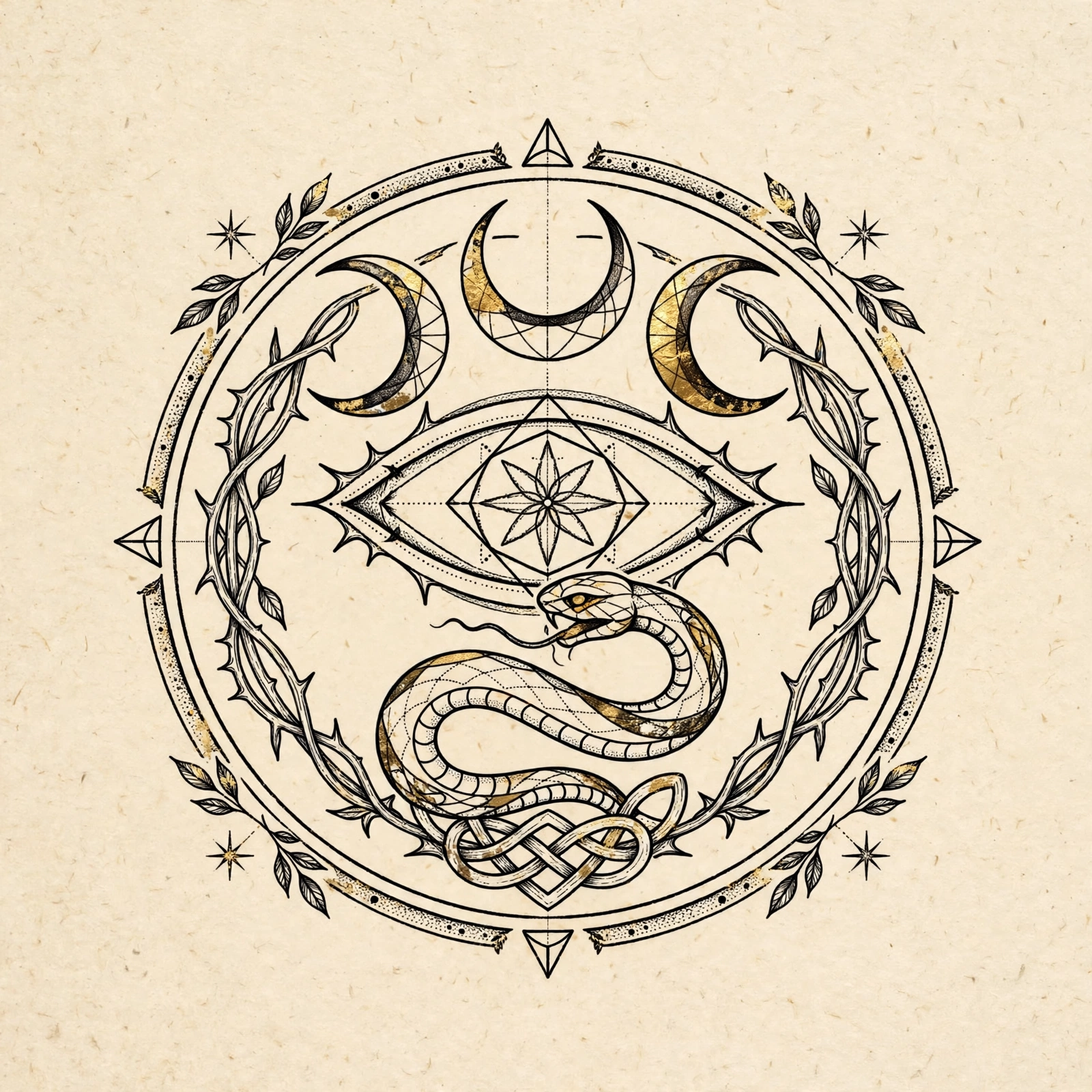
Fine-line evil eye on the inner wrist, single blue accent in the iris
Blackwork hamsa on the forearm with a tiny crescent moon in the palm
Small unalome between the shoulder blades with three clear ending dots
Triquetra inside a thin circle over the heart, plain and unshaded
Hamsa and olive branch sternum piece in soft dotwork shading
Minimal protective eye behind the ear with one short radiating line each side
Interlaced knot band around the ankle with a single star at the front
Evil eye framed by moon phases along the spine, small and vertical
See also: All Tattoo Meanings · Manifestation Sigil Maker · Spirit Animal Finder.
The generator reads your birth date, your intention and your style, so the design it makes is yours, not a copy of someone else's.
Size (Tiny to Extra Large) and style in, cost range out. Ranges are estimates — an artist quote wins. A 20% tip is shown separately.
All 23 placements from our placement guides — pick a spot, optionally compare a second one, and see its pain range, healing time, fading and size guidance, quoted from the same guide data, with a link to the full placement guide. Ranges only — sources disagree, no single decimal is a fact.
Two sun signs in, an honest reading out — no invented percentages. The tool compares the two signs' elements and ruling planets, tells you where the pairing clicks and where it rubs, and turns it into a matching-tattoo idea with links to both sign guides.
Your Sun, Moon and Rising signs from your birth date and time — all three computed in your browser, with the Moon and Rising honestly labelled approximate. Each sign comes with a short traditional reading and a tattoo angle, plus links to its sign guide and to the wheel and fusion tools.
See the full list on the Tattoo Meanings main page.
Sun Tattoo Meanings explored honestly — what the sun has meant across cultures, design variations that change the message, placement notes and ideas.
Moon Tattoo Meanings explored honestly — what the moon has meant across cultures, design variations that change the message, placement notes and ideas.
Star Tattoo Meanings explored honestly — what the star has meant across cultures, design variations that change the message, placement notes and ideas.
Lotus Tattoo Meanings explored honestly — what the lotus has meant across cultures, design variations that change the message, placement notes and ideas.
The evil eye and the hamsa are among the most widely recognised, both associated in Mediterranean and Middle Eastern cultures with deflecting ill intent and offering blessing. The unalome, from Buddhist tradition, is also popular, though its meaning is about the path through life rather than a shield.
It depends on how you approach it. Learning what the symbol means in its own tradition, keeping its structure intact and avoiding sacred imagery used as pure decoration are respectful basics. If a design is tied to a closed religious practice, ask questions first and be willing to choose differently.
Many people choose somewhere visible, like the wrist or forearm, because seeing the symbol is part of its purpose for them. The chest, back of the neck and between the shoulder blades suit larger or more private pieces. Match the size to the detail — fine knotwork and unalome lines need room.
Yes, if you simplify. A plain eye, a small triquetra or a short unalome can work at a few centimetres. Detailed hamsa designs and tight knotwork cannot shrink as far without blurring over time, so either give them more space or accept a bolder, simpler version.
You can, but combine with intention. An eye within a hamsa is a traditional pairing in its home cultures. Randomly stacking symbols from unrelated traditions can muddle the meaning and look careless. If two symbols both matter to you, ask your artist to give each its own clear space in the design.
AI designs are for inspiration only. Always consult a licensed tattoo artist. Astrology on this site is for inspiration and self-expression. This page does not provide medical advice. Last reviewed: 25 November 2026.