Tattoo Cost Estimator
Size (Tiny to Extra Large) and style in, cost range out. Ranges are estimates — an artist quote wins. A 20% tip is shown separately.
Sun Tattoo Meanings · Tattoo Meanings
Sun Tattoo Meanings explored honestly — what the sun has meant across cultures, design variations that change the message, placement notes and ideas.
A sun tattoo is the clearest symbol in the sky: light that leaves every night and still comes back. People choose it for renewal, vitality, honesty and survival, and its meaning shifts with the rays, the face and what you pair it with. This guide explains those meanings across cultures and in modern tattooing.
This page sits under Tattoo Meanings.
Key takeaways
| What | What to expect |
|---|---|
| Core meanings | Vitality, clarity, renewal, truth, endurance, and the steady return of light after dark periods |
| Watch out | A sun with a face or specific ray patterns can echo particular cultural or religious imagery; check the reference before copying it |
| Pairs well with | Moons, stars, waves, mountains, birth flowers, zodiac glyphs, and dates or initials set inside the disc |
Cultures around the world have treated the sun as a source of life, order and truth, because nothing else so visibly governs warmth, seasons and growing things. In ancient Egyptian tradition the sun was associated with the god Ra and the daily cycle of death and rebirth. In Japanese tradition it is linked with the goddess Amaterasu and national identity.
The sun's meanings start from observation: it rises, it warms, crops grow under it, and its return after winter or darkness feels like a promise kept. In ancient Egyptian religion, the sun's daily journey across the sky was associated with Ra and with a cycle of renewal, which is why solar imagery there connects light with life itself. In Greek tradition the sun was associated with Helios, who was said to see everything as he crossed the sky — one root of the sun's later link with truth and all-seeing clarity.
In Japanese tradition, the sun is associated with Amaterasu, a central deity in Shinto, and the rising sun remains a national symbol — which is also why rising-sun imagery should be used thoughtfully, since specific ray designs carry historical associations in parts of Asia. In several Indigenous traditions of the Americas, sun symbols are tied to life, healing and the calendar of seasons.
Most people who choose a sun today mean something personal by it: coming through a dark stretch, a naturally optimistic temperament, honesty, or a fresh start they want to mark permanently. It is also chosen for children — a literal ray of light — and, in astrology-minded designs, as a personal symbol of identity and vitality.
The comeback meaning is the most common modern reading. After illness, grief, a breakup or a hard few years, a sun says the light returned and so did you. Because the symbol is universally understood, it carries that message without needing any explanation to anyone who sees it — and without revealing the details of what the dark period actually was.
In astrology, the Sun represents the core self and vitality, and many people frame their sun tattoo that way — as personal interpretation, often combined with their zodiac sign's glyph at the centre of the disc. All of these are modern, personal meanings layered onto a very old symbol, and they sit comfortably alongside its history.
The rays do most of the talking. Straight, even rays feel ordered and strong; wavy rays feel warm and organic; a human face gives the sun a personality, watchful or serene. Adding a crescent moon turns the design toward balance.
A plain disc or ring is the most minimal sun: wholeness, cycles and light stated with almost no lines. Traditional-style suns with alternating straight and wavy rays and a calm face have a folk-art warmth and read as benevolent and steady. Sharp triangular rays in blackwork feel more assertive — closer to a warning or a blaze — and geometric suns built from compass-like points lean toward direction and order.
What surrounds the sun matters just as much. A sun rising over a horizon line is about beginnings; a sun at the centre of a mandala is about focus and self; a sun paired with a moon is about two forces in one life. Colour shifts the message too: golds and warm reds suggest dawn or late summer, while black ink keeps the symbol timeless and graphic. Decide whether your sun is a character, a cycle or a moment, and the design choices follow.
Suns suit round, open placements that let the design stay circular: the shoulder, upper arm, back, chest and calf all give it room to radiate. Small suns work on the wrist, ankle, collarbone or behind the ear. Because the shape is symmetrical, it sits naturally centred — between the shoulder blades, on the sternum or over the heart.
Placement follows the geometry. A sun wants a spot where a circle can sit without being distorted by movement, so the shoulder cap, the centre of the upper back and the chest are natural homes for medium and large pieces. Forearm and calf suns work well when the rays run along the limb rather than fighting its shape. Long rays can also be used deliberately to wrap — down a spine, or around an elbow or knee, where the joint becomes the sun's centre.
For small suns, choose placements where bold simplicity survives: ankle, inner wrist, collarbone and the back of the neck all suit a compact disc with short rays. Avoid stretching a detailed, fine-rayed design across skin that moves a lot, like the side of the ribs at small scale, because the circle will warp as you breathe and bend.
Make a sun yours by anchoring it to a specific light: the sunrise on a day that mattered, your sign's glyph at the centre, a child's name curved under the rays, or the horizon of a place you love. The sun itself is universal — the detail you attach to it is what makes the tattoo personal rather than generic.
The ideas below range from a two-centimetre wrist mark to a full back centrepiece, and each can be adjusted in ray style, expression and pairing. If you are drawn to the comeback meaning, consider a rising rather than a full sun — half above a horizon line says the return is the point. If the meaning is a person, initials or a birth flower tucked among the rays keeps the tribute subtle.
Bring your artist references for the ray pattern and the level of detail, and be clear about the feeling: serene, bold, playful or solemn. Suns are deceptively simple, and the difference between a design that glows and one that looks like clip art is usually line weight and spacing. A good artist will adjust ray length to your placement so the finished piece sits balanced on your body, not just on paper.
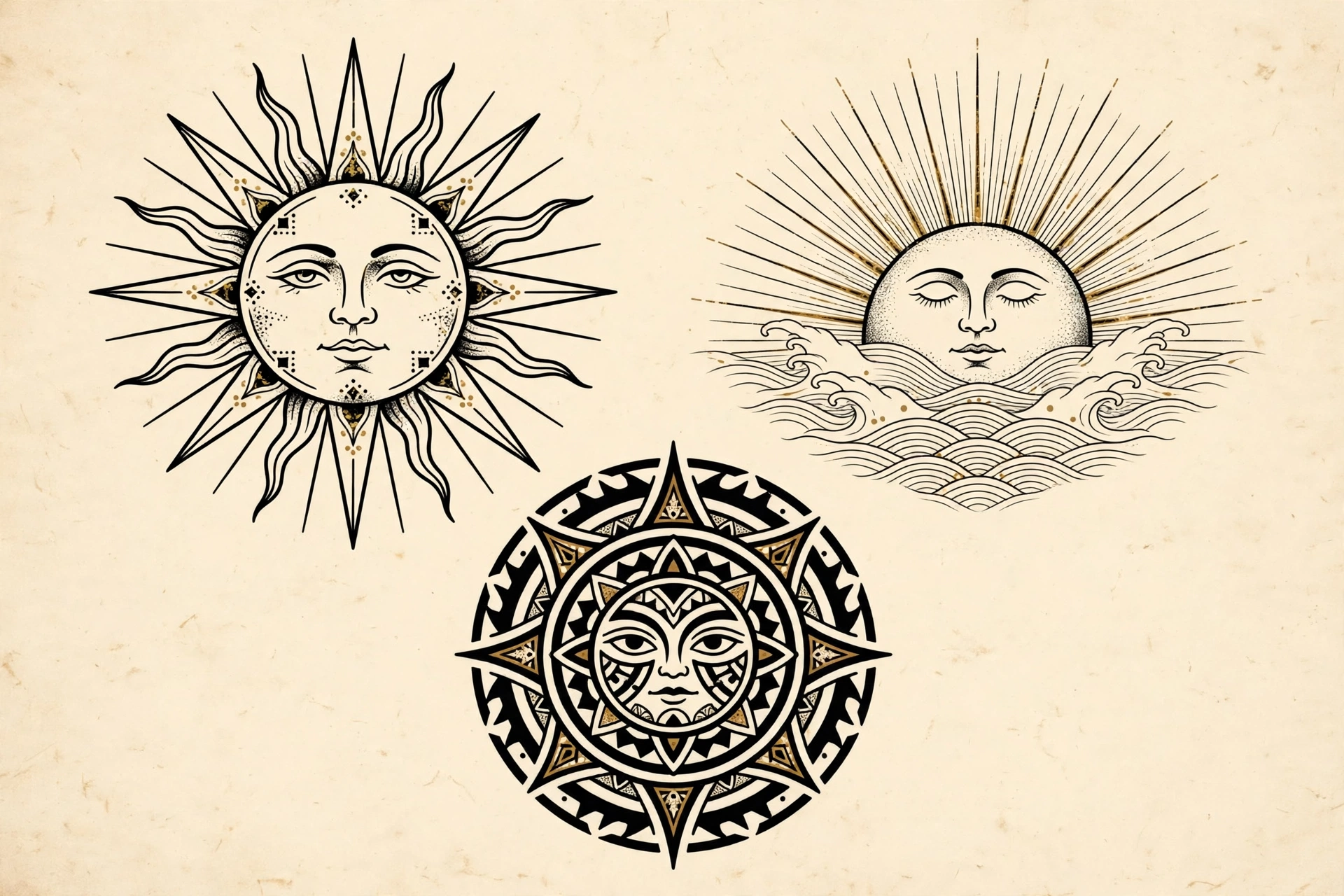
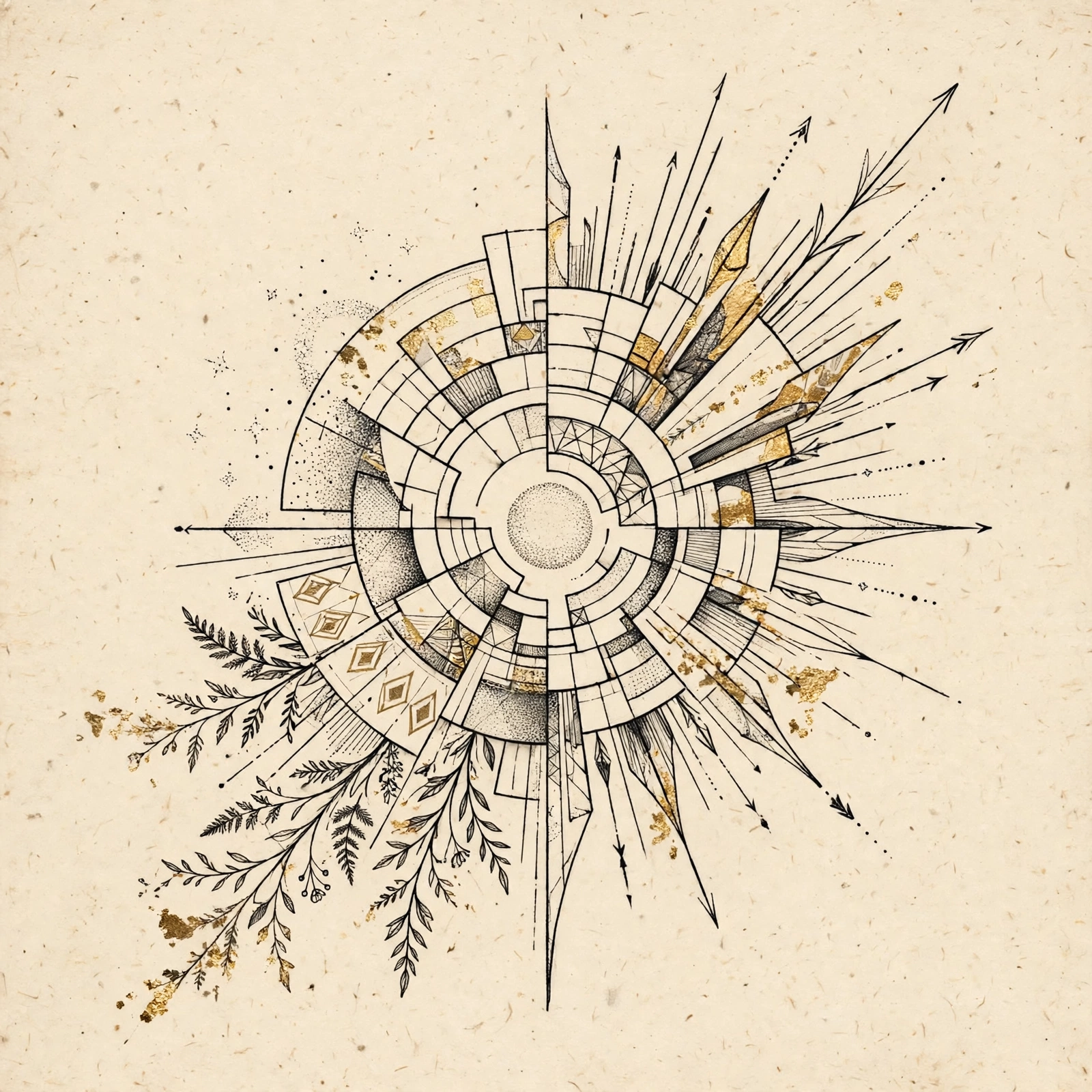
Fine-line sun with alternating straight and wavy rays on the inner forearm
Sun and crescent moon merged in one circle between the shoulder blades
Small bold sun on the ankle with eight short, even rays
Rising sun over a single-line mountain range across the collarbone
Blackwork sun face with closed eyes on the upper arm
Sun disc holding a tiny zodiac glyph at its centre on the wrist
Watercolour sunrise wash behind a simple black sun outline on the ribs
Matching small suns on each shoulder, one with a face, one plain
See also: All Tattoo Meanings · Manifestation Sigil Maker · Spirit Animal Finder.
The generator reads your birth date, your intention and your style, so the design it makes is yours, not a copy of someone else's.
Size (Tiny to Extra Large) and style in, cost range out. Ranges are estimates — an artist quote wins. A 20% tip is shown separately.
All 23 placements from our placement guides — pick a spot, optionally compare a second one, and see its pain range, healing time, fading and size guidance, quoted from the same guide data, with a link to the full placement guide. Ranges only — sources disagree, no single decimal is a fact.
Two sun signs in, an honest reading out — no invented percentages. The tool compares the two signs' elements and ruling planets, tells you where the pairing clicks and where it rubs, and turns it into a matching-tattoo idea with links to both sign guides.
Your Sun, Moon and Rising signs from your birth date and time — all three computed in your browser, with the Moon and Rising honestly labelled approximate. Each sign comes with a short traditional reading and a tattoo angle, plus links to its sign guide and to the wheel and fusion tools.
See the full list on the Tattoo Meanings main page.
Protection Symbol Tattoos explored honestly — what the protection symbols has meant across cultures, design variations that change the message, placement notes and ideas.
Moon Tattoo Meanings explored honestly — what the moon has meant across cultures, design variations that change the message, placement notes and ideas.
Star Tattoo Meanings explored honestly — what the star has meant across cultures, design variations that change the message, placement notes and ideas.
Lotus Tattoo Meanings explored honestly — what the lotus has meant across cultures, design variations that change the message, placement notes and ideas.
For most people it stands for renewal and getting through a dark period — the sun as the thing that reliably returns. Others choose it for vitality, honesty and clarity, or simply for warmth and optimism. Suns paired with moons usually shift the meaning toward balance between two sides of a personality or a relationship.
Yes, they are one of the most popular pairings in tattooing. Together they are commonly read as balance — light and dark, day and night, logic and intuition, or two people who complete each other. The design can be a single merged face, two separate pieces, or matching tattoos shared between partners or friends.
Ray style changes the feel a lot. Straight rays look bold, ordered and geometric; wavy rays feel warmer and more playful; alternating long and short rays give a classic, decorative rhythm. A plain circle with no rays is the most minimal reading — pure light and wholeness rather than a character.
It can, if you keep it simple. A small circle with short, bold rays stays readable at a few centimetres, especially on the wrist, ankle or shoulder. Very fine rays and detailed faces blur as the skin ages, so tiny suns work best with fewer, thicker lines.
Black ink is the most common and ages the most predictably, and it suits both bold and fine-line suns. Warm colours — gold, orange, muted red — add a sunrise or sunset feeling but can fade faster, especially yellows. Ask your artist how your chosen colours are likely to heal on your skin tone.
AI designs are for inspiration only. Always consult a licensed tattoo artist. Astrology on this site is for inspiration and self-expression. This page does not provide medical advice. Last reviewed: 25 November 2026.