Manifestation Sigil Maker
Intention text in, SVG sigil out. Client-side SVG generation only.
Fourteen questions — two for each of the seven chakras — read as a profile, not a score: every chakra is banded on its own two answers alone and comes with its traditional associations, a short reflective reading, and the tattoo angle of its lotus symbol, its petal count and its seed syllable.
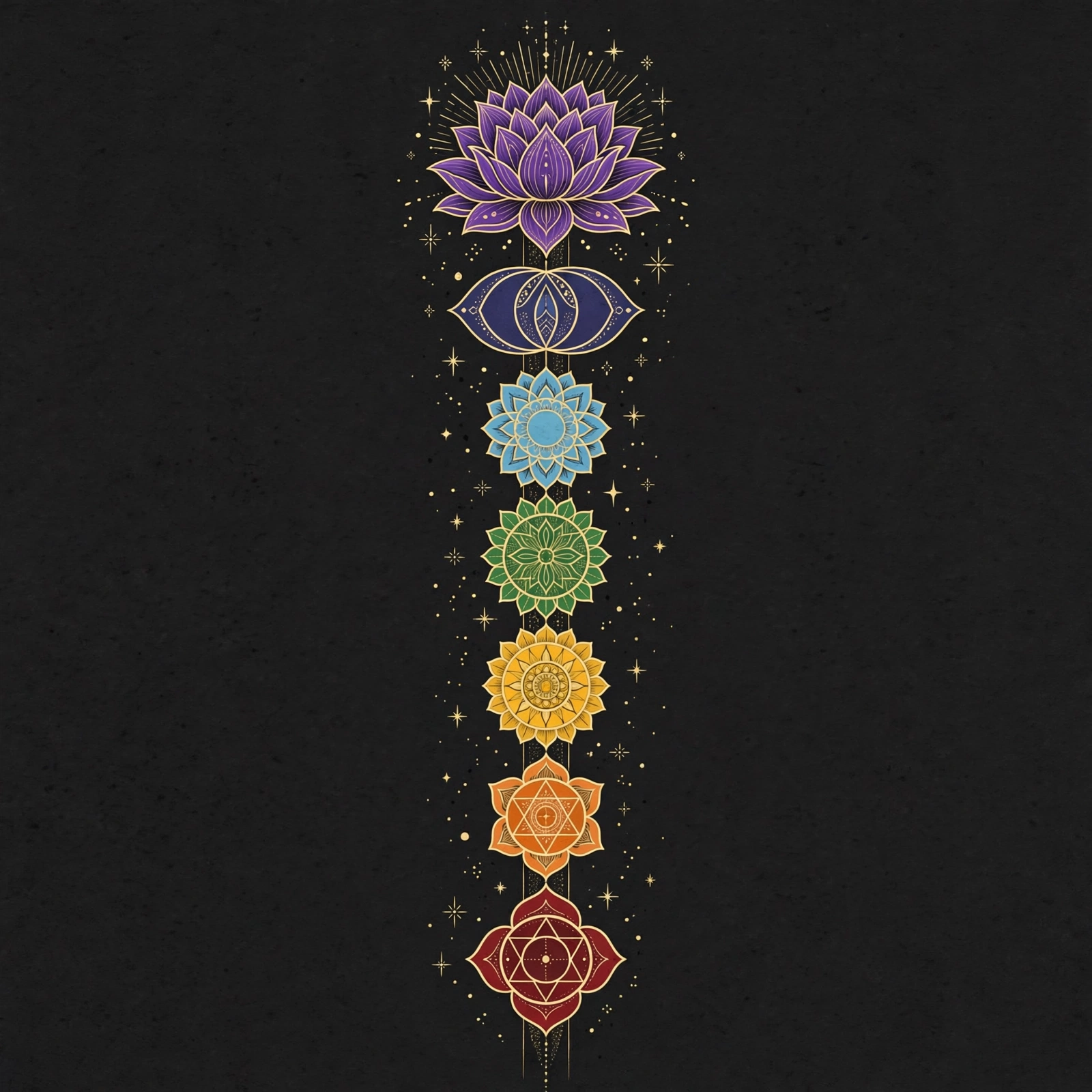
The chakra system comes out of the spiritual traditions of India, where texts more than a thousand years old describe centres — chakra means wheel — arranged along the spine, each one a place where the body's energies were understood to gather and turn. Seven are counted as the main column. The Root (Muladhara) at the base of the spine governs grounding and security; the Sacral (Svadhisthana), just below the navel, feeling and creativity; the Solar Plexus (Manipura), above the navel, will and confidence; the Heart (Anahata), at the centre of the chest, love and compassion; the Throat (Vishuddha), expression and truth; the Third Eye (Ajna), between the brows, intuition and insight; and the Crown (Sahasrara), at the top of the head, meaning and connection.
Each chakra also carries a small set of traditional associations, and they are used all through this page: an element (Earth, Water, Fire, Air, Space, Light — and the Crown beyond the elements), a colour, a lotus symbol whose petal count rises with the column, and a seed syllable, a one-sound mantra. One honest note about the colours: the neat rainbow sequence — red at the base to violet at the crown — is a modern standardisation, settled in the West in the twentieth century; older texts vary. The framework reached Western readers through yoga and Theosophy and is now a shared reflective vocabulary far beyond its origins. This page uses it the way its own result states: as a tradition to think with — like the daily rhythm of the Tarot Card of the Day — not as anatomy.
The quiz asks fourteen questions: two for the Root, two for the Sacral, and so on up the column. Each question is about its own chakra's traditional domain — the Root questions ask about security and the physical basics, the Throat questions about saying the true thing — and each answer scores only that chakra, 0, 1 or 2. The options are printed in that order, low to high, on purpose: the working is not hidden, and you can watch your own profile being built as you go. A chakra's pair totals 0 to 4, and the total becomes a band: Needs attention (0–1), Finding balance (2–3), Flowing well (4).
There is deliberately no percentage and no overall score. Two questions can honestly support a three-way qualitative judgement; they cannot support a number like 73%, and printing one would be invention dressed as measurement. The bands also protect the profile's whole point — that each chakra is read on its own evidence. Strong answers about your voice do not cancel quiet answers about your grounding; the column is shown as it answered, chakra by chakra. Answer as you are this week, not as you would like to be: the tradition treats a profile as weather, not character, and a retake on a different week is a legitimate second reading.
Read the profile from the bottom up, the way the column stands. A chakra in Needs attention is not broken and not diagnosed; in the tradition's language it is simply the quiet one in this week's answers, and its entry says what that quietness is traditionally taken to prompt — a question to sit with, not a condition to fix. Finding balance is the honest middle most chakras will land in most weeks: the domain is alive, tended unevenly. Flowing well means both answers came back strong — worth noticing too, because the tradition reads the flowing chakras as the resources the quiet ones can borrow from.
The result closes with the tradition's own working order: start here. It names your lowest-banded chakra — and if several share the lowest band, the lowest of them in the body, because the column is traditionally worked from the base up, foundation first. If all seven read Flowing well, it says so and invents no problem to solve. Take the whole thing as its framing insists: a reflective exercise in a spiritual tradition, not a health assessment. Nothing in a band speaks about your body or your mind as a clinician would, and anything that actually hurts deserves a professional, not a profile.
Chakra symbols were drawn for centuries before they were tattooed, and they carry their meaning in their geometry. Each is a lotus, and the petal count is the signature: four petals for the Root, around a square for Earth; six for the Sacral, holding a crescent moon for Water; ten for the Solar Plexus, around Fire's downward triangle; twelve for the Heart, around two crossing triangles; sixteen for the Throat; two for the Third Eye — the pair is the point — and for the Crown a thousand-petal bloom, drawn radiant and uncountable on purpose. Inside each lotus sits its seed syllable in the traditional script: LAM, VAM, RAM, YAM, HAM, OM — and for the Crown, silence. The sacred geometry tradition is where these symbols live as designs.
The classic composition is the column itself: all seven lotuses in order up the spine, each symbol sitting at the level of the body its chakra maps to — the one large tattoo this system seems to have designed itself for. Single symbols are just as common: the chakra a profile points to, worn at its own place (the Throat's lotus at the nape, the Heart's star at the sternum) or somewhere private. Two pieces of practical honesty: the traditional rainbow colours are beautiful, but coloured fills soften with age faster than line does, so many column pieces are drawn in black-and-gold line work with colour used sparingly; and a seven-symbol column is a multi-session commitment — most people start with one lotus and let the column grow. The AI Tattoo Generator can draft a single symbol or the full column before you commit to either.
No. This is a reflective quiz inside a spiritual tradition — a structured way of thinking about grounding, feeling, will, love, voice, intuition and meaning, using the chakra framework those questions have been organised by for centuries. Chakras are not anatomical structures, this quiz examines nothing physical, and no result here diagnoses, treats or says anything medical about you. If something in your body or mind actually hurts or worries you, the right reader for that is a qualified professional, not a tattoo website — the quiz says so on its own result, and it means it.
Because two questions cannot honestly carry one. Two answers per chakra can support a plain qualitative judgement — low, mixed, strong — and that is exactly what the bands are. A figure like 73% would be invented precision: arithmetic dressed up as measurement, of the kind this site removed from its compatibility tool for printing the same fixed numbers for everyone. Bands keep the result honest about how much evidence stands behind it, and they keep the focus where the tradition puts it: on the shape of the whole profile, not on a league table of your insides.
Because a profile is only a profile if each part is read on its own evidence. A single blended score would let strong answers about, say, your voice cancel out weak answers about your grounding — and then name a 'most out of balance' chakra by arithmetic rather than by anything you said about it. Here, the Root is read from two questions about security and the physical basics, the Heart from two about closeness and forgiveness, and so on through all seven traditional domains. What you get is seven small honest readings, not one big blurred one.
It is the tradition's own working order, offered as a place to begin rather than a prescription. The result finds your lowest band; if several chakras share it, it names the lowest of them in the body, because the chakra column is traditionally worked from the base up — the Root is described as the foundation the other six stand on. If every chakra reads Flowing well, the result says that instead and invents no problem. Treat 'start here' the way you would treat the first chapter of a book: a sensible opening, not a diagnosis of what is wrong with you.
From the traditional iconography of the system, as it has been taught for centuries: each chakra is drawn as a lotus whose petals multiply as the column rises — four for the Root, six for the Sacral, ten for the Solar Plexus, twelve for the Heart, sixteen for the Throat, two for the Third Eye, and a thousand for the Crown, which is what Sahasrara means. Each lotus carries a seed syllable, a bija mantra: LAM, VAM, RAM, YAM, HAM, OM — and for the Crown, traditionally, no syllable at all: silence. Lineages differ in small details; this page uses the most widely taught set, and the petal counts are one reason chakra symbols make such satisfying tattoos — the count is the signature.
Both ways are well worn. A single chakra symbol is usually chosen for its meaning — the Heart's twelve-petal star for love, the Throat's sixteen petals for a voice reclaimed — and placed where the tradition maps it, or somewhere more private. The full column is the classic spine tattoo: all seven lotuses in order up the back, each at its own level of the body, which is why the spine is the one placement this system designed itself for. Two practical notes: the traditional colours are beautiful but colour softens with age faster than line, so many column pieces are drawn in black and gold line work with colour kept in the fills; and a seven-piece column is a commitment — most people start with the single symbol their profile points to, and add the rest over years. The AI Tattoo Generator can draft a symbol at either scale before you commit.