Tattoo Cost Estimator
Size (Tiny to Extra Large) and style in, cost range out. Ranges are estimates — an artist quote wins. A 20% tip is shown separately.
Celestial Tattoo Ideas · Tattoo Ideas
Celestial tattoo ideas — minimalist moon and star designs, constellations, sun-and-moon pairs and zodiac sky art — with the meanings behind each and where they sit best.
Celestial tattoo ideas start with the oldest pictures humans have: a crescent moon, a scatter of stars, the sun and moon paired in one circle. They work at almost any size, from a two-centimetre star behind the ear to a full constellation across the collarbone, and every one carries meaning you choose.
This page sits under Tattoo Ideas.
Key takeaways
| What | What to expect |
|---|---|
| Core motifs | Crescent moon, moon phases, stars, sun and constellations |
| Smallest workable designs | Single star, tiny crescent or small planet at 1 to 2 centimetres |
| Personal option | The constellation or moon phase from a specific date |
| Cost band (Tiny) | $50–250, usually 30 minutes to 1 hour |
| Cost band (Small) | $50–500, usually 1 to 3 hours |
The sky is tattooing's oldest subject because everyone shares it and nobody owns it. Moons marked cycles, stars guided travellers, and the sun stood for life itself long before tattoos were fashionable. Celestial designs still work because those associations are built into how people read them at a glance.
Before written calendars, the moon was the calendar. Stars were maps and stories at once, grouped into constellations carrying myths. A moon phase row or constellation borrows that old visual language, and most viewers understand it instantly.
The same crescent can be drawn as a hairline, a solid blackwork shape or a dotwork curve and stay recognisably itself, which is why the night sky appears on first tattoos and full backs alike.
Minimalist moons and stars are the small end of celestial work: a single crescent, a four-point star, a tiny ringed planet or a short row of phases, drawn in fine line with generous space around them. They suit wrists, ankles, collarbones and behind the ear, and heal quickly.
The discipline at this size is subtraction. One crescent with one star says more than a crowded cluster, because every element has room to stay separate as the ink settles. Keep dots clearly spaced, let the crescent's points end cleanly, and resist adding rays, clouds and sparkles to a design that is only a few centimetres wide. Your artist can always add later; removing is not an option.
Small celestial pieces also make natural first tattoos and quiet matching designs. Two people can wear the same tiny moon in different placements, or mirror crescents on opposite wrists, without the design feeling like a uniform. On this site's bands these pieces are usually Tiny, $50–250 for about 30 minutes to 1 hour, subject to the shop minimum.
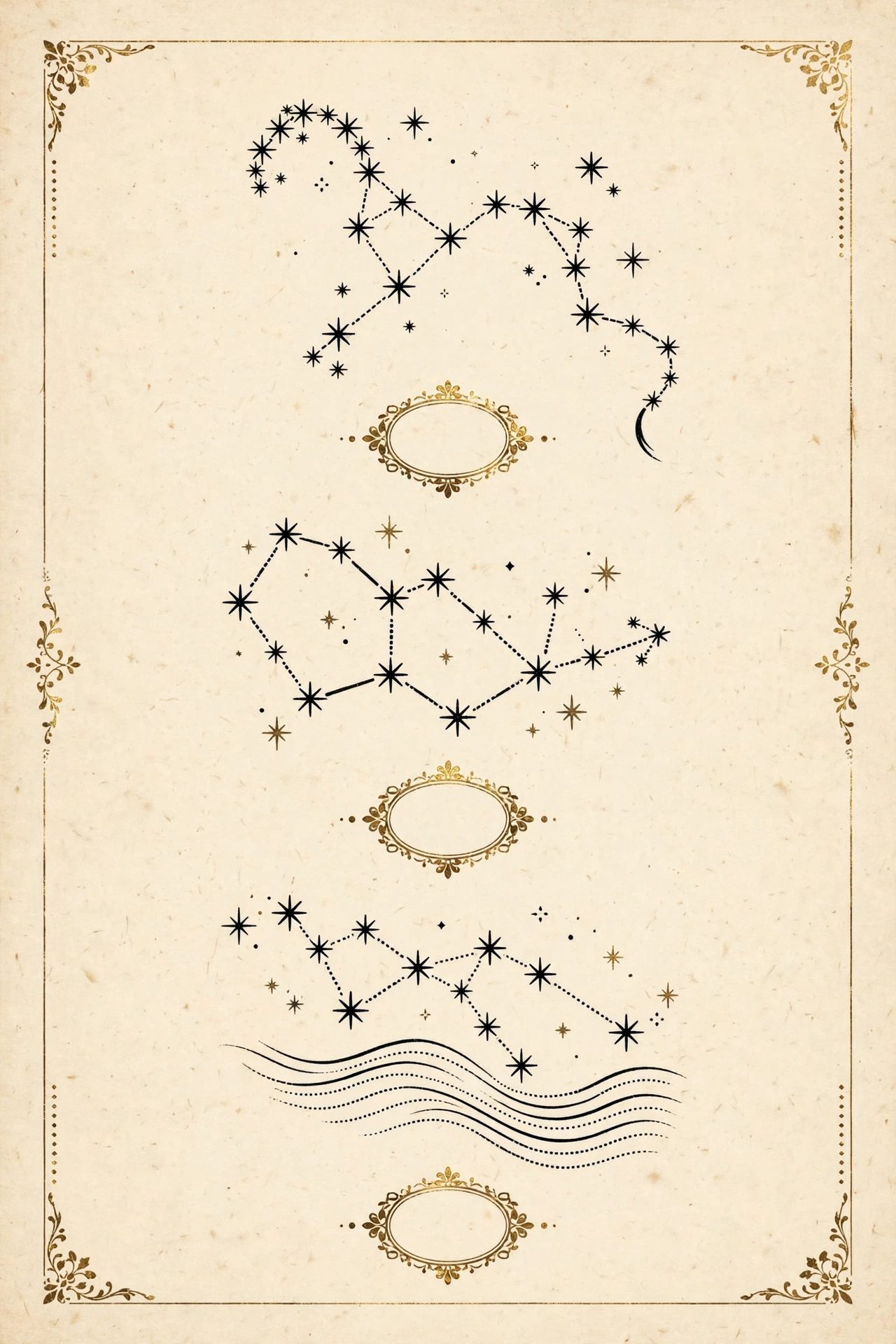
Constellations and star maps are the personal end of celestial tattooing: the actual pattern of stars from your sign, your birth sky or a date that matters, reduced to dots and fine connecting lines. The meaning is specific to you, even when the design looks abstract to everyone else.
A zodiac constellation works on two levels. Visually it is an elegant scatter of dots and lines that follows flat or gently curved skin beautifully, along a collarbone, down a spine or across a shoulder blade. Personally it is a record: this was the sky, or this is the sign, that you chose to mark. Read it as interpretation and self-description, a symbol of temperament and story, rather than as a claim about fate.
Star maps go one step further and plot a real moment. Bring the date and place, and expect your artist to simplify hard. A true sky contains far more stars than skin can hold at tattoo scale, so the craft lies in choosing the brightest points and keeping their spacing honest. The result is less accurate as astronomy and far better as a tattoo, which is the right trade.
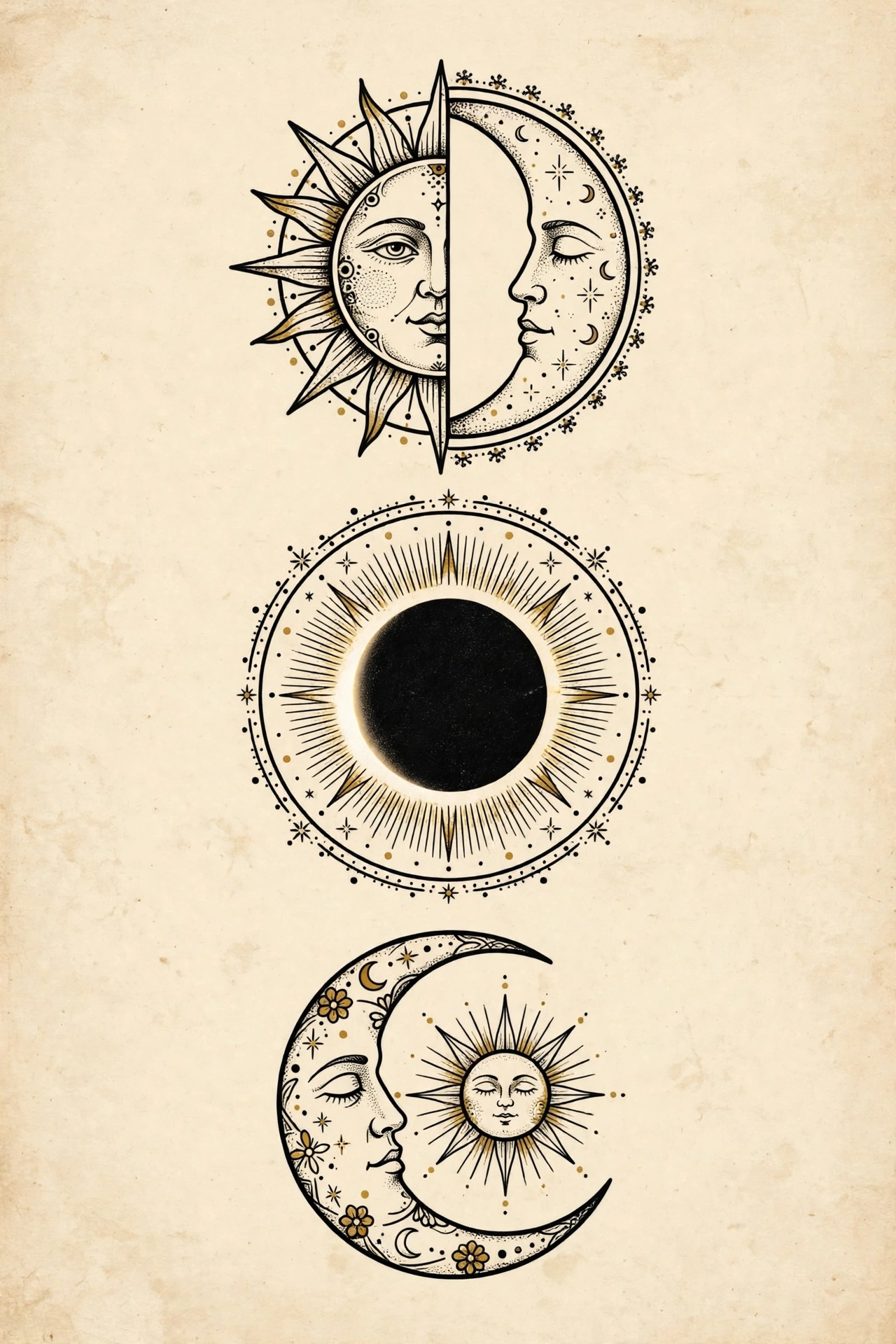
Sun and moon together form tattooing's classic balance pair: day and night, light and dark, energy and rest held in a single design. They are usually drawn sharing one circle or face, and people choose them to mark opposite sides of their own nature, or two people who complete each other.
The paired design has been drawn for centuries in many cultures, often as a sun face with rays beside or inside a crescent moon. Modern versions range from bold blackwork circles that read across a room to fine-line pairs small enough for an inner arm. Because the composition is naturally symmetrical, it sits well on centred placements: between the shoulder blades, on the sternum, or on the upper arm.
Think about which side leads. Some people draw the sun larger, marking drive and daytime energy; others give the moon the space, marking intuition and recovery. That quiet decision turns a familiar motif into a personal statement, because the balance of the drawing carries the meaning.
Celestial designs shine on placements that echo their shapes: the collarbone for arcs and constellations, the spine for vertical moon phases, the shoulder for round suns and full moons, and the inner wrist or ankle for small single motifs. Flat, sheltered skin keeps fine star lines clearest.
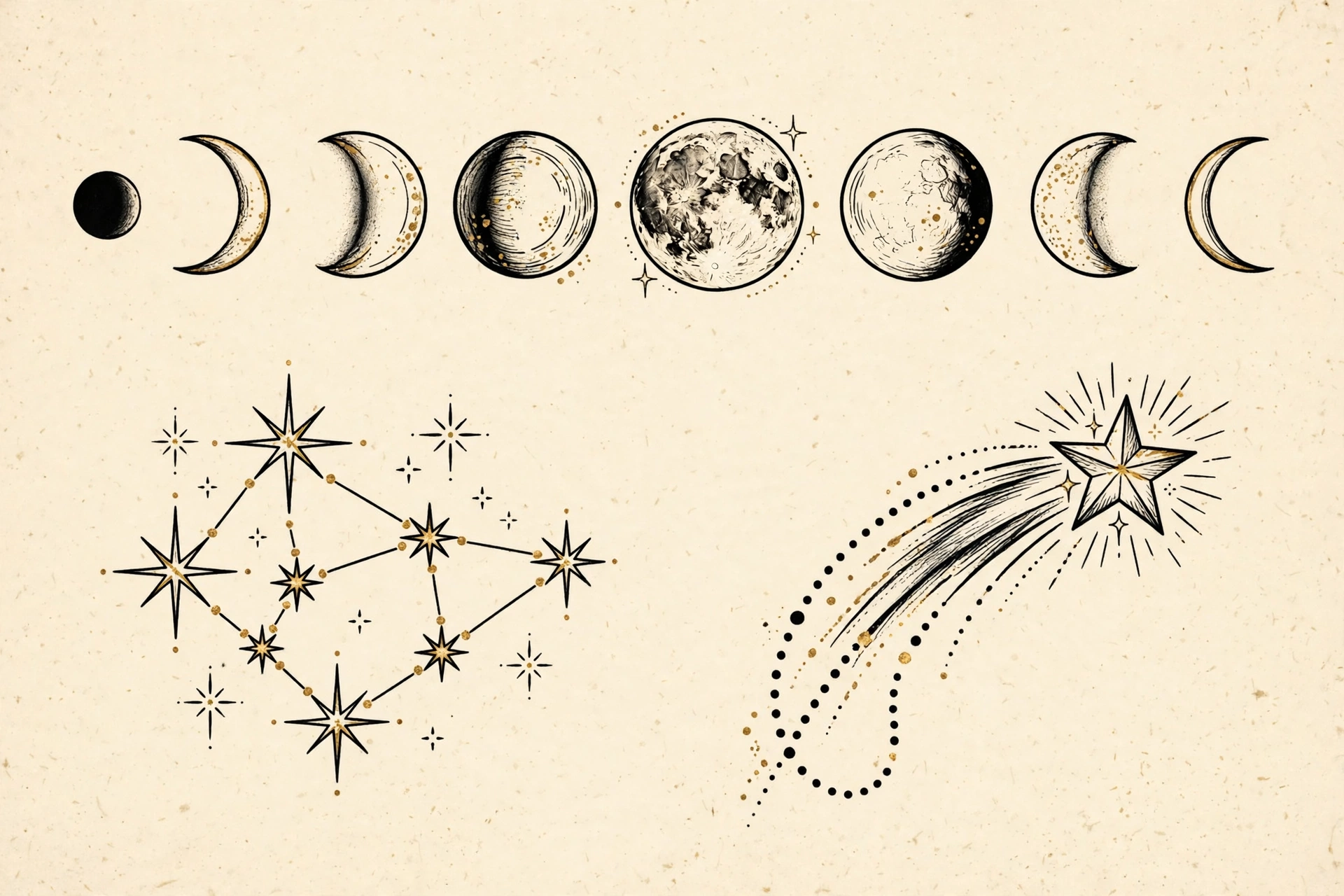
Match the geometry to the body. A horizontal row of moon phases follows the collarbone or the top of the back; the same row turned vertical runs down the spine like a seam. Circular designs, full moons, eclipses and sun faces, need rounder ground, so the shoulder, calf and between the shoulder blades serve them best. Scattered star fields are the most forgiving of all, since they can fade out naturally around a curve.
Consider light as well as shape. Fine-line stars on skin that sees heavy sun will soften faster than the same work on the inner arm or back, and tiny dots on fingers or feet need the boldest treatment of all. If your dream placement is a high-wear one, scale the design up slightly and let the stars grow with it.
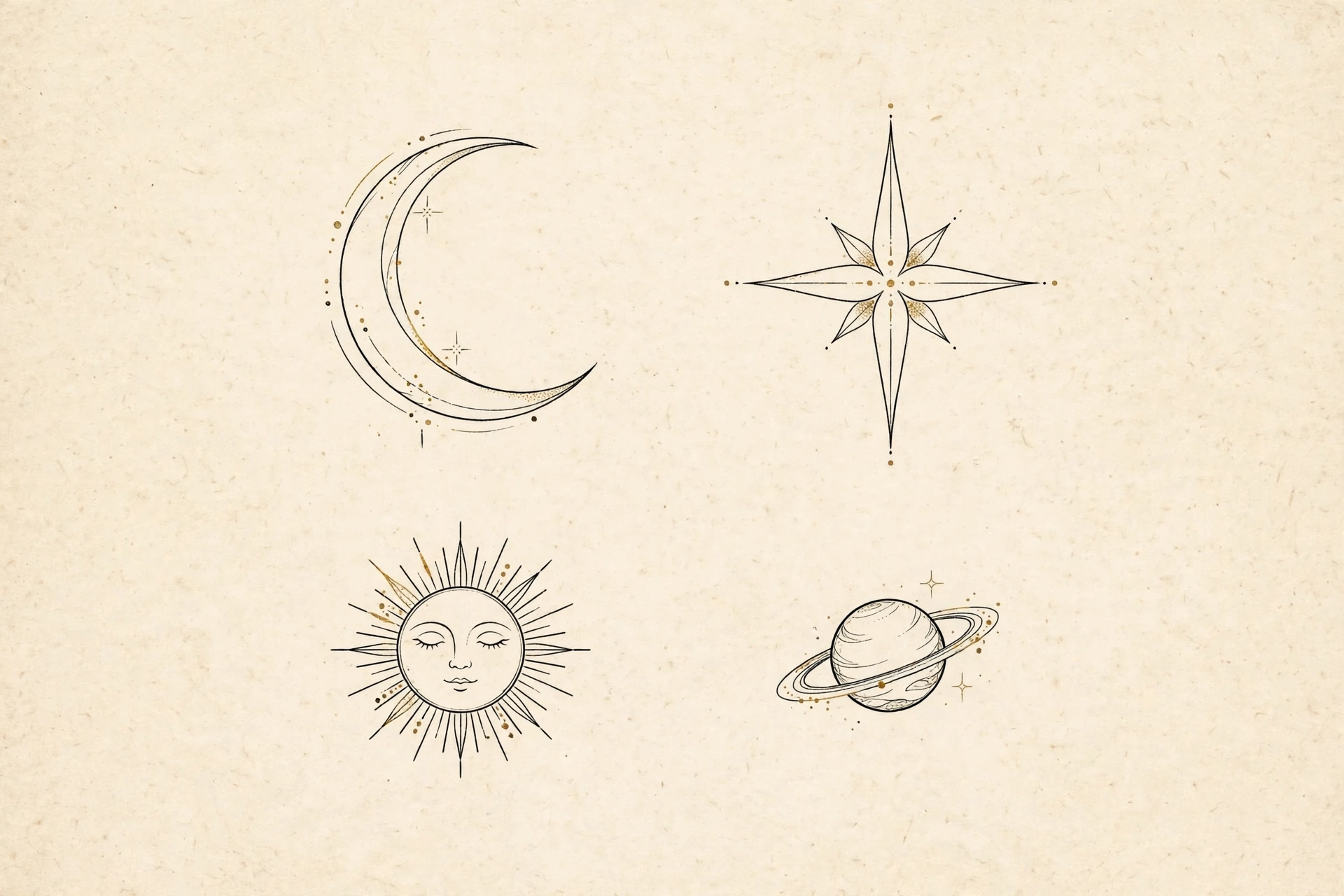
Fine-line crescent moon with a single hanging star on a dotted chain, sized for the inner wrist or collarbone.
Vertical moon phase column down the spine, seven moons from crescent to full, the full moon filled solid.
Your star sign constellation joined by fine dotted lines across the collarbone, one star drawn slightly larger.
Sun and moon sharing one circular face, half rays and half crescent, in blackwork on the upper arm.
Shooting star with a dotted trail curving over the shoulder blade, tail fading into three tiny stars.
Small ringed planet with two orbiting moons in fine line, placed on the inner forearm at about 4 centimetres.
Star map circle of a meaningful date's sky, simplified to the brightest stars inside a thin ring, on the shoulder.
Scatter of tiny stars and dots across the ankle, densest at the centre and fading out like real starlight.
Eclipse design of a black disc ringed by fine rays, bold and simple, sized for the inner arm or calf.
Moon cradling a small sun inside its crescent, drawn in dotwork, placed between the shoulder blades.
Cluster of three four-point stars descending the back of the arm, largest at the top, smallest near the elbow.
Full moon with a calm face and surrounding dot stars in illustrative style, a palm-sized piece for the thigh.
Pair of matching tiny crescents for two people, mirrored on opposite wrists, each with a different star beside it.
Zodiac wheel segment showing only your sign's arc, with its glyph and constellation, on the inner forearm.
See also: Night Sky Tattoo · Star Map Tattoo · Constellation Tattoo Meaning · Moon Phase Finder.
The generator reads your birth date, your intention and your style, so the design it makes is yours, not a copy of someone else's.
Size (Tiny to Extra Large) and style in, cost range out. Ranges are estimates — an artist quote wins. A 20% tip is shown separately.
All 23 placements from our placement guides — pick a spot, optionally compare a second one, and see its pain range, healing time, fading and size guidance, quoted from the same guide data, with a link to the full placement guide. Ranges only — sources disagree, no single decimal is a fact.
Two sun signs in, an honest reading out — no invented percentages. The tool compares the two signs' elements and ruling planets, tells you where the pairing clicks and where it rubs, and turns it into a matching-tattoo idea with links to both sign guides.
Your Sun, Moon and Rising signs from your birth date and time — all three computed in your browser, with the Moon and Rising honestly labelled approximate. Each sign comes with a short traditional reading and a tattoo angle, plus links to its sign guide and to the wheel and fusion tools.
See the full list on the Tattoo Ideas main page.
Tattoo ideas for women from fine-line florals and sternum pieces to bold blackwork — collarbone, rib, spine and ankle designs with honest notes on pain and how they age.
Tattoo ideas for men across forearm, chest, back and sleeve — blackwork, geometric, traditional and zodiac designs, with honest notes on pain, visibility and how each ages.
Small tattoo ideas that stay readable for years — tiny symbols, fine-line florals, mini moons and meaningful micro designs, with the placements where small ink ages best.
In tattoo symbolism the crescent moon is most often read as change, cycles and intuition, while a full moon suggests completeness or a peak moment. Read them as personal interpretations, not fixed meanings or predictions.
Yes, and it is one of the best uses of the style. Artists can plot the moon phase or the visible stars for a birth, wedding or other important date, then simplify the result into clean lines and dots.
A single small star, crescent or planet works at 1 to 2 centimetres if the shape stays simple and bold enough. Constellations need more room because the dots and connecting lines must stay separated as the ink settles.
The spine suits a vertical run of moon phases, the collarbone follows a constellation's natural arc, and the inner wrist or forearm holds a small crescent and star clearly. The shoulder and ankle also work well for scattered star fields that fade out softly at the edges.
It can, which is why one slightly larger anchor star helps: it gives the eye a starting point and lets the smaller dots stay small. Ask for clear spacing between dots and keep the connecting lines fine but unbroken. A constellation that reads at arm's length on the stencil will read healed.
Tiny celestial pieces fall in the Tiny band on this site, $50–250 for about 30 minutes to 1 hour, with most studios charging a shop minimum of usually $80–$150. Small pieces run $50–500 over 1 to 3 hours. Tip is shown separately from the design price.
AI designs are for inspiration only. Always consult a licensed tattoo artist. Astrology on this site is for inspiration and self-expression. This page does not provide medical advice. Last reviewed: 25 November 2026.