Tattoo Cost Estimator
Size (Tiny to Extra Large) and style in, cost range out. Ranges are estimates — an artist quote wins. A 20% tip is shown separately.
Geometric Tattoos · Tattoo Styles
Geometric tattoos explained — circles, grids and exact symmetry. How the style ages, the placements that suit it, and design ideas to take to your artist.
Geometric tattoos are built from exact shapes: circles, triangles, grids and repeating patterns drawn with ruler-straight lines and careful symmetry. The appeal is order you can see at a glance, clean, balanced and precise, whether the piece is a small hexagon on the wrist or a patterned panel across the back.
This page sits under Tattoo Styles.
Key takeaways
| What | What to expect |
|---|---|
| Line | Ruler-straight, even lines; circles and angles drawn to exact measure |
| Colour | Usually black ink; sometimes one flat accent colour inside a shape |
| Aging | Bold shapes hold well; fine close-set lines and tiny shapes merge first |
| Best placements | Forearm, upper arm, chest, back and calf, where symmetry sits flat |
A geometric tattoo is defined by measured shape and line: circles that truly close, triangles with matching angles, grids, hexagons and repeating patterns arranged with clear symmetry or deliberate rhythm. Subjects, animals, flowers, mountains, are often rebuilt from these shapes, so a fox or an owl becomes an arrangement of facets and lines.
Two families live inside the style. Pure pattern work uses tessellation, interlocking shapes and mandala-like repetition, where the pleasure is in the system itself. Faceted illustration takes a recognisable subject and redraws it as flat geometric planes, like a low-poly model, keeping just enough of the original form to read instantly. Both depend on the same foundation: lines of even weight, angles that meet cleanly, and spacing that stays consistent across the whole piece.
That precision is unforgiving. A slightly wobbling line in an illustrative piece reads as hand-drawn charm; in a geometric piece it reads as a mistake, and asymmetry that was not planned is obvious to anyone who looks. Stencils are transferred with extra care, often measured against the body's centre line, and good artists will reposition a stencil repeatedly rather than tattoo a pattern that sits a few degrees off true.
Bold geometric tattoos age well because their lines and shapes have the same sturdy structure as blackwork. The risks are specific: hairline grids set close together can merge into a solid patch, tiny shapes lose their corners, and perfect circles soften very slightly, so precision work needs bolder sizing than people expect.
Ink spreads a little under the skin over the years, and geometry feels that spread mathematically. Two parallel lines drawn close together drift toward each other until the gap of skin between them narrows or closes, which is why dense line patterns and fine hatching inside small shapes are the first parts of a geometric tattoo to change. Solid filled shapes and widely spaced bold lines barely change at all.
Symmetry also ages honestly: a design centred on the spine or sternum stays centred, but skin itself changes with muscle, weight and time, so an enormous precision pattern across a joint or a highly flexible area may distort more than the same design on the forearm or back. The practical rule is simple: the more exact the pattern, the larger and bolder it should be, and the flatter the skin it deserves.
Geometric tattoos sit best on flat, stable placements where symmetry can be measured and kept: the forearm, upper arm, calf, chest, sternum and back. Centred designs belong on the body's midline, between the shoulder blades, on the sternum or down the spine, where their balance reads exactly as drawn.
The forearm is the most popular geometric canvas because it is flat, visible and easy to stencil accurately, suiting bands, faceted animals and vertical patterns alike. The upper arm and calf wrap patterns around a limb in a controlled curve, which works beautifully for repeating designs and armband-style geometry. The chest and back offer the scale that complex patterns really want, with room for a full symmetrical panel.
Be careful around joints and strongly curved areas. A perfect circle across an elbow or knee will not stay a circle when the joint bends, and a rigid grid over the ribs must fight the body's movement with every breath. Artists handle this by flowing patterns around joints, breaking grids at natural seams, or choosing a nearby flatter area. Take their placement advice seriously in this style; a centimetre can be the difference between true and visibly off.
Geometric pain follows placement as usual, with one style-specific note: long straight lines and repeated passes to perfect them can make sittings feel methodical and, over bony areas such as the sternum, spine or ankle, distinctly sharp. The outer arm, forearm, calf and thigh remain the more comfortable choices.
Cost on this site is framed by size band and time. A Tiny piece in the $50 to $250 band usually takes 30 minutes to 1 hour, a Small piece in the $50 to $500 band takes 1 to 3 hours, a Medium piece in the $200 to $1000 band takes 2 to 5 hours, a Large piece in the $500 to $2000 band takes 4 to 8 hours, and an Extra Large piece in the $500 to $2000 band takes 4 to 8 hours or more. Most shops set a minimum, usually $80 to $150.
Precision takes time beyond the tattooing itself: measuring, stencil placement and checking symmetry from several angles all happen inside your appointment for larger work. A complex patterned panel may sit in the Large band and be split across sittings even where a simpler design of the same size would not. Ask how your artist plans the sessions, and whether the drawing and measuring time is included in their estimate.
Strong geometric ideas either commit to pure pattern or rebuild a loved subject from shapes: a faceted fox head, interlocking circles forming a band, a mountain range reduced to triangles, or a hexagon cluster that breaks into dots. Decide which family you want first, because they ask for different artists and different placements.
For pure pattern, look at tessellations, repeating triangles, cube illusions and mandala structures built from measured petals and rings. These designs scale gracefully from a forearm panel to a full back piece and combine naturally with dotwork shading, which softens the precision with grainy gradients. Bands are a gentle entry point: one repeating shape carried around the arm or ankle, bold enough to survive, exact enough to satisfy.
For faceted subjects, choose something with a strong silhouette, an owl, a wolf, a whale, a lotus, because the shape must survive being rebuilt from flat planes. Ask to see the design both at full size and small on a screen: if the subject still reads when shrunk, the facets are doing their job. And keep the internal lines bold and well spaced, since those fine divisions are exactly where ageing will test the piece first.
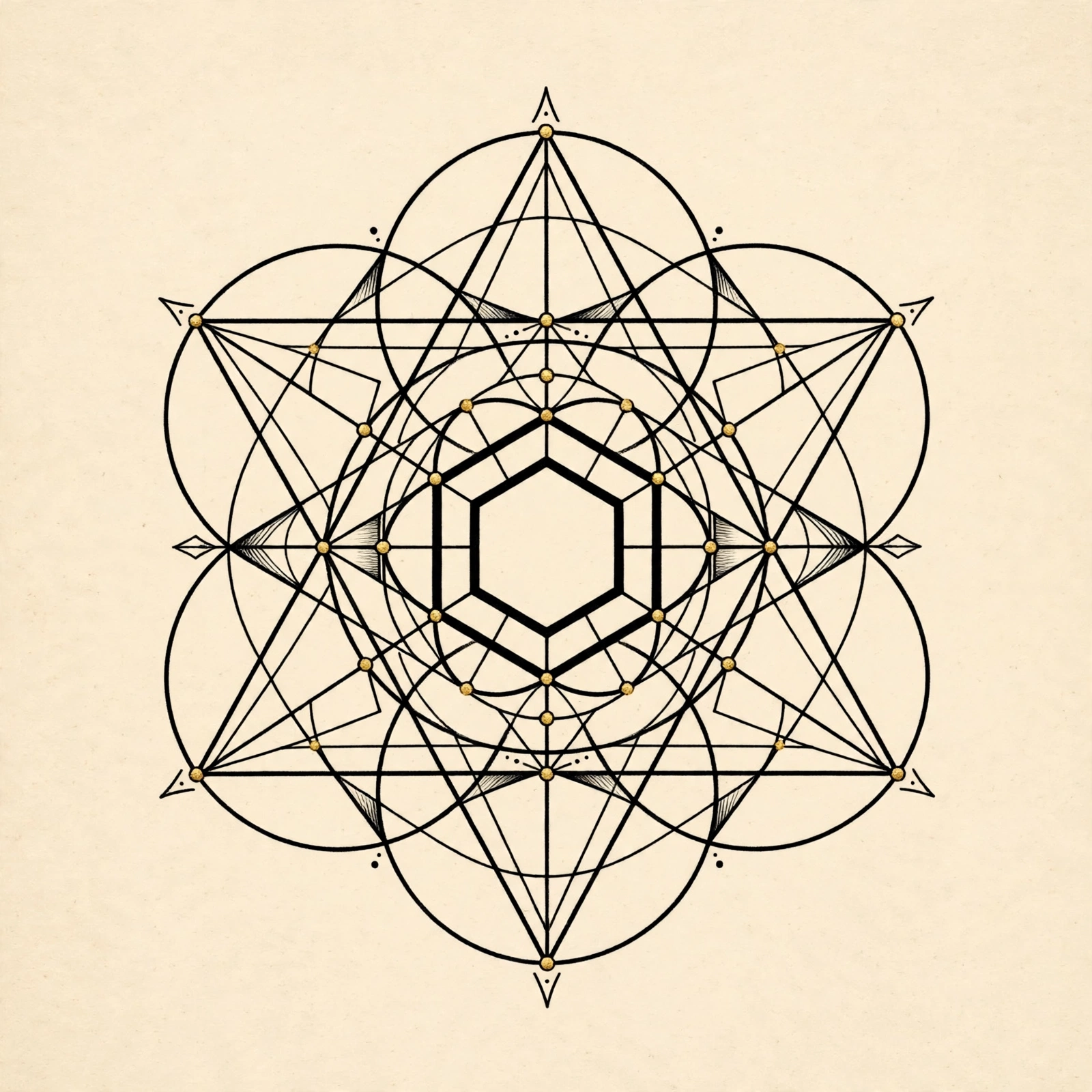
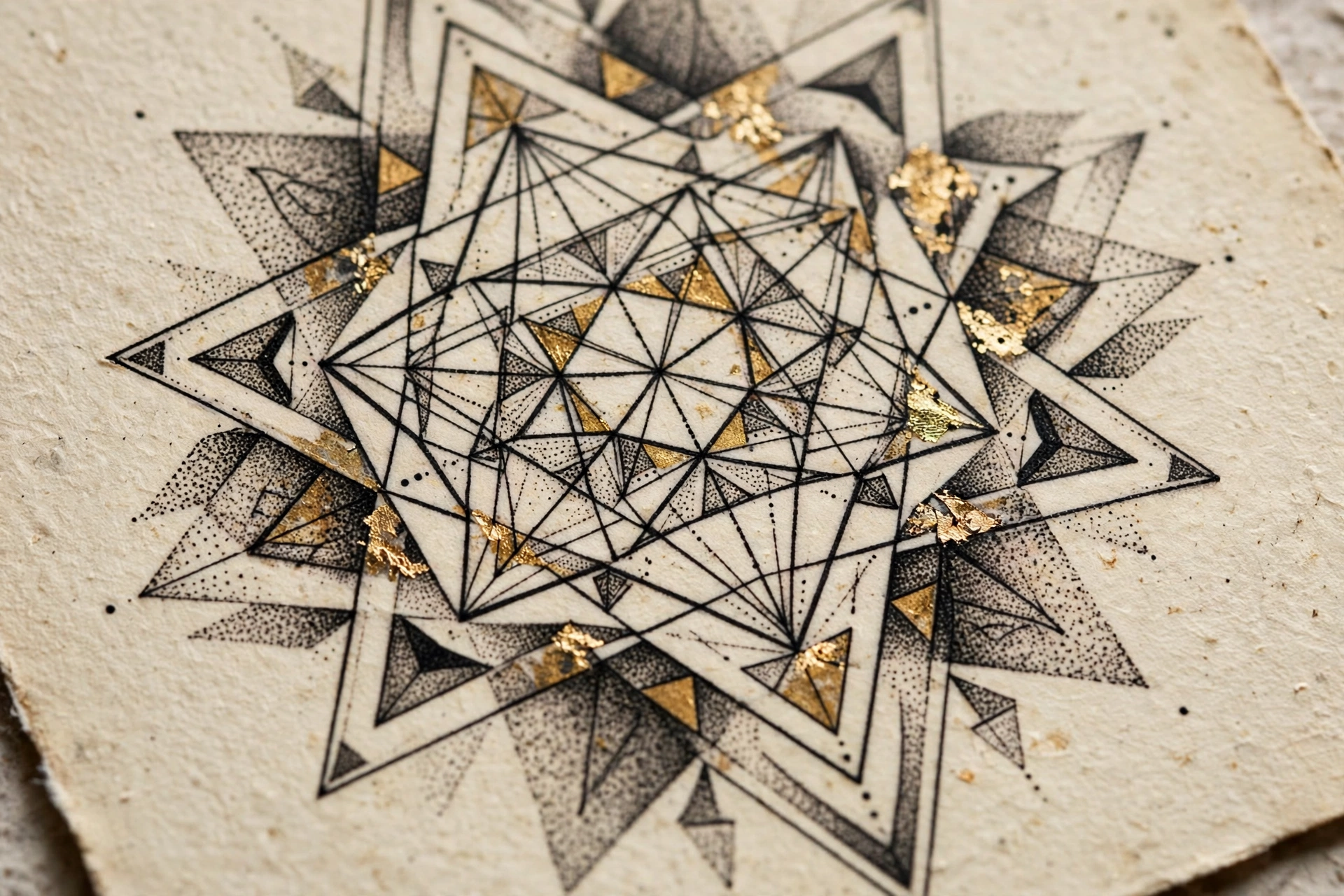
Faceted fox head built from bold triangles on the forearm
Interlocking circles forming a repeating band around the upper arm
Mountain range reduced to layered triangles with a solid circle sun
Hexagon cluster on the shoulder that dissolves into dotwork at its edges
Symmetrical geometric owl centred between the shoulder blades
Cube illusion pattern panel running down the calf
Geometric lotus with measured petals and a fine circle frame
Stag head rebuilt from flat facets with long straight antler lines
See also: Tattoo Style Finder Quiz · Tattoo Cost Estimator · All Tattoo Styles.
The generator reads your birth date, your intention and your style, so the design it makes is yours, not a copy of someone else's.
Size (Tiny to Extra Large) and style in, cost range out. Ranges are estimates — an artist quote wins. A 20% tip is shown separately.
All 23 placements from our placement guides — pick a spot, optionally compare a second one, and see its pain range, healing time, fading and size guidance, quoted from the same guide data, with a link to the full placement guide. Ranges only — sources disagree, no single decimal is a fact.
Two sun signs in, an honest reading out — no invented percentages. The tool compares the two signs' elements and ruling planets, tells you where the pairing clicks and where it rubs, and turns it into a matching-tattoo idea with links to both sign guides.
Your Sun, Moon and Rising signs from your birth date and time — all three computed in your browser, with the Moon and Rising honestly labelled approximate. Each sign comes with a short traditional reading and a tattoo angle, plus links to its sign guide and to the wheel and fusion tools.
See the full list on the Tattoo Styles main page.
Fine Line tattoos explained — single-needle hairlines and delicate detail. How the style ages, the placements that suit it, and design ideas to take to your artist.
Gothic tattoos explained — cathedral arches, dark ornament and medieval letterforms. How the style ages, the placements that suit it, and design ideas to take to your artist.
Dotwork tattoos explained — thousands of single dots building tone and texture. How the style ages, the placements that suit it, and design ideas to take to your artist.
Illustrative tattoos explained — drawn like a book illustration, with visible sketch lines. How the style ages, the placements that suit it, and design ideas to take to your artist.
Look for healed geometric pieces in their portfolio and inspect the lines closely: they should be even, straight and evenly spaced, with circles that close cleanly. Precision is a specialism, so an artist whose feed is mostly geometric and dotwork is a safer choice than a generalist for this style.
Yes, if it is simple: one hexagon, a small triangle composition or a short band. Complex patterns with many fine lines need medium size or larger, because close lines merge as ink settles. Your artist may suggest simplifying or enlarging a dense design, and that advice is worth taking.
Minor imperfections are part of hand-applied work on living skin, but a visibly misaligned pattern can often be balanced by thickening a line or extending the design. Prevention is better: careful stencil placement, checked from standing and from a distance, is where good geometric tattoos are really made.
Frequently. Dotwork shading inside geometric frames is the classic pairing, and blackwork fill, fine line subjects and sacred geometry patterns all combine well. Keep the geometric structure in charge so the precision that defines the piece is not lost in the mixture.
A well-measured band, tattooed with the arm in a natural position, stays even. Your artist will mark it carefully because the arm tapers and twists. Expect them to check it from several angles and with your arm relaxed before starting, and follow that lead rather than posing for the stencil.
AI designs are for inspiration only. Always consult a licensed tattoo artist. Astrology on this site is for inspiration and self-expression. This page does not provide medical advice. Last reviewed: 25 November 2026.