Tattoo Cost Estimator
Size (Tiny to Extra Large) and style in, cost range out. Ranges are estimates — an artist quote wins. A 20% tip is shown separately.
Moon Tattoo Meanings · Tattoo Meanings
Moon Tattoo Meanings explored honestly — what the moon has meant across cultures, design variations that change the message, placement notes and ideas.
A moon tattoo is a symbol for people who live by cycles rather than straight lines: phases, tides, moods and seasons that change without ending. Its meanings run from intuition and calm to feminine energy and quiet resilience, and the phase you choose changes the message. This guide explains each one clearly.
This page sits under Tattoo Meanings.
Key takeaways
| What | What to expect |
|---|---|
| Core meanings | Cycles, intuition, change, calm, feminine energy in many traditions, and comfort with hidden or quiet phases of life |
| Watch out | Moon phases are a sequence — getting the order or shapes wrong undermines a design whose whole meaning is the cycle |
| Pairs well with | Suns, stars, wolves, moths, tides and waves, birth flowers, zodiac glyphs, and unalome lines |
The moon has been linked across cultures with cycles, timekeeping and the unseen, because it visibly changes while staying the same body. In Greek tradition it was associated with Selene and later with Artemis; in Hindu tradition the moon, Chandra, is connected with calm and the mind; lunar calendars made it a marker of festivals, planting and tides.
Before clocks and printed calendars, the moon was how people counted. Its phases structured months, religious festivals and agricultural timing in many cultures, which is why it is so often associated with rhythm, patience and trust in a pattern larger than a single day.
In Greek tradition the moon was personified as Selene, and linked with Artemis, goddess of the wild and the hunt — one source of the moon's enduring association with independence and feminine energy. In Hindu tradition, Chandra, the moon, is associated with coolness, calm and the mind. In Chinese tradition the moon is linked with reunion and longing, celebrated at the Mid-Autumn Festival when families gather under a full moon. None of these traditions agree on a single meaning, but all treat the moon as a presence that governs cycles and feelings rather than force.
Today a moon usually stands for intuition, cycles and acceptance of change — the understanding that quiet or dark phases are part of a pattern, not a failure. Many people choose it after a life transition, to honour their emotional nature, or as one half of a sun-and-moon balance. The phase matters: crescents suggest becoming, full moons suggest completion.
The most common modern reading is cyclical resilience. Someone who has lived through grief, illness, new parenthood or a career change often recognises their own experience in the phases: not always full, not always bright, but always returning. A moon tattoo states that without words, and it works as a private comfort as much as a public design.
In astrology-minded framing — always personal interpretation rather than fact — the Moon is linked with feelings, memory and inner life, and some wearers choose the phase the moon was in on a birthday, a wedding or the night a child was born. Others simply love the night: quiet, tides, nocturnal animals and working while the world sleeps. If your meaning is about a phase you are in now, choose that phase deliberately, because a waxing and a waning crescent tell different stories.
Each phase says something different. A waxing crescent is growth and intention, a full moon is completion and illumination, and a waning crescent is rest and letting go. Adding stars, a sun, a face or an animal shifts the design from a statement about time toward one about personality or companionship.
Crescents are the most popular single moon because they are graceful, easy to place and open to interpretation. Orientation carries meaning for many wearers: a waxing crescent, lit on the right in the northern hemisphere, points toward growth; a waning crescent points toward release. Getting this right is worth a minute's checking, because phase accuracy is the whole point of the symbol. Full moons invite detail — craters, shading, a face — and read as the moment of fullness in a story.
A horizontal or vertical run of phases, usually five or seven shapes from crescent to full and back, is the cycle stated plainly and suits spines, forearms and collarbones. Pairings refine the message further: moon and stars for guidance and night, moon and wolf or moth for wild, nocturnal energy, moon and waves for tides and emotion.
Moons follow the body's curves beautifully: a crescent hugs a collarbone, ankle, wrist or the curve of a shoulder, and phase sequences run naturally down the spine, along a forearm or across the upper back. Small moons suit behind the ear and the inner wrist; detailed full moons need the room of an upper arm, thigh or back.
The crescent is one of the most placeable shapes in tattooing because it is itself a curve. It can sit over an ankle bone, cup the side of a wrist, follow the collarbone or frame another small design. Phase rows are linear designs, so they belong on linear real estate — the spine is the most popular, followed by the forearm, the sternum's centre line and the back of the calf.
Scale honestly. A full moon's crater shading and a crescent's inner detail both need a few centimetres to survive ageing; a thumbnail-sized full moon will heal into a plain disc, which may be fine if a plain disc is what you want. Behind-the-ear and finger moons are charming but sit on fast-wearing skin, so expect softening and plan for a possible touch-up. Ask your artist to draw the phases at final size, not enlarged, so you judge the real level of detail.
Personalise a moon by fixing it to a real night: the phase on the day you were born, the night you met someone, or the night something changed. Add your sign's constellation, a birth flower in the crescent's curve, or initials hidden in the stars. A specific moon will always mean more than a generic one.
The ideas below cover the main families — single crescents, full moons and phase sequences — at sizes from discreet to statement. If your meaning is cyclical, the phase row is the most literal and the most forgiving design, since each shape is simple. If your meaning is a single moment, one well-drawn moon with one personal detail beats a crowded composition.
Talk to your artist about line weight in the thinnest parts of a crescent, because hairline tips are where moon tattoos soften first. A slightly bolder crescent with clean tips will look better in five years than a wispy one looks in five weeks. Bring a phase reference if orientation matters to you, and confirm the stencil's direction on your body — left and right reverse depending on placement and which way the design faces.
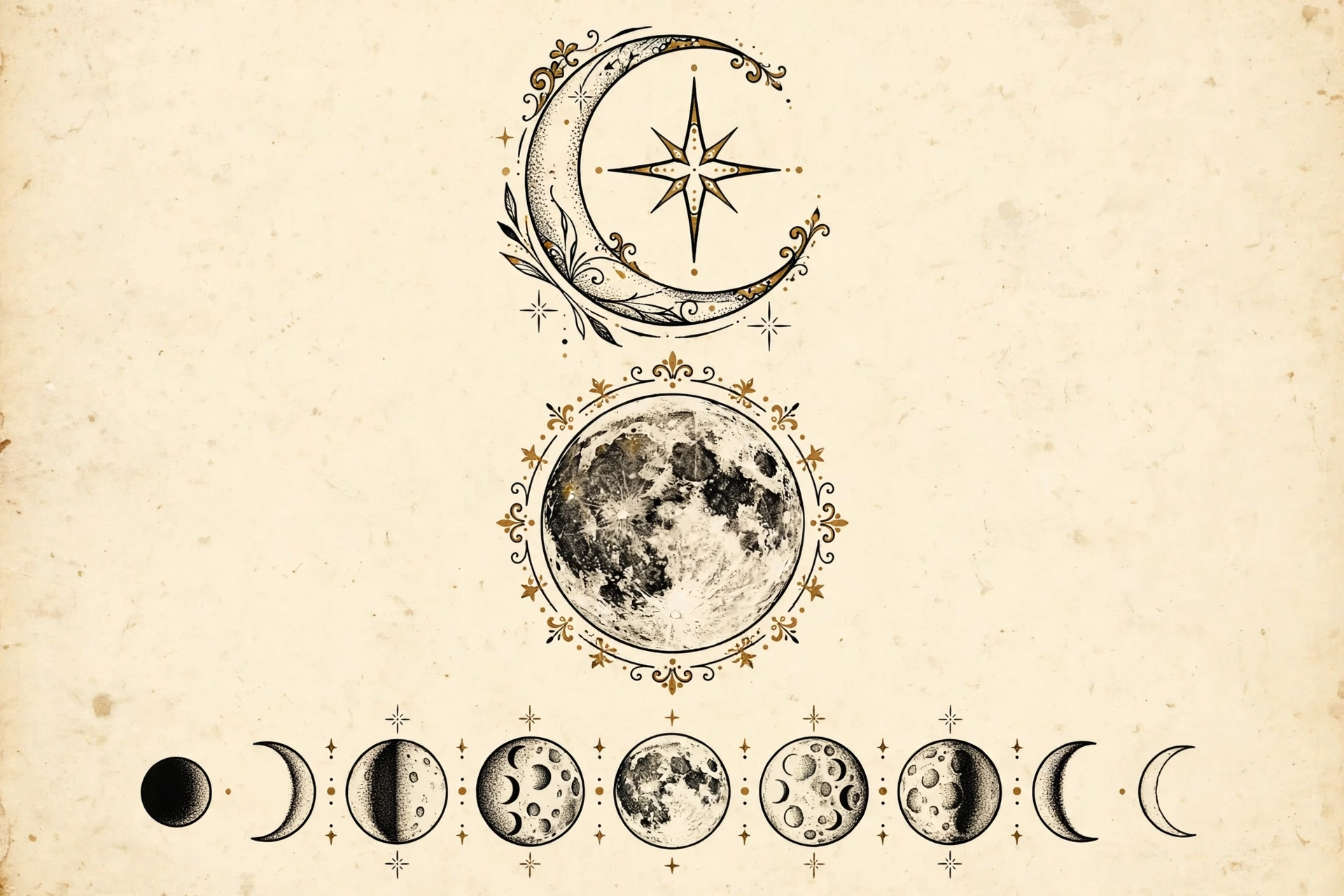
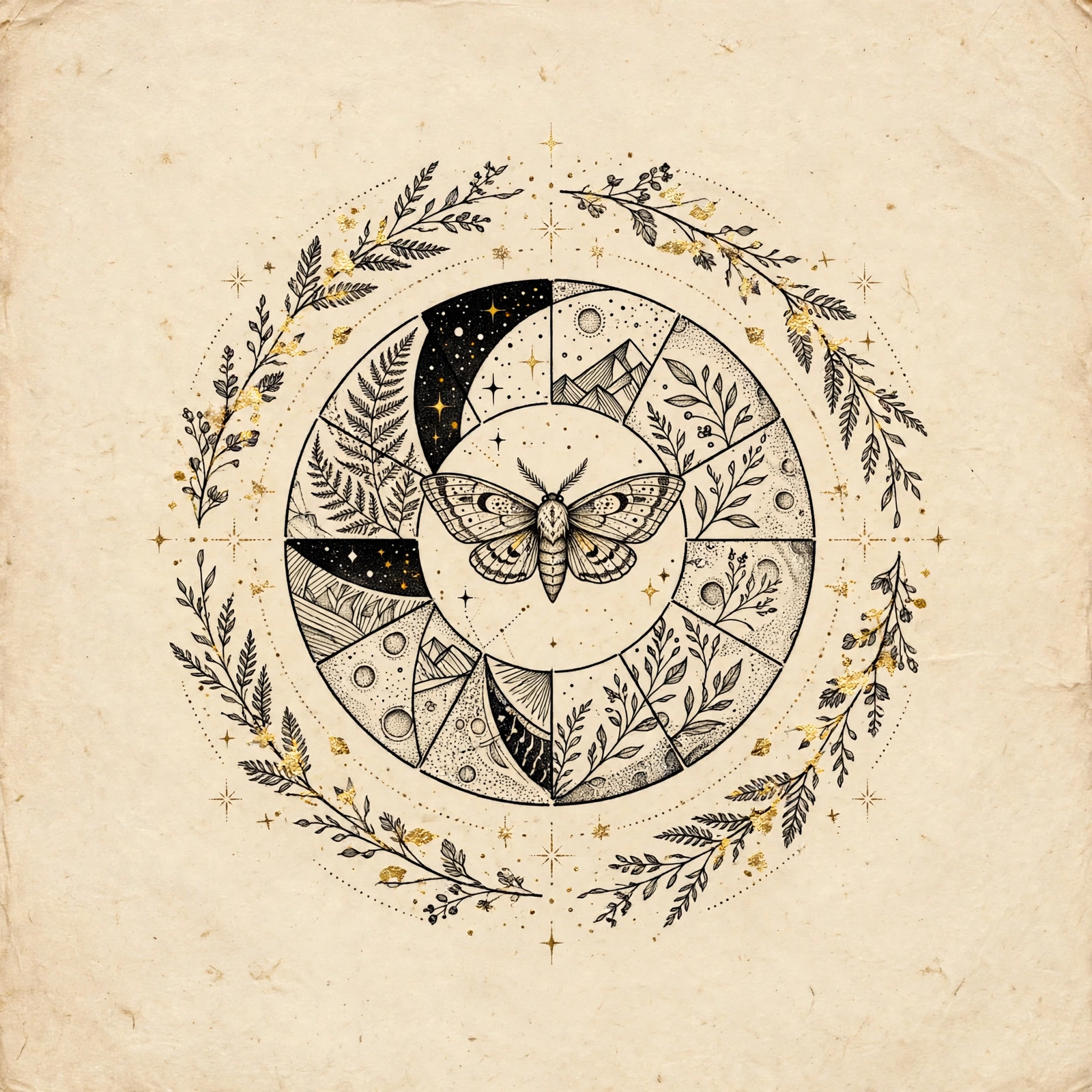
Vertical row of five moon phases down the spine in fine line
Crescent moon cradling a small star on the inner wrist
Full moon with dotwork craters and a moth below it on the upper arm
Crescent and birth flower pairing along the collarbone
Moon phases curved around the ankle like a bracelet
Blackwork crescent with a serene face on the shoulder blade
Tiny waxing crescent behind the ear with a single dot star
Moon over fine-line waves on the forearm, marking a love of the sea
See also: All Tattoo Meanings · Manifestation Sigil Maker · Spirit Animal Finder.
The generator reads your birth date, your intention and your style, so the design it makes is yours, not a copy of someone else's.
Size (Tiny to Extra Large) and style in, cost range out. Ranges are estimates — an artist quote wins. A 20% tip is shown separately.
All 23 placements from our placement guides — pick a spot, optionally compare a second one, and see its pain range, healing time, fading and size guidance, quoted from the same guide data, with a link to the full placement guide. Ranges only — sources disagree, no single decimal is a fact.
Two sun signs in, an honest reading out — no invented percentages. The tool compares the two signs' elements and ruling planets, tells you where the pairing clicks and where it rubs, and turns it into a matching-tattoo idea with links to both sign guides.
Your Sun, Moon and Rising signs from your birth date and time — all three computed in your browser, with the Moon and Rising honestly labelled approximate. Each sign comes with a short traditional reading and a tattoo angle, plus links to its sign guide and to the wheel and fusion tools.
See the full list on the Tattoo Meanings main page.
Sun Tattoo Meanings explored honestly — what the sun has meant across cultures, design variations that change the message, placement notes and ideas.
Star Tattoo Meanings explored honestly — what the star has meant across cultures, design variations that change the message, placement notes and ideas.
Protection Symbol Tattoos explored honestly — what the protection symbols has meant across cultures, design variations that change the message, placement notes and ideas.
Lotus Tattoo Meanings explored honestly — what the lotus has meant across cultures, design variations that change the message, placement notes and ideas.
A crescent is most often read as growth, intention and becoming — the moon on its way to full. Waxing and waning crescents face opposite directions, and wearers sometimes choose the direction deliberately: waxing for building something new, waning for releasing something. Your artist can check the orientation against a simple moon phase reference.
Moon phases usually stand for cycles and acceptance of change — the idea that low, dark phases are part of a pattern, not an ending. People choose them after periods of change, for fertility or family in a personal sense, or simply because the rhythm of the sequence feels true to how their life actually moves.
Not in any fixed way. Moons are chosen by people of all genders, and while many traditions link the moon with feminine deities and energy, plenty of wearers choose it for cycles, night work, tides, calm or a love of the night sky. The meaning is yours to set.
Yes, moons are one of the best small tattoos because the shapes are simple and bold. A tiny crescent, a small full moon with light dotwork shading, or three mini phases all stay readable at a few centimetres. Very fine crater detail and hairline phase sequences are the versions to avoid at small sizes.
They are often paired because together they suggest balance — light and dark, day and night, or two different sides of one person. Many couples and friends also split the pair between them. The combined design usually shows a sun face with a crescent, or the two symbols side by side within one frame.
AI designs are for inspiration only. Always consult a licensed tattoo artist. Astrology on this site is for inspiration and self-expression. This page does not provide medical advice. Last reviewed: 25 November 2026.