Tattoo Cost Estimator
Size (Tiny to Extra Large) and style in, cost range out. Ranges are estimates — an artist quote wins. A 20% tip is shown separately.
Blackwork Tattoos · Tattoo Styles
Blackwork tattoos explained — solid black ink, bold shapes and high contrast. How the style ages, the placements that suit it, and design ideas to take to your artist.
Blackwork tattoos use only black ink, laid down bold: solid filled shapes, strong lines and high contrast against bare skin, sometimes softened with dotwork or fine grey texture. It is one of the oldest and most durable ways to tattoo, and one of the clearest to read from across a room.
This page sits under Tattoo Styles.
Key takeaways
| What | What to expect |
|---|---|
| Line | Bold, confident outlines and solid shapes; fine detail kept secondary |
| Colour | Black ink only, with skin itself providing the highlights |
| Aging | Holds exceptionally well; solid areas stay dark, edges soften only slightly |
| Best placements | Forearm, upper arm, calf, chest and back; works almost anywhere bold |
Blackwork is defined by a single rule: black ink only, used at full strength. The design is built from solid filled areas, bold lines and the bare skin left between them, which acts as the highlight. Dotwork, linework and engraved-style hatching can all appear, but the contrast and confidence stay unmistakably blackwork.
Within that one rule the range is huge. At one end sit small, solid symbols and simple silhouettes. At the other are large illustrative pieces, moths, snakes, skulls and botanical designs, where solid black wings or coils are balanced with dot-shaded bellies and fine line detail. Ornamental blackwork leans on symmetry and pattern, while some artists borrow the cross-hatching of old engravings to build tone without any grey wash at all.
What unites them is decision. Blackwork does not hide behind soft shading: every edge is visible, every shape must earn its place, and negative space is designed, not left over. When you look at portfolios, judge the healed work, not just fresh photos. Clean healed blackwork shows even, saturated fill with no patchy pale spots, and lines that stayed the width they were drawn.
Blackwork ages better than almost any other style, which is a large part of its appeal. Solid black stays dark and readable for many years, bold lines spread only slightly, and high-contrast designs remain clear even as the skin changes. The finest dotwork and hairline details soften first, as they do everywhere.
Black pigment is the most stable ink in the skin, and large solid areas give ageing very little to damage. A bold blackwork piece photographed years later usually still reads exactly as designed, with perhaps a slight softening at the edges and a deep charcoal tone rather than the blue-black of fresh ink. That reliability is why blackwork is also a common choice for covering older, faded tattoos.
There are still limits. Very fine lines packed close together can merge as ink spreads, tiny white gaps inside a design can close up, and dense dotwork gradients lose their lightest end first. Keep small gaps generous, avoid cramming detail into a small piece, and protect the work from sun, which dulls even black ink over time. If solid fill heals slightly patchy, a short touch-up sitting usually evens it out.
Blackwork suits almost any placement because bold shapes stay readable at any angle, but it shines where there is room for contrast: the forearm, upper arm, calf, chest and back. Symmetrical designs love the sternum and between the shoulder blades, while sleeves and leg pieces let pattern and solid shapes alternate down a limb.
The forearm and upper arm are the classic starting points: flat enough for clean shapes, easy to show or cover, and among the less painful areas. The calf takes bold work well and moves in a way that suits wrapping designs such as snakes or bands. On the chest and back, blackwork can go genuinely large, with solid areas balanced across the body's natural symmetry.
Think about contrast against your own skin and existing tattoos. A heavy black piece sits dramatically on its own, but a dense collection of smaller blackwork designs needs breathing room between them or the whole area reads as one dark mass. Hands, neck and face are high-visibility commitments with faster-wearing skin, so treat them as later choices, not first ones, and expect more frequent touch-ups there.
Blackwork pain is mostly about fill. Packing a large solid area takes repeated passes over the same skin, which can feel raw by the end of a sitting, while line-only blackwork is usually more manageable. Placement still rules: ribs, feet and inner arm hurt more than the outer arm, calf or thigh.
On this site, cost is framed by size band and time, and blackwork follows the same bands. A Tiny piece in the $50 to $250 band usually takes 30 minutes to 1 hour, a Small piece in the $50 to $500 band takes 1 to 3 hours, a Medium piece in the $200 to $1000 band takes 2 to 5 hours, a Large piece in the $500 to $2000 band takes 4 to 8 hours, and an Extra Large piece in the $500 to $2000 band takes 4 to 8 hours or more. Most shops set a minimum, usually $80 to $150.
Solid fill is the variable to discuss with your artist. Two designs of identical size can sit in different bands if one is mostly open line and the other is mostly packed black. Large blackwork, such as a sleeve or back piece, is normally planned over several sittings, which spreads both the cost and the healing, and lets each section settle before the next is added.
Strong blackwork ideas pair one bold silhouette with one quieter texture: a solid moth with a dotted belly, a coiled snake with hatched scales, or a botanical stem with fully blackened leaves. Keep the main shape readable from a distance, let dotwork or line detail reward a closer look, and leave real gaps of bare skin.
Animals and insects suit this style naturally because their shapes are already bold: moths, beetles, snakes, crows and wolves all hold up as silhouettes with limited internal detail. Botanical blackwork, blackened leaves, seed heads and thorn stems, gives the same contrast a softer subject. Ornamental routes include symmetrical chest pieces, patterned bands and mandala-like designs built from solid wedges and dots.
Whatever subject you choose, test it at arm's length. Squint at the sketch or view it small on a phone: if the main shape still reads clearly, the design is built on solid ground. Then check the gaps. The slivers of skin inside curls, between leaves or inside letter-like forms need to be wider than feels necessary on paper, because those are the spaces that close as the tattoo settles.
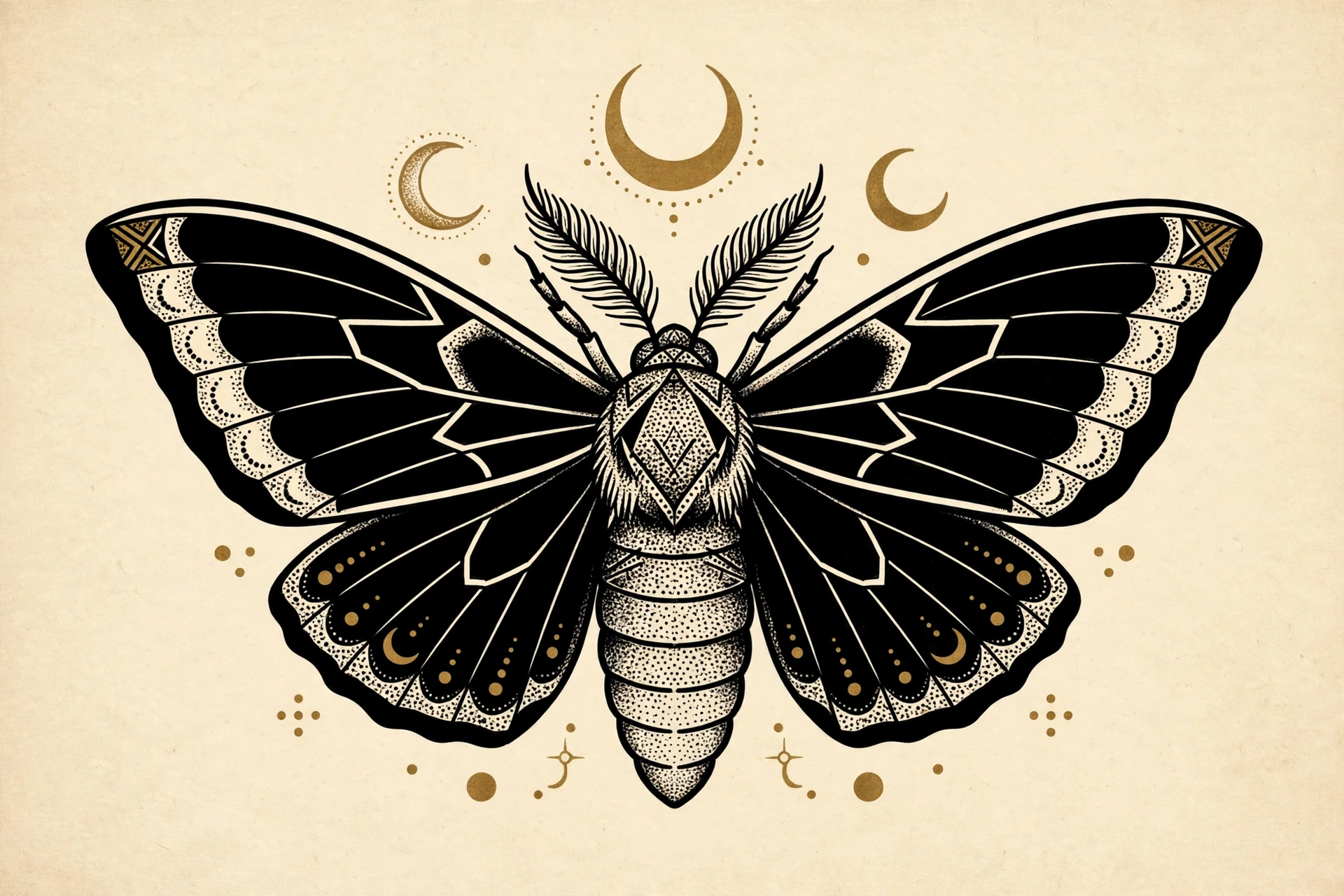
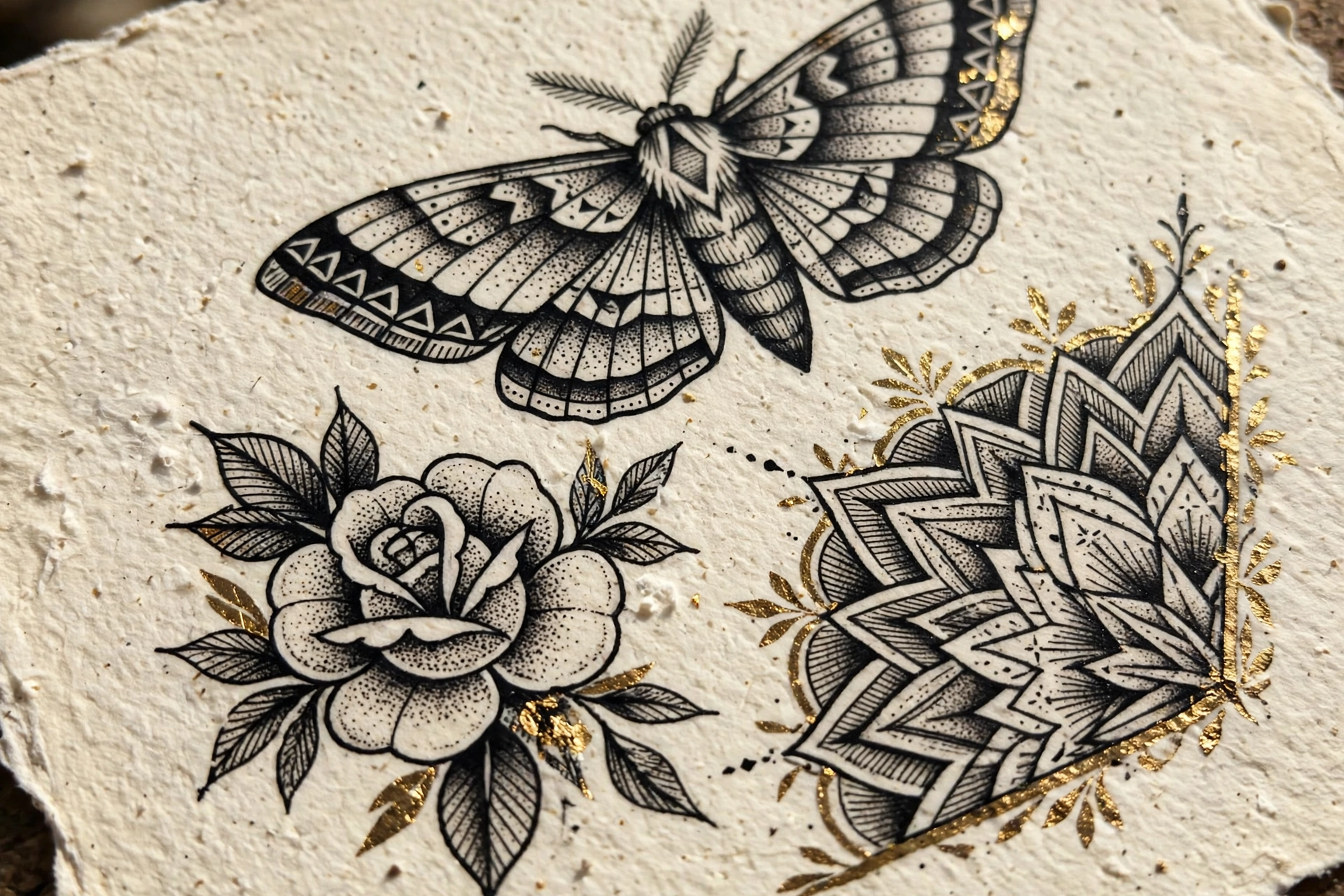
Solid black moth with dotwork belly and crescent moon above it
Coiled snake in bold black with fine hatched scale detail
Blackened botanical sprig of leaves and a seed head up the forearm
Symmetrical ornamental chest piece built from solid wedges and dots
Crow in profile with fully black wings and a fine-line branch
Bold black sun with alternating straight and wavy solid rays
Blackwork beetle with patterned wing cases made of dots and lines
Wrapping black band with a cut-out geometric pattern around the calf
See also: Tattoo Style Finder Quiz · Tattoo Cost Estimator · All Tattoo Styles.
The generator reads your birth date, your intention and your style, so the design it makes is yours, not a copy of someone else's.
Size (Tiny to Extra Large) and style in, cost range out. Ranges are estimates — an artist quote wins. A 20% tip is shown separately.
All 23 placements from our placement guides — pick a spot, optionally compare a second one, and see its pain range, healing time, fading and size guidance, quoted from the same guide data, with a link to the full placement guide. Ranges only — sources disagree, no single decimal is a fact.
Two sun signs in, an honest reading out — no invented percentages. The tool compares the two signs' elements and ruling planets, tells you where the pairing clicks and where it rubs, and turns it into a matching-tattoo idea with links to both sign guides.
Your Sun, Moon and Rising signs from your birth date and time — all three computed in your browser, with the Moon and Rising honestly labelled approximate. Each sign comes with a short traditional reading and a tattoo angle, plus links to its sign guide and to the wheel and fusion tools.
See the full list on the Tattoo Styles main page.
Abstract tattoos explained — shapes, splashes and compositions that suggest rather than depict. How the style ages, the placements that suit it, and design ideas to take to your artist.
Dotwork tattoos explained — thousands of single dots building tone and texture. How the style ages, the placements that suit it, and design ideas to take to your artist.
Fine Line tattoos explained — single-needle hairlines and delicate detail. How the style ages, the placements that suit it, and design ideas to take to your artist.
Geometric tattoos explained — circles, grids and exact symmetry. How the style ages, the placements that suit it, and design ideas to take to your artist.
The outlining feels similar to other styles. Large solid fill can feel more intense because the artist passes over the same area repeatedly to pack the black evenly. Shorter sittings and good placement choices keep it manageable for most people.
Solid black is the hardest ink to lighten and the easiest to build over. If you think you may want change later, know that a heavy blackwork piece is a long-term commitment. On the positive side, blackwork itself is often used to cover older faded tattoos successfully.
Black ink shows on every skin tone, with the contrast highest on lighter skin and a rich, deep finish on darker skin. An experienced artist will adjust boldness and spacing for your skin. Look for healed examples on similar skin in their portfolio.
A full sleeve is a Large to Extra Large project, meaning sittings of 4 to 8 hours repeated over multiple sessions in the $500 to $2000 per-band framing used on this site. Your artist will map the design in stages rather than attempting it in one sitting.
Slight patchiness in large solid areas is common and usually fixed with one short touch-up once the tattoo has fully healed. Contact your artist rather than judging the fill in the first two weeks, when the skin is still settling and can look uneven.
AI designs are for inspiration only. Always consult a licensed tattoo artist. Astrology on this site is for inspiration and self-expression. This page does not provide medical advice. Last reviewed: 25 November 2026.