Tattoo Cost Estimator
Size (Tiny to Extra Large) and style in, cost range out. Ranges are estimates — an artist quote wins. A 20% tip is shown separately.
Watercolor Tattoos · Tattoo Styles
Watercolor tattoos explained — painterly washes and splashes without hard outlines. How the style ages, the placements that suit it, and design ideas to take to your artist.
Watercolor tattoos trade the black outline for washes of translucent colour — splashes, drips, bleeds and soft gradients that look like paint soaking into paper. It is one of the most beautiful styles when fresh, and the one that changes most as it ages. This page is honest about both halves of that bargain, so you can choose wisely.
This page sits under Tattoo Styles.
Key takeaways
| What | What to expect |
|---|---|
| Line | Often none, or a soft line beneath the colour — washes of colour replace the traditional black outline |
| Colour | The whole point: translucent layered colour, splashes, drips and gradients that imitate paint on paper |
| Aging | Softens and fades faster than any outlined style, especially without a black structure; expect the edges to diffuse over time |
| Best placements | Forearm, upper arm, shoulder, calf and back — visible, flatter areas; sun-protected spots help colour last |
Watercolor tattoos are defined by colour behaving like paint in water: translucent washes layered over each other, soft bleeding edges, splashes, drips and speckles, usually with little or no black outline. The subject — a bird, flower, animal or abstract wash — is carried by colour and tone rather than line, looking more like a painting than a drawing.
The technique borrows its effects directly from watercolour painting. A wash is a diluted sweep of colour that lightens as it spreads; a bleed is where two wet colours meet and feather into each other; splatter and dry-brush textures add the looseness that makes the style feel spontaneous. A skilled watercolour tattoo artist recreates all of that with a needle, building colour in soft layers rather than packing it solid.
Many pieces do include a whisper of structure — a fine-line drawing under the colour, or a black element the washes play around — and that is not cheating. It is often the difference between a tattoo that stays readable and one that does not. Pure colour with no line at all is the boldest version of the style, and the one that asks the most of both artist and wearer, for reasons the next section explains plainly.
Here is the honest part: watercolor tattoos soften and fade faster than any other major style, especially where colour floats without a black outline to hold it. Edges diffuse, pale washes can lighten dramatically, and the piece gradually looks like a gentle stain of colour. Saturation, darker tones, sun protection and touch-ups slow that change, not stop it.
An outline is not just a drawing choice — it is a border that keeps a tattoo's shapes separate as ink settles and spreads slightly over the years. Remove it, and neighbouring colours drift toward each other while the lightest tones, having the least pigment, disappear first.
None of this means do not get one. It means get the right one: colour laid in more saturated than your reference looks, some genuine darkness somewhere in the design for contrast, a subject that still reads if the softest edges vanish, and an artist experienced enough in this style to show you healed, aged examples. Wearers who choose watercolour knowing it will evolve tend to love how it settles; wearers promised it will stay fresh forever are the ones who feel let down.
Watercolor suits flatter, calmer areas where a wash of colour can spread like it would on paper: the forearm, upper arm, shoulder, calf, upper back and sternum. Sun exposure matters just as much — a placement usually covered by clothing keeps colour brighter for longer. Hands, feet and other high-friction, high-sun areas are the hardest homes for this style.
Think of the design as a painting that needs a decent sheet of paper. A forearm or calf gives a wash room to bleed and trail naturally, a shoulder lets colour wrap a curve softly, and the upper back offers the broad canvas that galaxy washes and large floral pieces really want. Tight, detailed spots force the colour into a small area where its softness has nowhere to express itself.
Then think like a conservator. Shoulders and forearms that live in the sun all summer will fade any colour tattoo faster, and watercolour has the least margin to spare. If your dream placement is a sunny one, talk to your artist about deeper saturation and an anchor element, keep up sun protection once healed, and accept that this piece, more than most, will reward a refresh session down the line.
Watercolor work takes a specialist's patience — colour is built in soft passes rather than packed once — so sessions can run longer than a simple line piece of the same size, and prices follow the standard size bands with detailed work toward the top. Large soft washes mean repeated gentle passes, which some find easier than outlining, others wearing.
As a guide, a Tiny piece runs $50–250, Small $50–500, Medium $200–1000, Large $500–2000 and Extra Large $500–2000 on this site's bands, with a shop minimum of usually $80–$150 and a tip normally separate. Most watercolour pieces live in the small to large bands — big enough for washes to breathe — and a truly experienced watercolour artist is worth budgeting for, because this style punishes inexperience more visibly than most.
For pain, placement rules as always: soft colour work on the outer arm, calf or thigh is very manageable for most people, while the sternum, ribs and inner arm will feel sharper, especially as repeated passes build the colour up. Eat beforehand and take breaks when offered.
The strongest watercolor ideas pair a subject that suits looseness — birds, animals, flowers, feathers, waves, galaxies and butterflies — with colour that can carry it: saturated washes, at least one deeper tone, and often a fine-line or black element underneath for structure. Subjects built from soft colour in nature forgive the softening; subjects needing crisp edges fight it.
Movement is watercolour's friend. A hummingbird's wings, a fox's tail, a breaking wave and a drifting feather all look natural dissolving into splashes, because in life they are never perfectly still or sharply edged either. Florals work the same way — petals are translucent in reality, so a wash of pink or lilac feels true, especially over a fine-line stem that keeps the flower's shape as the colour gentles.
Bring your artist paintings and colour references you love rather than only photos of other tattoos, and listen carefully if they push your palette deeper or suggest adding a line element. That advice is the voice of healed experience. The watercolour tattoos that age happiest are almost always the ones where artist and wearer designed for year five, not just for the photograph on day one.

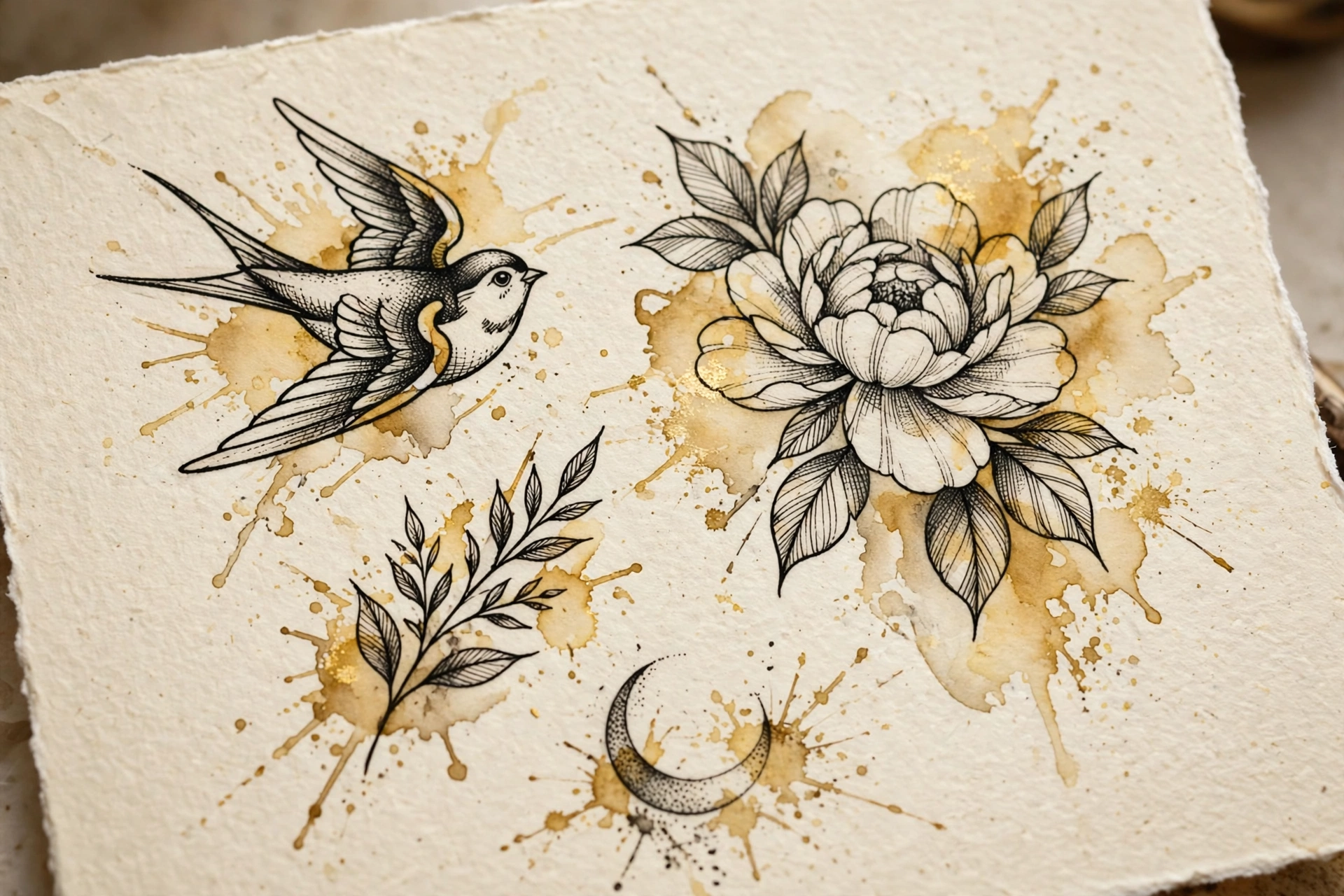
Hummingbird in flight on the shoulder, wings dissolving into teal and violet splashes
Watercolour galaxy wash across the upper back, deep blues and purples with fine white star dots
Fox curled on the forearm in warm orange washes, tail fading into loose colour
Watercolour lotus on the sternum, petals in soft pink and lilac washes over a fine-line stem
Butterfly on the calf with one wing in detailed line and the other in pure colour splash
Ocean wave curling around the ankle in layered blues, spray rendered as scattered droplets
Watercolour feather drifting down the spine, barbs dissolving into blue and gold pigment
Poppy cluster on the upper arm in red washes, anchored by a black fine-line stem and leaves
See also: Tattoo Style Finder Quiz · Tattoo Cost Estimator · All Tattoo Styles.
The generator reads your birth date, your intention and your style, so the design it makes is yours, not a copy of someone else's.
Size (Tiny to Extra Large) and style in, cost range out. Ranges are estimates — an artist quote wins. A 20% tip is shown separately.
All 23 placements from our placement guides — pick a spot, optionally compare a second one, and see its pain range, healing time, fading and size guidance, quoted from the same guide data, with a link to the full placement guide. Ranges only — sources disagree, no single decimal is a fact.
Two sun signs in, an honest reading out — no invented percentages. The tool compares the two signs' elements and ruling planets, tells you where the pairing clicks and where it rubs, and turns it into a matching-tattoo idea with links to both sign guides.
Your Sun, Moon and Rising signs from your birth date and time — all three computed in your browser, with the Moon and Rising honestly labelled approximate. Each sign comes with a short traditional reading and a tattoo angle, plus links to its sign guide and to the wheel and fusion tools.
See the full list on the Tattoo Styles main page.
Tribal tattoos explained — bold black flowing shapes rooted in Indigenous traditions. How the style ages, the placements that suit it, and design ideas to take to your artist.
Traditional (Old School) tattoos explained — bold outlines, limited palette and timeless motifs. How the style ages, the placements that suit it, and design ideas to take to your artist.
Sketch tattoos explained — raw pencil-energy lines, cross-hatching and unfinished edges. How the style ages, the placements that suit it, and design ideas to take to your artist.
Sacred Geometry tattoos explained — flower of life, metatron and mathematical pattern. How the style ages, the placements that suit it, and design ideas to take to your artist.
The softening is real but gradual, and a well-built piece — saturated colour, some darker values, ideally a line or black element anchoring it — will read as a gentle watercolour for many years rather than vanishing. Go in expecting evolution, choose an experienced watercolour artist, and protect it from the sun.
Yes, and many artists recommend exactly that. A fine-line or blackwork subject — a bird, a flower stem, a small figure — gives the tattoo a skeleton that survives even as the colour softens, while the washes provide the watercolour atmosphere around it. It is the most practical way to wear the style long-term.
Both fade with time and sun, and lighter, paler colours generally soften sooner than deep saturated ones. Your artist may suggest going slightly more vivid than your reference, because healed watercolour settles softer than it looks fresh. Skin tone also affects how translucent colour reads, which a good artist will discuss honestly.
Very likely, sooner than an outlined tattoo would. Many wearers plan on a colour refresh after some years to restore the vibrancy, and a good watercolour artist will tell you this upfront. Budget and choose the style with that maintenance in mind rather than treating it as a surprise.
By size: Small pieces fall in the $50–500 band, Medium in $200–1000 and Large in $500–2000, with a shop minimum usually $80–$150. Building layered, painterly colour takes a specialist's time, so expect a quote toward the upper part of the band for detailed work.
AI designs are for inspiration only. Always consult a licensed tattoo artist. Astrology on this site is for inspiration and self-expression. This page does not provide medical advice. Last reviewed: 25 November 2026.