Tattoo Cost Estimator
Size (Tiny to Extra Large) and style in, cost range out. Ranges are estimates — an artist quote wins. A 20% tip is shown separately.
Dotwork Tattoos · Tattoo Styles
Dotwork tattoos explained — thousands of single dots building tone and texture. How the style ages, the placements that suit it, and design ideas to take to your artist.
Dotwork tattoos are built entirely from single dots: thousands of them, placed closer together for dark tones and further apart for light ones, until shading, texture and whole images emerge. The result has a soft, grainy quality no solid shading can copy, and it rewards patience from both artist and wearer.
This page sits under Tattoo Styles.
Key takeaways
| What | What to expect |
|---|---|
| Line | Minimal or none; edges and shading formed by dots alone |
| Colour | Almost always black ink; occasionally a single accent colour |
| Aging | Softens gracefully; sparse light areas fade first, dense areas hold longest |
| Best placements | Upper arm, forearm, back, chest and thigh, where gradients have room |
Dotwork is defined by its building block: the single dot. Artists place dots by machine or by hand, varying the spacing to create every tone in the design. Dense clusters read as near-black, open spacing reads as pale grey, and the eye blends the field into smooth, grainy shading with no solid fill anywhere.
The technique, also called stippling, changes how a design is drawn. There are few hard outlines; a shape emerges because dots gather along its edge or because the tone shifts across it. Mandalas and geometric pieces use dots to soften rigid patterns, while illustrative dotwork builds animals, skulls, landscapes and celestial scenes from stippled tone alone, often with striking patience and precision.
Because each tone is a texture, dotwork looks different up close and far away: a fine grain in person, a soft image at distance. That dual quality is the style's signature. When reviewing portfolios, zoom in. Skilled dotwork shows even, deliberate spacing with no random dark clumps or accidental lines, and gradients that change gradually rather than in visible steps or bands.
Dotwork ages softly rather than badly. Over the years the dots spread very slightly, gradients become gentler, and the palest, most widely spaced areas may fade until they nearly vanish. Dense areas hold well. A design with a strong structure underneath its shading will still read clearly when the subtlest tones have softened.
Think of a dotwork gradient as having a strong end and a fragile end. The dark, densely dotted passages behave much like blackwork and stay put. The light end, where a handful of scattered dots suggests a highlight or a fade into skin, is where change happens first. Those dots can lighten, spread into the background tone of the skin, and lose the delicate edge they had when fresh.
Good artists design for this by keeping the important shapes in the mid and dark tones and treating the palest fade as decoration rather than structure. You can help by keeping the piece out of strong sun, which fades sparse ink fastest. If a gradient loses too much of its light end over the years, an artist can often re-stipple the area in a short sitting to restore the balance.
Dotwork needs room for its gradients to breathe, so it suits the upper arm, forearm, back, chest and thigh best. Flat or gently curved areas keep dot spacing even and patterns true. Very small placements force the dots so close together that the soft gradient effect is lost, so think medium or larger.
The upper arm and forearm give long, even surfaces where a stippled design can develop from dark to light without interruption. The back is the premium canvas for large mandalas and symmetrical pieces, with space for detail that would be cramped anywhere else. The chest suits centred, symmetrical dotwork that follows the body's own balance, and the thigh offers a large, relatively comfortable area for a first bigger piece.
Be cautious with hands, fingers, feet and the inner wrist. Skin there renews and flexes more, sparse dots fade quickly, and fine stippled detail blurs sooner than on stable skin. Curved, bony spots such as elbows and knees also distort spacing, so artists often keep dotwork just clear of them or design the pattern to flow around the joint rather than across it.
Many people find dotwork gentler than solid fill because the needle touches are lighter and there is less dragging across the skin, though a long stippled sitting still becomes tiring and tender. Placement matters most: ribs, sternum and feet feel sharper than the outer arm, calf or thigh in any technique.
Time is the honest cost driver in dotwork, because thousands of individual dots simply take longer than the same area of solid shading. Use this site's size bands as your frame: a Tiny piece in the $50 to $250 band usually takes 30 minutes to 1 hour, a Small piece in the $50 to $500 band takes 1 to 3 hours, a Medium piece in the $200 to $1000 band takes 2 to 5 hours, a Large piece in the $500 to $2000 band takes 4 to 8 hours, and an Extra Large piece in the $500 to $2000 band takes 4 to 8 hours or more. Most shops set a minimum, usually $80 to $150.
Expect a heavily stippled design to sit at the upper end of its size band, or to need the band above the one its outline dimensions suggest. Ask your artist how they charge for dotwork and whether a large piece will be split into sittings, which is common and makes both healing and budgeting easier.
Dotwork shines on subjects built from tone rather than outline: mandalas that radiate from dense centres, animals shaded entirely in stipple, mountains and moons fading into scattered stars, and geometric patterns softened by dotted gradients. Pair a clear, bold structure with the stipple so the design survives its softest tones fading.
Sacred and geometric patterns are the natural home of this style: a mandala whose petals darken toward the centre, or a hexagon pattern dissolving into dots at its edges, uses the technique exactly as intended. Nature subjects follow closely: a stippled whale, moth or pine forest gains a misty, atmospheric quality that solid shading cannot give, and celestial designs can scatter from a dense moon into open starfield dots.
When planning your own piece, decide where the darkest passage sits and build outward from it. Show your artist references for the gradient quality you like, grainy and visible or smooth and subtle, because dot size and spacing are choices, not defaults. Finally, size generously: a design that needs three distinct tones needs enough skin for each tone to exist, and crowding them is the fastest route to a muddy result.
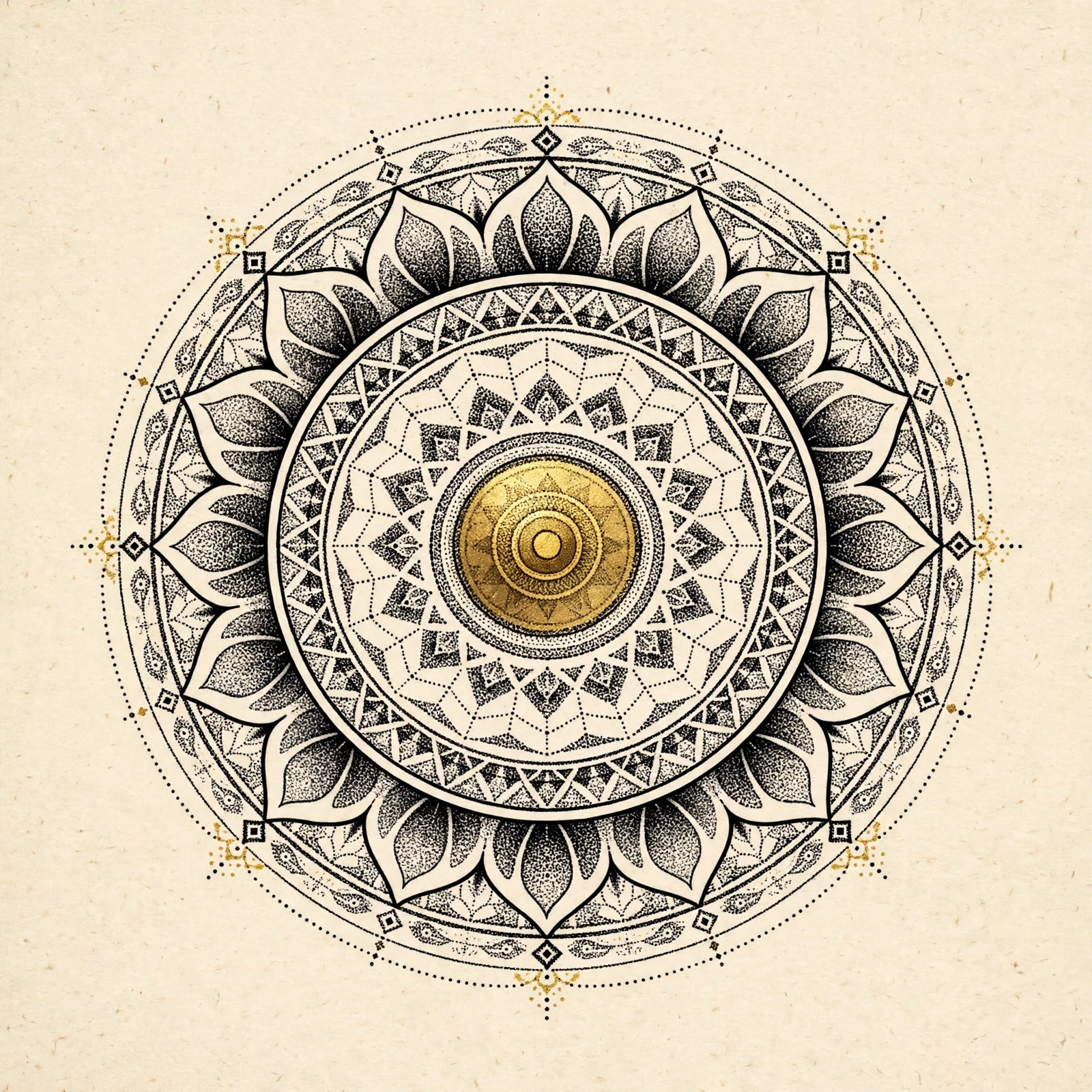
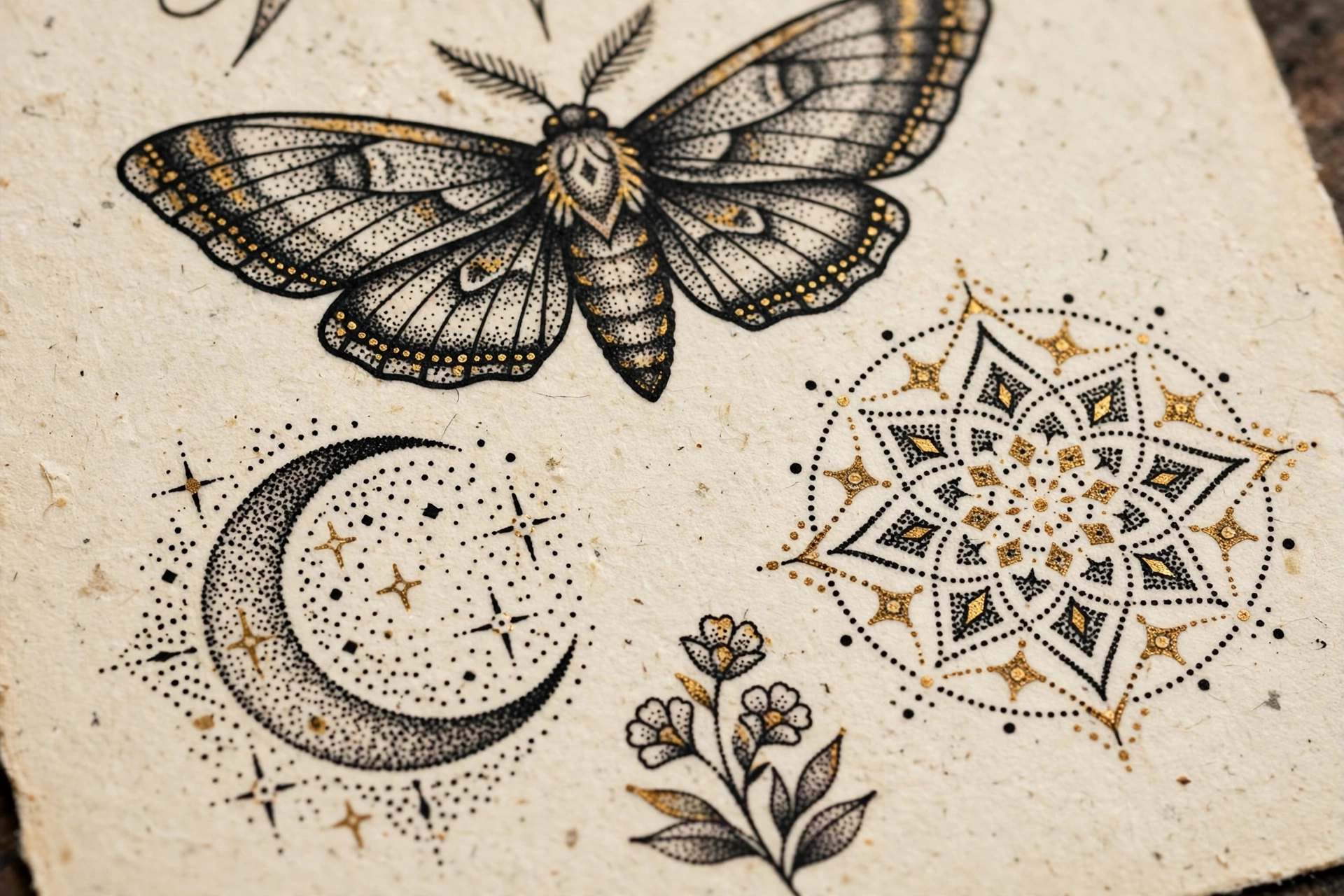
Mandala radiating from a dense dotted centre between the shoulder blades
Stippled moth with wings fading from dark bodies to scattered edge dots
Mountain ridge and moon built entirely from dots, dissolving into stars
Geometric hexagon pattern that breaks apart into loose dots at its edges
Dotwork whale shaded in stipple, swimming across the upper arm
Pine forest silhouette with a misty dotted sky above it on the forearm
Symmetrical chest ornament of dotted gradients and small solid accents
Skull softened by stippled shading and a crown of dotted flowers
See also: Tattoo Style Finder Quiz · Tattoo Cost Estimator · All Tattoo Styles.
The generator reads your birth date, your intention and your style, so the design it makes is yours, not a copy of someone else's.
Size (Tiny to Extra Large) and style in, cost range out. Ranges are estimates — an artist quote wins. A 20% tip is shown separately.
All 23 placements from our placement guides — pick a spot, optionally compare a second one, and see its pain range, healing time, fading and size guidance, quoted from the same guide data, with a link to the full placement guide. Ranges only — sources disagree, no single decimal is a fact.
Two sun signs in, an honest reading out — no invented percentages. The tool compares the two signs' elements and ruling planets, tells you where the pairing clicks and where it rubs, and turns it into a matching-tattoo idea with links to both sign guides.
Your Sun, Moon and Rising signs from your birth date and time — all three computed in your browser, with the Moon and Rising honestly labelled approximate. Each sign comes with a short traditional reading and a tattoo angle, plus links to its sign guide and to the wheel and fusion tools.
See the full list on the Tattoo Styles main page.
Blackwork tattoos explained — solid black ink, bold shapes and high contrast. How the style ages, the placements that suit it, and design ideas to take to your artist.
Fine Line tattoos explained — single-needle hairlines and delicate detail. How the style ages, the placements that suit it, and design ideas to take to your artist.
Abstract tattoos explained — shapes, splashes and compositions that suggest rather than depict. How the style ages, the placements that suit it, and design ideas to take to your artist.
Geometric tattoos explained — circles, grids and exact symmetry. How the style ages, the placements that suit it, and design ideas to take to your artist.
Both exist. Hand-poked dotwork is slower and has a slightly organic irregularity many people love, while machine dotwork is faster and very even. The healed result can be excellent either way, so choose by the artist's portfolio rather than the method alone.
Usually yes for shaded areas, because tone is built dot by dot. A small dotwork symbol may be quick, but a large stippled gradient will take longer than the same design in solid shading. Your artist can estimate sittings once the design and size are fixed.
Dense areas hold well and sparse areas soften, which is normal ageing rather than failure. Designs with strong structure in the darker tones stay readable for years. Very tiny, tightly packed dotwork is the exception to avoid, because close dots merge as the ink settles.
Very easily. Dotwork shading pairs with blackwork shapes, geometric patterns, fine line outlines and ornamental designs. Many artists specialise in these hybrids. Just keep one technique in charge of the main structure so the piece does not become a mixture with no clear character.
Small dotwork symbols work if they use few tones and bold spacing. Intricate gradients need medium size or larger to exist at all. If your artist suggests sizing up, it is usually to protect the gradient, not to sell you a bigger tattoo.
AI designs are for inspiration only. Always consult a licensed tattoo artist. Astrology on this site is for inspiration and self-expression. This page does not provide medical advice. Last reviewed: 25 November 2026.