Tattoo Cost Estimator
Size (Tiny to Extra Large) and style in, cost range out. Ranges are estimates — an artist quote wins. A 20% tip is shown separately.
Traditional (Old School) Tattoos · Tattoo Styles
Traditional (Old School) tattoos explained — bold outlines, limited palette and timeless motifs. How the style ages, the placements that suit it, and design ideas to take to your artist.
Traditional tattoos — old school — are the durability benchmark of the whole craft: thick black outlines, a small palette of bold solid colours, simple shading and subjects that read clearly from across a room. Eagles, roses, daggers, swallows and anchors, drawn as they have been for generations. If you want a tattoo built to outlast trends, start here.
This page sits under Tattoo Styles.
Key takeaways
| What | What to expect |
|---|---|
| Line | Thick, bold black outlines — the backbone of the style, holding every shape clearly |
| Colour | A limited, punchy palette of solid red, green, yellow, blue and brown, packed flat with minimal shading |
| Aging | The durability benchmark — bold lines and solid colour are built to stay readable for decades |
| Best placements | Almost anywhere with room for a bold shape: upper arm, forearm, calf, thigh, chest and back |
Traditional, or old school, tattoos are defined by thick black outlines, a limited palette of bold colours — red, green, yellow, blue and brown — laid in flat and solid, with simple whip shading and subjects drawn in a direct, symbolic way. Nothing is delicate or photographic. Every shape is simplified until it cannot be misunderstood.
The classic subject list is short and proud: eagles, roses, daggers, swallows, anchors, hearts, panthers, snakes, ships and pin-up figures. Each one is drawn from well-worn conventions — the eagle's feathers follow a familiar pattern, the rose is built from clear petal shapes — because traditional tattooing grew up as flash: designs on the wall, chosen on the day, tattooed to last on working skin in all weathers.
Technically, the style rests on three decisions. The outline is bold enough to hold the design together for life. The colour is packed solid rather than blended, so it heals evenly. And the shading is minimal and purposeful, usually black softened at the edges of a shape rather than a full gradient. Artists who work traditionally guard those rules closely, because breaking them is what turns a traditional piece into something else.
Traditional tattoos age better than any other style, which is why artists call the approach bold will hold. Thick outlines contain the design as ink spreads slightly over the years, solid colour fades evenly instead of patchily, and simple shapes stay readable long after fine detail in other styles has blurred. Colours mellow, but the tattoo remains unmistakably clear.
Every style on this site is judged against this one for longevity, and the reason is structural. A fine line has nowhere to go when it softens; a bold traditional outline is still a clear outline decades later. A soft realism gradient depends on subtle differences that time erodes; a block of solid red simply becomes a slightly softer block of solid red, still bordered by black.
That does not make traditional tattoos maintenance-free. Sun exposure fades colour in any style, reds and yellows generally soften sooner than black, and a touch-up years later can refresh a beloved piece. But the design itself — the drawing — is the most likely of any style to survive intact, which is why so many collectors say their oldest traditional pieces are still their clearest.
Traditional tattoos work almost anywhere the body offers room for a bold, self-contained shape: the upper arm, forearm, calf and thigh are classic homes, with the chest and back reserved for larger centrepieces. The style suits patchwork collecting — single pieces placed one at a time with space between them — as well as single statement designs.
The traditional sleeve is rarely drawn as one composition. It is built piece by piece over years — an eagle here, a rose there, filler stars and dots in the gaps — and the arms and legs are perfect for that way of collecting because they offer a series of clear panels. The chest and back suit the style's bigger set pieces: a full eagle, a ship under sail or a sacred heart that needs width to read properly.
Size is the one rule to respect. Traditional clarity comes from bold lines and open shapes, and shrinking a classic design too far forces the artist to thin the lines and crowd the colour, losing exactly what makes it work. If space is tight, choose a simpler subject — a single rose or swallow — rather than a detailed scene squeezed small.
Traditional tattooing is efficient work: bold lines laid once, colour packed flat, no hours of layered blending. Sessions are usually shorter than realism or fine dotwork at the same size, and price follows the standard size bands fairly. The sensation is honest linework and solid colour packing — intense on tender spots, but rarely a marathon.
Using the usual bands as a guide, a Tiny traditional piece runs $50–250, Small $50–500, Medium $200–1000, Large $500–2000 and Extra Large $500–2000, with a shop minimum of usually $80–$150 and a tip normally on top. A palm-size rose or swallow is a small-band piece done in one sitting, while a full chest eagle is a large piece that may still finish faster than an equally sized shaded design in another style.
Pain is mostly placement, as always. Bold lines on the outer arm, calf or thigh are very sit-able for most people; the same work across the ribs, sternum or inner arm will feel considerably sharper. Solid colour packing means the needle passes over an area thoroughly, so expect a building warmth by the end of a bigger fill — normal, and over sooner than you fear.
Traditional design ideas draw on a century of flash: eagles, roses with daggers, swallows, anchors, sacred hearts, panthers, snakes, ships and lucky symbols, each bold, symbolic and drawn to be read instantly. The pleasure is choosing a classic and letting a good artist draw it their way — the conventions are shared, but every strong artist has a recognisable hand.
Start with the subject that carries your meaning. Sailors' swallows marked miles travelled and a hope of coming home, anchors stand for steadiness, the sacred heart for devotion, and the panther simply for power that does not need to explain itself. You do not need a deep story, though — plenty of people choose a design because it looks magnificent, which has always been reason enough in this style.
Ask your artist to draw the piece rather than tracing a photograph of someone else's tattoo. Traditional designs live in the drawing — the exact curve of a wing, the way a rose opens — and a version drawn for your body, at your size, by the person tattooing it will heal bolder and feel like yours. It also leaves the door open to grow a patchwork collection around it over time.
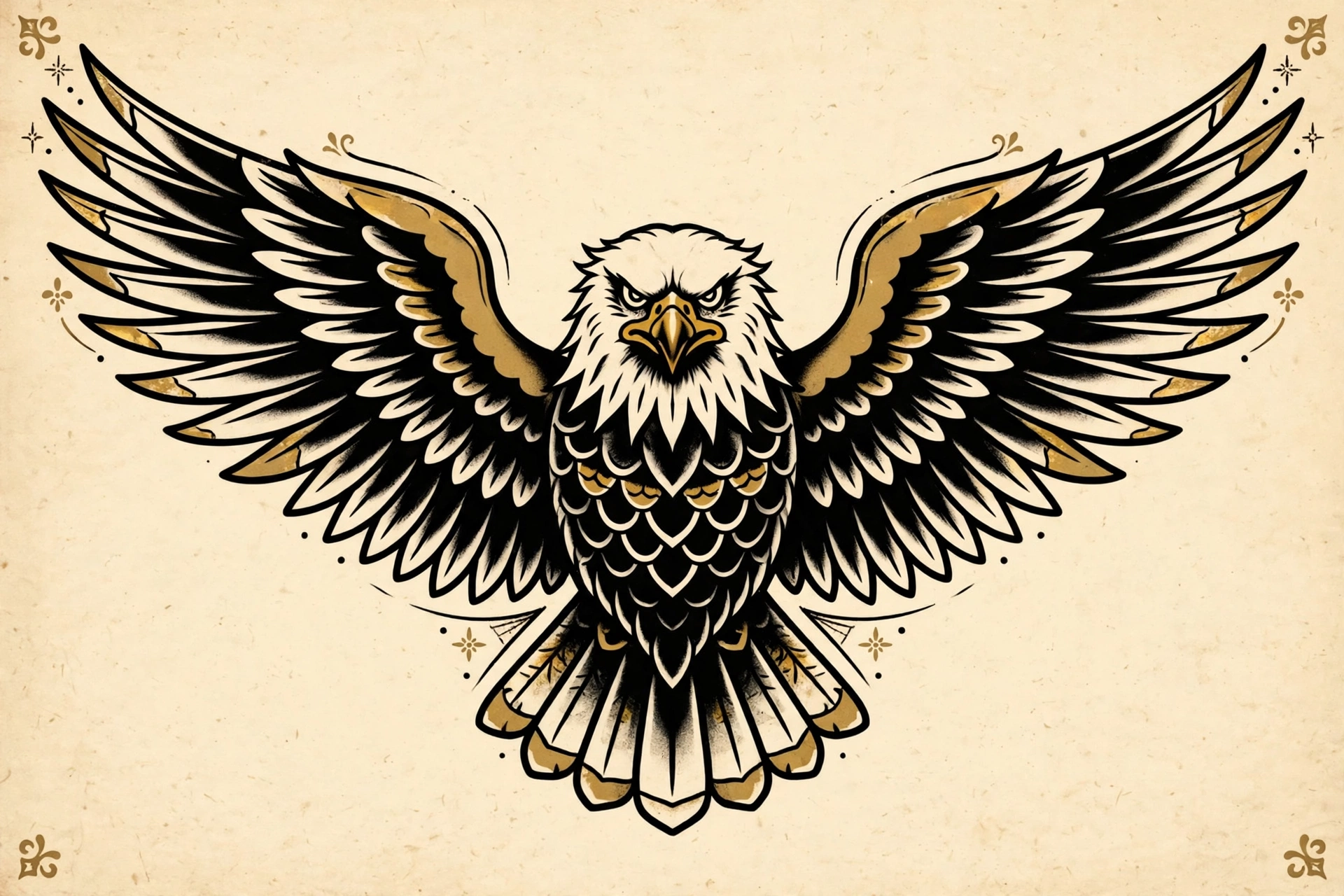
Classic eagle with spread wings across the upper arm or chest, bold red and gold plumage
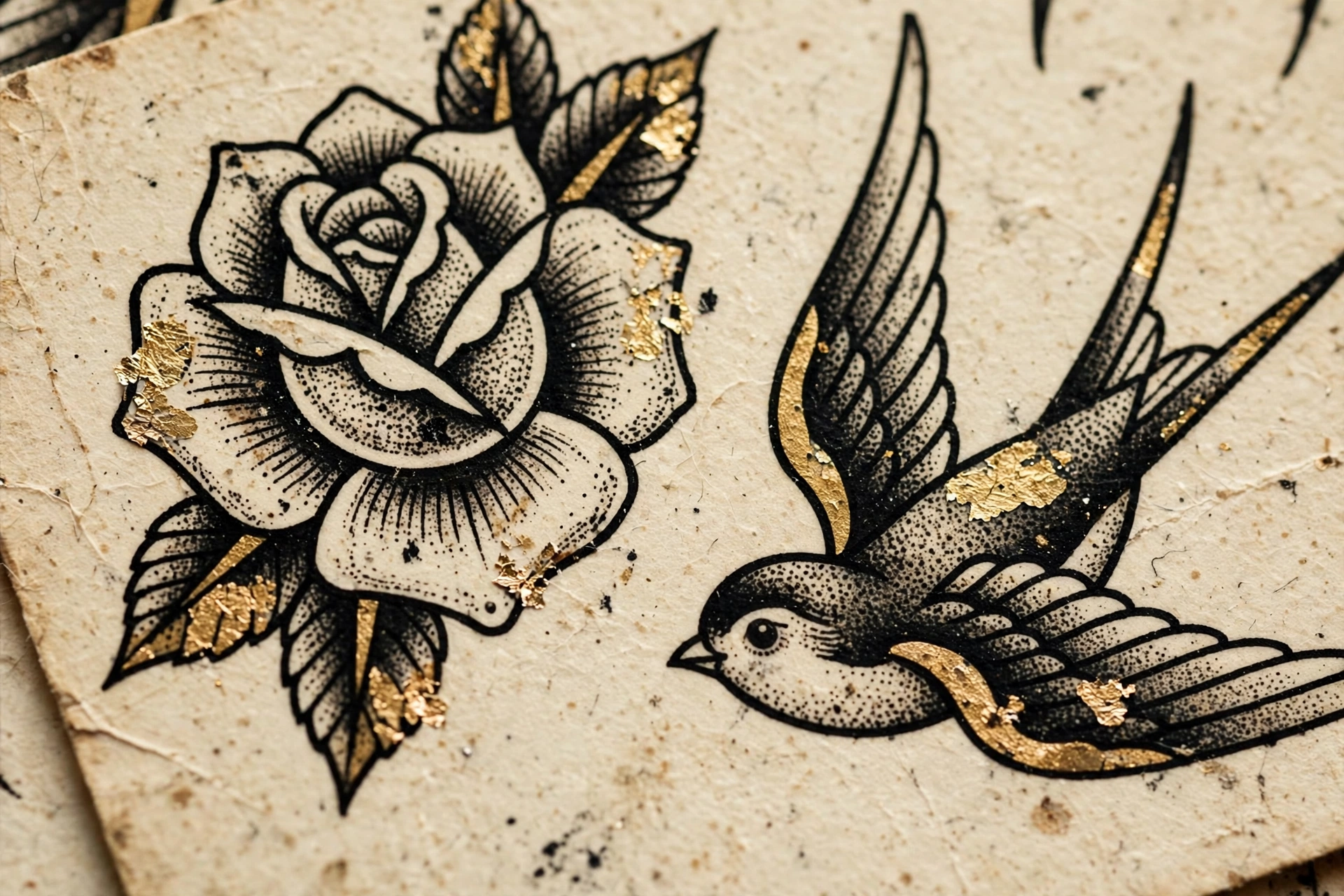
Rose and dagger pairing on the forearm, deep red petals with a clean steel blade
Swallow in flight on each collarbone or shoulder, traditional red and blue colouring
Anchor wrapped with rope and a rose on the calf, simple and unmistakable
Panther crawling down the upper arm in solid black with red accents
Sacred heart with flames and rays on the chest or upper back, full classic palette
Pin-up style sailing ship with full sails and waves on the thigh or upper arm
Snake coiled around a rose on the forearm, green scales against solid red petals
See also: Tattoo Style Finder Quiz · Tattoo Cost Estimator · All Tattoo Styles.
The generator reads your birth date, your intention and your style, so the design it makes is yours, not a copy of someone else's.
Size (Tiny to Extra Large) and style in, cost range out. Ranges are estimates — an artist quote wins. A 20% tip is shown separately.
All 23 placements from our placement guides — pick a spot, optionally compare a second one, and see its pain range, healing time, fading and size guidance, quoted from the same guide data, with a link to the full placement guide. Ranges only — sources disagree, no single decimal is a fact.
Two sun signs in, an honest reading out — no invented percentages. The tool compares the two signs' elements and ruling planets, tells you where the pairing clicks and where it rubs, and turns it into a matching-tattoo idea with links to both sign guides.
Your Sun, Moon and Rising signs from your birth date and time — all three computed in your browser, with the Moon and Rising honestly labelled approximate. Each sign comes with a short traditional reading and a tattoo angle, plus links to its sign guide and to the wheel and fusion tools.
See the full list on the Tattoo Styles main page.
Sketch tattoos explained — raw pencil-energy lines, cross-hatching and unfinished edges. How the style ages, the placements that suit it, and design ideas to take to your artist.
Tribal tattoos explained — bold black flowing shapes rooted in Indigenous traditions. How the style ages, the placements that suit it, and design ideas to take to your artist.
Sacred Geometry tattoos explained — flower of life, metatron and mathematical pattern. How the style ages, the placements that suit it, and design ideas to take to your artist.
Watercolor tattoos explained — painterly washes and splashes without hard outlines. How the style ages, the placements that suit it, and design ideas to take to your artist.
They come from the same family tree. Neo-traditional keeps the bold outline but adds a wider colour palette, softer shading and more detailed, flowing compositions. Traditional is stricter and simpler — fewer colours, flatter fills, classic subjects — and that simplicity is a large part of why it ages so well.
It holds up better than almost anything else. Bold outlines give the image a structure that survives the slight spreading all ink does, and solid blocks of colour fade more evenly than fine gradients. Colours may mellow over the years, but the design itself stays bold and readable.
Yes, traditional flash is designed exactly for that — small, bold, self-contained pieces that sit happily on an arm or leg and leave room for neighbours. Many collectors build a whole patchwork sleeve from individual traditional pieces added one at a time, which is one of the style's great pleasures.
Traditionally, yes — the classic palette is part of the style's identity. That said, plenty of artists work traditional in black and grey or in a personal variation of the palette. Talk to your artist about what you love; a good traditional artist will tell you honestly what still counts and what changes the feel.
By size: Small traditional pieces sit in the $50–500 band, Medium in $200–1000 and Large in $500–2000, with a shop minimum usually $80–$150. Because the work is efficient — bold lines, flat colour — a traditional piece often tattoos faster than a shaded realism piece of the same size.
AI designs are for inspiration only. Always consult a licensed tattoo artist. Astrology on this site is for inspiration and self-expression. This page does not provide medical advice. Last reviewed: 25 November 2026.